
Pipes, Drainage & Ducting
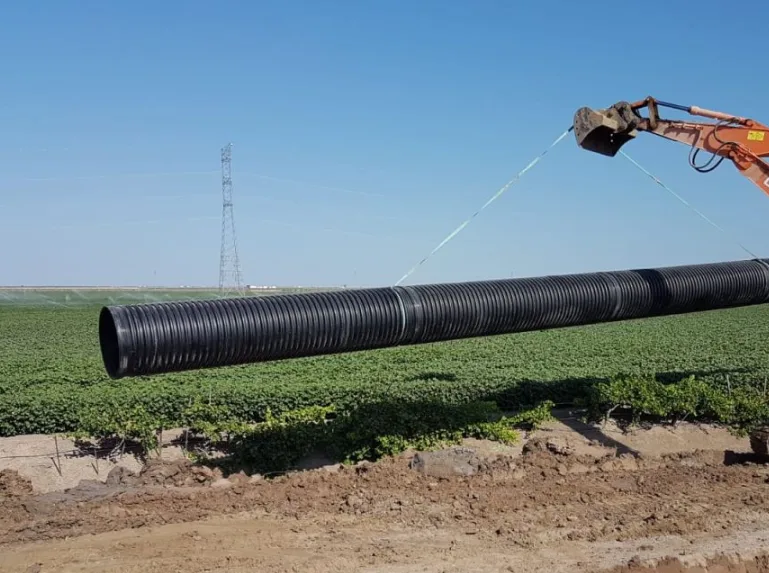
GeoStruct™ HDPE Structured Wall Pipe
Spirally wound HDPE structured wall pipe for gravity sewer, stormwater, culvert and bulk drainage. DN300 to DN1500 in SN4 and SN8, manufactured to SANS 21138. Around 90 % lighter than equivalent concrete pipe, with a smooth bore holding Manning's n = 0.01 across a design life of up to 100 years.
Overview
GeoStruct is a spirally wound HDPE structured wall pipe engineered for gravity sewer, stormwater, culvert and bulk drainage. A rectangular HDPE profile is extruded and wound onto a precision mandrel, the overlapping edge fused homogeneously in the hot plastic state to form a continuous smooth internal bore. The result carries the hydraulic and structural performance of solid wall HDPE at a fraction of the weight of equivalent concrete pipe.
The system is defined by internal diameter and ring stiffness class, and is available across the full DN300 to DN1500 range in both SN4 and SN8. Four jointing methods are supported: coupling and rubber seal, hot gas extrusion weld to SANS 10268-1, extrusion welded HDPE sleeve, and clamp joint for non-pressure and repair duty. Where extrusion welded, the line becomes fully jointless with no infiltration or exfiltration path, which is why GeoStruct is approved for dolomite land categories D2 and D3 under SANS 1936-3.
HDPE does not crack, so there is no route for root ingress, and it is immune to the hydrogen sulfide crown corrosion that limits concrete sewers. It ranks first among pipe materials for abrasion resistance, roughly five times that of concrete. Prefabricated HDPE manholes in the same DN range complete the system.
- MaterialHigh Density Polyethylene (HDPE)
- StructureSpirally wound structured wall profile, smooth internal bore
- ColourBlack
- StandardSANS 21138 · SANS 10268-1 (jointing)
- Roll WidthDN300 – DN1500 internal diameter
- Roll Length6 m and 12 m lengths · 60 m minimum production run
Typical Properties
| Property | Test Method | Unit | GeoStruct 4 kN/m² | GeoStruct 8 kN/m² |
|---|---|---|---|---|
| Material | - | - | HDPE | HDPE |
| Ring Stiffness - Standard | ISO 9969 | kN/m² | 4 | 8 |
| Nominal Diameter Range (DN) | - | mm | 300 – 1500 | 300 – 1500 |
| Outer Diameter Range | - | mm | 328 – 1624 | 338 – 1650 |
| Standard Length | - | m | 6 | 6 |
| Manning's Roughness Coefficient (n) | - | - | 0.01 | 0.01 |
| Density | ISO 1183-1 | g/cm³ | ≥ 0.950 | ≥ 0.950 |
| Flexural Modulus | ISO 178 | MPa | 1 000 – 2 000 | 1 000 – 2 000 |
| Melt Flow Index (190 °C / 5 kg) | ISO 1133 | g/10 min | ≤ 1.6 | ≤ 1.6 |
| Oxidation Induction Time (200 °C) | ISO 11357-6 | min | ≥ 20 | ≥ 20 |
| Impact Strength (TIR) | ISO 3127 | % | ≤ 10 | ≤ 10 |
| Longitudinal Reversion | ISO 2505 | % | ≤ 3 | ≤ 3 |
| Creep Ratio (2-year extrapolation) | ISO 9967 | - | ≤ 4 | ≤ 4 |
| Min. Weld Tensile Strength | ISO 13262 | N | 380 – 1 020 (size dependent) | 380 – 1 020 (size dependent) |
| Standard Compliance | - | - | SANS 21138 | SANS 21138 |
Note: The above specifications represent the product family properties. Please refer to the product datasheet for individual SKU values.
Typical Applications
View all applicationsMunicipal gravity sewer
Gravity sewer reticulation and trunk mains, DN300 to DN1500. HDPE does not suffer the hydrogen sulfide crown corrosion that degrades concrete sewers, and extrusion welded joints eliminate infiltration and exfiltration entirely. Manning's n = 0.01 holds across the design life because the bore does not roughen with age.
Stormwater and drainage
Urban stormwater reticulation, trunk mains, attenuation and outfall structures, DN300 to DN1500. Twelve metre lengths cut joint count up to fivefold against concrete, and pipe weight around 90 % lower removes most crane and plant requirements on site.
Road and rail culverts
Cross-drainage culverts and road edge drainage. Minimum cover of 0.6 m or 2 × OD applies, with the 8 kN/m² class specified under carriageways and haul roads. Structural flexibility lets the pipe accommodate embankment settlement without cracking.
Dolomite-risk ground
Approved for dolomite land categories D2 and D3 under SANS 1936-3. Hot gas extrusion welding to SANS 10268-1 produces a fully jointless line with no leakage path to trigger subsidence, tested to at least 1.5 bar. The primary technical reason to move off concrete on dolomitic sites.
Mining and industrial drainage
Process water, slurry drainage and site dewatering. HDPE ranks first among pipe materials for abrasion resistance, roughly five times that of concrete, and resists most industrial effluent chemistries without lining.
Compatible Systems
View all systemsDN300 – DN400 - Small Bore
Sewer reticulation, subsoil and road edge drainage, erosion control outlets. The most common replacement size for 300 and 375 concrete pipe.
DN450 – DN600 - Municipal Standard
Municipal stormwater and gravity sewer reticulation, minor culverts, industrial site drainage. The highest volume band in municipal reticulation work.
DN700 – DN900 - Trunk
Trunk stormwater, road and rail culverts, mine and haul road drainage. Handles the collector duty where concrete joint counts and plant costs start to dominate.
DN1000 – DN1200 - Bulk
Bulk stormwater mains, major culverts, attenuation and detention systems. Weight advantage over concrete is largest in this band, cutting crane and transport requirements.
DN1500 - Large Diameter
Marine outfall and intake pipelines, major river crossings, relining of failed bulk lines. Available fully jointless by hot gas extrusion weld where infiltration cannot be tolerated.
Installation Guidance
Standard Method Statement
Excavate & Prepare Trench - Excavate to the required depth and grade. Trench width should allow 150 mm clearance each side of the pipe for embedment compaction. Lay a 100 mm compacted sand or gravel bedding layer at the trench bottom to the design gradient before pipe placement.
Place & Joint Pipes - Lower pipes into the trench and align vertically and horizontally. For coupling and seal jointing, clean pipe ends, fit the rubber seal, apply lubricant to the coupling interior and push to insertion depth. For extrusion weld jointing on dolomite projects, the HDPE sleeve is pre-welded to the first pipe - insert the second pipe on site and complete the extrusion weld in accordance with SANS 10268-1.
Haunch & Initial Backfill - Place selected granular embedment material in 75 mm layers up to the crown of the pipe, compacting each layer by hand tamper. Ensure no voids form under the pipe haunches. Leave all joints exposed at this stage for inspection and testing.
Test & Final Backfill - Conduct leak testing with all joints exposed. Once testing is passed, complete backfill in 300 mm compacted layers to the required surface level. The final backfill level should be slightly above natural ground to allow for consolidation.
Quality Assurance & Testing
Field QA/QC Checklist
- Delivery & Storage: Materials checked against the delivery note and conformance certificates, stored off the ground, covered from UV and kept clear of sharp objects and fuel.
- Material Conformance: Pipe certificates checked for ring stiffness class (e.g. SN4/SN8) to EN 13476 / ISO 21138.
- Bedding & Haunching: Trench, bedding and haunching material compacted as designed; installation practice per ASTM D2321 or the local equivalent.
- Jointing: Seals fitted and joints fully engaged; joint water or air testing where specified.
- Deflection Check: Post-installation deflection checked by mandrel or CCTV against the specification limit.
Manufacturing Standards
- EN 13476 / ISO 21138 structured-wall pipe specification
- ASTM D2321 flexible pipe installation
- Manufacturer QC certificates
- SANS 21138 · SANS 10268-1 (jointing)
Documents
Product Selection Guide
Compare performance properties across the entire category hierarchy before specifying.
Installation & Method Statement
Standard deployment procedures, installation specifications, and field application method statements.
QA/QC Site Checklist
Field quality control procedures, inspection checklists, and testing standards to verify installation integrity.
Technical Data Sheet (TDS)
Guaranteed minimum average roll values (MARV) and material testing properties.
Chemical Resistance / Accessories Guide
Chemical compatibility matrix and list of auxiliary materials needed for installation.
Projects Using GeoStruct™ HDPE Structured Wall Pipe
Submit your BOQ.
Get a quote – not just a price.
Upload your BOQ or speak to our technical team for expert recommendations and support.