
Geogrids & Interlayers
MIRAGRID® PEC Biaxial Reinforcement Geocomposite
MIRAGRID® PEC biaxial geocomposite from Solmax: high modulus polyester fibres on a continuous filament nonwoven geotextile backing, for subgrade stabilisation and base reinforcement. Full range from PEC 40/40 to PEC 95/95 (42 to 100 kN/m) in 5.3 m × 100 m rolls, delivered across Africa.
Overview
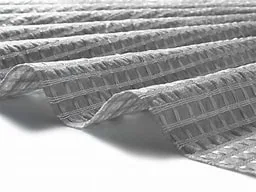
MIRAGRID® PEC is a biaxial reinforcement geocomposite manufactured by Solmax, composed of high modulus polyester fibres attached to a continuous filament nonwoven geotextile backing. Solmax describes it as suitable for short and long term soil reinforcement applications, and specifically for subgrade stabilisation and base reinforcement.
The biaxial construction carries equal strength in both directions, and we supply the full range: PEC 40/40 at 42 kN/m, PEC 55/55 at 58 kN/m, PEC 75/75 at 79 kN/m and PEC 95/95 at 100 kN/m, in both machine and cross-machine direction. PEC 55/55 and PEC 95/95 are the fastest-moving grades on African projects and are held in stock, with the other grades available to order.
What makes the geocomposite different from a geogrid alone is the nonwoven backing. It carries the reinforcement fibres and at the same time separates the fill from the soft subgrade beneath, while remaining highly permeable: water permeability normal to the plane is 55 mm/s, so pore water can drain through the plane rather than building up pressure under the fill.
Designers work from the low-strain tensile values, because reinforcement performs at working strain rather than at break. At 2% strain the range develops 9, 13, 18 and 22 kN/m across PEC 40/40 to PEC 95/95, rising to 23, 30, 40 and 54 kN/m at 5% strain, with elongation at nominal strength of about 11%. These stiffness values are what a geotechnical engineer compares when sizing reinforcement for a working platform, embankment or reinforced fill.
All grades are supplied in 5.3 m wide rolls, 100 m long, weighing 200, 225, 259 and 296 kg per roll from PEC 40/40 up to PEC 95/95. Other forms of supply are available on request. The product is cut to size on site with a sharp knife or scissors, joined by overlapping or sewing, and placed with the reinforcement as perpendicular as possible to the sloped face unless the design says otherwise.
For long term design strength, friction behaviour and other design parameters, we obtain the data directly from Solmax for your project. Solmax is not a design or engineering professional and does not determine whether the product suits a particular project, so the reinforcement design remains the responsibility of your geotechnical engineer. We supply the certified product, the technical data and the installation support.
Geosynthetics Africa stocks MIRAGRID PEC with delivery to over 30 countries across Africa and installation by our own crews. MIRAGRID® is a registered trademark of Solmax.
- MaterialHigh modulus polyester (PET) on nonwoven backing
- StructureBiaxial Geocomposite (geogrid reinforcement + nonwoven backing)
- ColourGrey
- StandardISO 9001, ISO 14001, ISO 45001 Certified; CE Marked; Tensile Tested per EN ISO 10319
- Roll Width5.3 m
- Roll Length100 m (≈296 kg per roll)
Typical Properties
| Property | MIRAGRID® PEC Uniaxial | MIRAGRID® PEC Biaxial | TechGrid TGC-B Biaxial |
|---|---|---|---|
| Construction | PET- nonwoven | PET- nonwoven | Knitted PET + PP nonwoven |
| Grades | PEC 40 – PEC 230 | PEC 40/40 – 95/95 | TGC-B 55/55 – 210/210 |
| Tensile strength, MD (min) | 40 - 230 kN/m | 40 - 95 kN/m | 55 - 210 kN/m |
| Tensile strength, CMD (min) | 10.9–11.4 kN/m | 40–95 kN/m | 55–210 kN/m |
| Elongation at maximum strength | 11% | 10.5–11% | 10% (±2%) |
| Opening size (O90 / AOS) | 95–120 µm | 95–120 µm | 150 µm |
| Roll size (W × L) | 5.3 × 100 m | 5.3 × 100 m | 5.0 × 100 m |
| Primary applications | Soft-soil embankments, slopes | Soft-soil embankments, slopes | Platforms, soft ground |
Note: The above specifications represent the product family properties. Please refer to the product datasheet for individual SKU values.
Typical Applications
View all applicationsEmbankments on Soft Soil
Basal reinforcement lets road and rail embankments be built safely over soft, compressible ground.
Piled Embankments
Spans between pile caps, transferring embankment loads into the piles and controlling surface settlement.
Reinforcement Over Voids
Protects roads and platforms over dolomite, sinkholes and old mine workings from sudden collapse.
Working Platforms
Stable platforms for piling rigs, cranes and heavy plant over weak or saturated subgrades.
Mine Haul Roads & Pads
Reinforces haul roads, ROM pads and laydown areas over soft ground or tailings.
Compatible Systems
View all systemsMIRAGRID® PEC Uniaxial – Reinforcement Geocomposite
High-modulus polyester fibres attached to a continuous filament nonwoven backing, with strength concentrated along the roll for heavily loaded structures. Seven grades from PEC 40 to PEC 230, with minimum machine-direction strengths of 40–230 kN/m, supplied in 5.3 m × 100 m rolls. Suited to basal reinforcement of embankments over soft soil and reinforced slopes, particularly with fine-grained fills.
MIRAGRID® PEC Biaxial – Reinforcement Geocomposite
The same high-modulus polyester and continuous filament nonwoven construction, with equal strength in both directions plus separation and filtration in a single layer. Four grades from PEC 40/40 to PEC 95/95, with minimum tensile strengths of 40–95 kN/m in both directions, supplied in 5.3 m × 100 m rolls. Suited to subgrade stabilisation, base reinforcement and load platforms over weak ground.
TechGrid TGC-B – Biaxial Reinforcement Geocomposite
Knitted high-tenacity polyester yarns provide low-creep reinforcement, combined with a polypropylene needle-punched nonwoven for separation and drainage. Three grades, TGC-B 55/55, 105/105 and 210/210, with minimum tensile strengths of 55–210 kN/m in both directions, supplied in 5 m × 100 m rolls. Suited to load platforms, basal reinforcement over soft ground and heavily loaded biaxial applications.
Installation Guidance
Standard Method Statement
Clear the subgrade of trees, roots and sharp objects, and level it as far as ground conditions allow. Unroll the geocomposite with the nonwoven side facing down, flat and free of folds, with its main strength direction across the embankment unless the design specifies otherwise.
Overlap adjacent rolls by at least 300 mm, and more on very soft ground, or sew the seams where the design requires. Never overlap in the direction of principal load unless the design specifies it. Cover the material promptly to limit UV exposure.
Keep vehicles off the exposed geocomposite. Back-tip fill from previously placed material and spread it forward with tracked plant, keeping the first layer thick enough to protect the reinforcement before compaction. Always follow the manufacturer's installation guideline and the project specification. Our team provides on-site technical support on every project.
Quality Assurance & Testing
Field QA/QC Checklist
- Delivery & Storage: Rolls identified to ISO 10320, stored flat and protected from UV until installation.
- Material Conformance: Certificates checked against the specified properties: tensile strength (ISO 10319 / ASTM D6637), junction efficiency and aperture size.
- Subgrade Preparation: Subgrade graded and proof-rolled; soft spots treated as directed by the engineer.
- Placement & Overlaps: Geogrid laid flat and tensioned by hand, overlaps to the design (typically increasing on soft subgrades), and pinned where needed.
- Fill Placement: Aggregate end-tipped and spread ahead of equipment; no tracked plant directly on the geogrid; minimum fill thickness before trafficking.
Manufacturing Standards
- ISO 10319 / ASTM D6637 tensile strength
- ISO 10320 identification on site
- Manufacturer QC certificates per roll
- ISO 9001, ISO 14001, ISO 45001 Certified; CE Marked; Tensile Tested per EN ISO 10319
Documents
Product Selection Guide
Compare performance properties across the entire category hierarchy before specifying.
Installation & Method Statement
Standard deployment procedures, installation specifications, and field application method statements.
QA/QC Site Checklist
Field quality control procedures, inspection checklists, and testing standards to verify installation integrity.
Technical Data Sheet (TDS)
Guaranteed minimum average roll values (MARV) and material testing properties.
Chemical Resistance / Accessories Guide
Chemical compatibility matrix and list of auxiliary materials needed for installation.
Projects Using MIRAGRID® PEC Biaxial Reinforcement Geocomposite
Submit your BOQ.
Get a quote – not just a price.
Upload your BOQ or speak to our technical team for expert recommendations and support.