
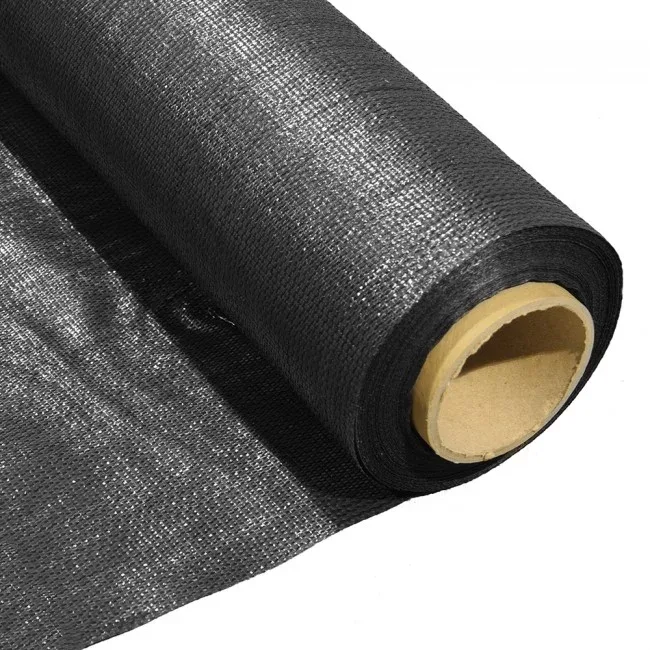
Geotextile Fabrics
PolyTape™ - High-Flow Woven PP Geotextile
PolyTape is a UV-stabilised woven polypropylene geotextile in 30, 40, 45, 60 and 105 kN/m grades. High-Flow construction combines woven tensile performance with hydraulic conductivity, for separation, filtration and reinforcement on roads, platforms, embankments and mine infrastructure. Supplied continent-wide with mill certificates and MARV-based QA documentation.
Overview
Woven Reinforcement Without the Hydraulic Compromise
PolyTape High-Flow is a UV-stabilised woven polypropylene geotextile supplied in five grades from 30 to 105 kN/m. The range is built around a single design problem: conventional woven geotextiles deliver the tensile strength that separation and basal reinforcement demand, but their hydraulic performance is limited, and in fine-grained soils they are prone to blinding. Designers have historically resolved this by accepting lower tensile with a nonwoven, or by specifying two layers.
The High-Flow construction addresses both requirements in one fabric - woven tensile performance with the permittivity and flow rate to function as a filter. Grade selection then follows design tension rather than a trade-off against drainage.
Grade selection. PolyTape 30 and 40 cover general separation and stabilisation beneath haul roads, working platforms and hardstandings. PolyTape 45 and 60 handle basal reinforcement over soft and compressible ground, heavy haul road construction and mine platform bases. PolyTape 105 is the high-tensile grade for major basal reinforcement, piled embankment load transfer platforms and heavily loaded mine infrastructure.
Specification and QA. Every grade is supplied against MARV values with mill test certificates. Tensile and elongation to ASTM D4595, permittivity and flow rate to ASTM D4491, apparent opening size to ASTM D4751, CBR puncture to ASTM D6241.
Geosynthetics Africa supplies across South Africa and the wider continent, with pan-African logistics putting roll volumes on site on a single specification and lead time.
- MaterialPolypropylene (PP) - UV-stabilised slit-film woven
- StructureWoven PolyTape (slit-film) - high-flow open weave
- ColourBlack
- StandardISO 9001:2015, CE marked - EN 13249 to EN 13265
- Roll Width5.2 m
- Roll Length100 m (520 m² per roll)
Typical Properties
| Property | Test Method | WG 30 HF | WG 45 HF | WG 60 HF | WG 105 HF |
|---|---|---|---|---|---|
| Polymer Type | - | Polypropylene | Polypropylene | Polypropylene | Polypropylene |
| Primary Function | EN 13249–13265 | F, S, R | F, S, R | F, S, R | F, S, R |
| Tensile Strength (MD) | EN ISO 10319 | 30 kN/m | 45 kN/m | 60 kN/m | 105 kN/m |
| Tensile Strength (CMD) | EN ISO 10319 | 30 kN/m | 45 kN/m | 60 kN/m | 105 kN/m |
| Elongation MD/CD | EN ISO 10319 | 15 / 10 % | 20 / 15 % | 18 / 11 % | 18 / 10 % |
| Characteristic Opening Size O₉₀ | EN ISO 12956 | 300 µm | 600 µm | 600 µm | 300 µm |
| Water Permeability VI₅₀ | EN ISO 11058 | 39 mm/s | 40 mm/s | 27 mm/s | 25 mm/s |
| Static Puncture (CBR) | EN ISO 12236 | 3.2 kN | 5.0 kN | 7.3 kN | 12 kN |
| Dynamic Perforation | EN ISO 13433 | 20 mm | 10 mm | 10 mm | 3 mm |
| Mass per Unit Area | EN ISO 9864 | 145 g/m² | 210 g/m² | 280 g/m² | 500 g/m² |
| Thickness (2 kPa) | EN ISO 9863-1 | 0.6 mm | 0.9 mm | 1.4 mm | 2.0 mm |
| Standard Roll Width | - | 5.3 m | 5.3 m | 5.3 m | 5.3 m |
| Standard Roll Length | - | 100 m | 100 m | 100 m | 100 m |
Note: The above specifications represent the product family properties. Please refer to the product datasheet for individual SKU values.
Typical Applications
View all applicationsRoads & Highways
Separation and filtration between subgrade and sub-base on permanent road construction, preventing fines migration that degrades the granular layer over its service life. WG35HF to WG50HF covers most subgrades; soft ground with heavy construction traffic moves up to WG55HF or WG60HF. Declared against EN 13249.
Haul Roads & Working Platforms
Mine haul roads, piling mats and crane platforms where heavy axle loads run over weak ground for extended periods. Puncture resistance governs here, since coarse angular capping is placed and trafficked directly on the fabric. WG60HF to WG105HF depending on subgrade CBR and plant loading. EN 13249
Railway Formations
Separation and filtration beneath ballast and sub-ballast, preventing ballast fouling from subgrade fines under cyclic loading. Dynamic perforation resistance matters as much as tensile strength under repeated impact. WG55HF to WG80HF. EN 13250.
Embankments & Basal Reinforcement
Basal reinforcement of embankments over very soft ground, where the fabric carries tensile load to control lateral spreading and improve stability. Tensile stiffness at working strain is the governing property - WG105HF develops 61 kN/m at 10% elongation. WG80HF to WG105HF. EN 13251.
Drainage Systems
Trench wrap, subsoil drains and filter layers around granular drainage media, letting water through while retaining surrounding soil. Opening size must be checked against the soil gradation. WG30HF to WG45HF, where flow rates reach 40 l/m²/sec. EN 13252.
Compatible Systems
View all systemsWG30HF - Light Duty Separation & Filtration
30 kN/m in both directions at 145 g/m², with 3200 N CBR puncture resistance and a 300 µm opening size. The tightest filtration in the light-duty range paired with 39 l/m²/sec flow, suited to trench wrap, subsoil drainage, erosion control beneath rip-rap and light access tracks. The lowest-cost route to separation where reinforcement isn't the governing requirement.
WG45HF - General Civil Construction
45 kN/m with 5000 N puncture resistance and the highest flow in the range at 40 l/m²/sec. A 600 µm opening size suits coarser subgrades, and 20% MD elongation gives forgiving behaviour over uneven ground. The general-purpose grade for road and platform separation beneath sub-base on typical subgrades.
WG60HF - Heavy Duty Platforms & Haul Roads
60 kN/m with 7.3 kN CBR puncture resistance at 280 g/m², and dynamic perforation of 10 mm against coarse angular fill placed directly on the fabric. Elongation drops to 18/11%, so load is picked up at lower strain than the lighter grades. Specified for haul roads, working platforms for piling and cranage, railway formations and reinforced embankments over soft ground.
WG105HF - Basal Reinforcement
105 kN/m in both directions at 500 g/m², with 12 kN CBR puncture resistance and just 3 mm dynamic perforation. Develops 23 kN/m at 5% strain and 61 kN/m at 10%, so reinforcement mobilises well before the structure above it deforms. The 300 µm opening size returns to fine filtration despite the mass. For basal reinforcement of embankments over very soft ground, piled platforms, mine haul roads and heavy-load geobag applications. Supplied in 5.2 m rolls.
Installation Guidance
Standard Method Statement
Subgrade Preparation - Prepare a smooth, stable subgrade free from sharp objects, large stones, roots and debris that could damage the geotextile during installation.
Geotextile Placement - Unroll directly onto the prepared surface without wrinkles or folds, ensuring full contact with the underlying ground and correct panel orientation.
Overlaps & Seaming - Provide overlaps in accordance with project specifications and ground conditions. Increase overlap widths or use sewn seams where very weak subgrades are encountered.
Aggregate Placement - Place cover material carefully to prevent displacement or damage to the geotextile. Do not allow construction traffic directly on exposed geotextile unless specified by the engineer.
Quality Assurance & Testing
Field QA/QC Checklist
- Delivery & Storage: Rolls identified, stored and handled to ASTM D4873: wrapped, off the ground and protected from UV until installation.
- Material Conformance: Roll labels and certificates checked against the specified class (e.g. AASHTO M288) and properties: mass, tensile strength (ISO 10319 / ASTM D4632), CBR puncture (ISO 12236) and opening size.
- Subgrade Preparation: Surface cleared of sharp objects and graded so the geotextile lies flat without folds or bridging.
- Placement & Overlaps: Overlaps or sewn seams to the specified minimum; geotextile anchored against wind and placed in the direction of fill placement.
- Cover & Damage Check: Covered within the UV exposure limit stated by the manufacturer; tears or holes patched with an overlapping piece before covering.
Manufacturing Standards
- ASTM D4873 identification, storage and handling
- ASTM D4759 conformance to manufacturer specification
- ISO 10319 / ASTM D4632 tensile strength
- ISO 12236 CBR puncture resistance
- AASHTO M288 (where specified)
- ISO 9001:2015, CE marked - EN 13249 to EN 13265
Documents
Product Selection Guide
Compare performance properties across the entire category hierarchy before specifying.
Installation & Method Statement
Standard deployment procedures, installation specifications, and field application method statements.
QA/QC Site Checklist
Field quality control procedures, inspection checklists, and testing standards to verify installation integrity.
Technical Data Sheet (TDS)
Guaranteed minimum average roll values (MARV) and material testing properties.
Chemical Resistance / Accessories Guide
Chemical compatibility matrix and list of auxiliary materials needed for installation.
Projects Using PolyTape™ - High-Flow Woven PP Geotextile
Submit your BOQ.
Get a quote – not just a price.
Upload your BOQ or speak to our technical team for expert recommendations and support.