
Geogrids & Interlayers
Tensar® Biaxial (SS/TGSG) Geogrids
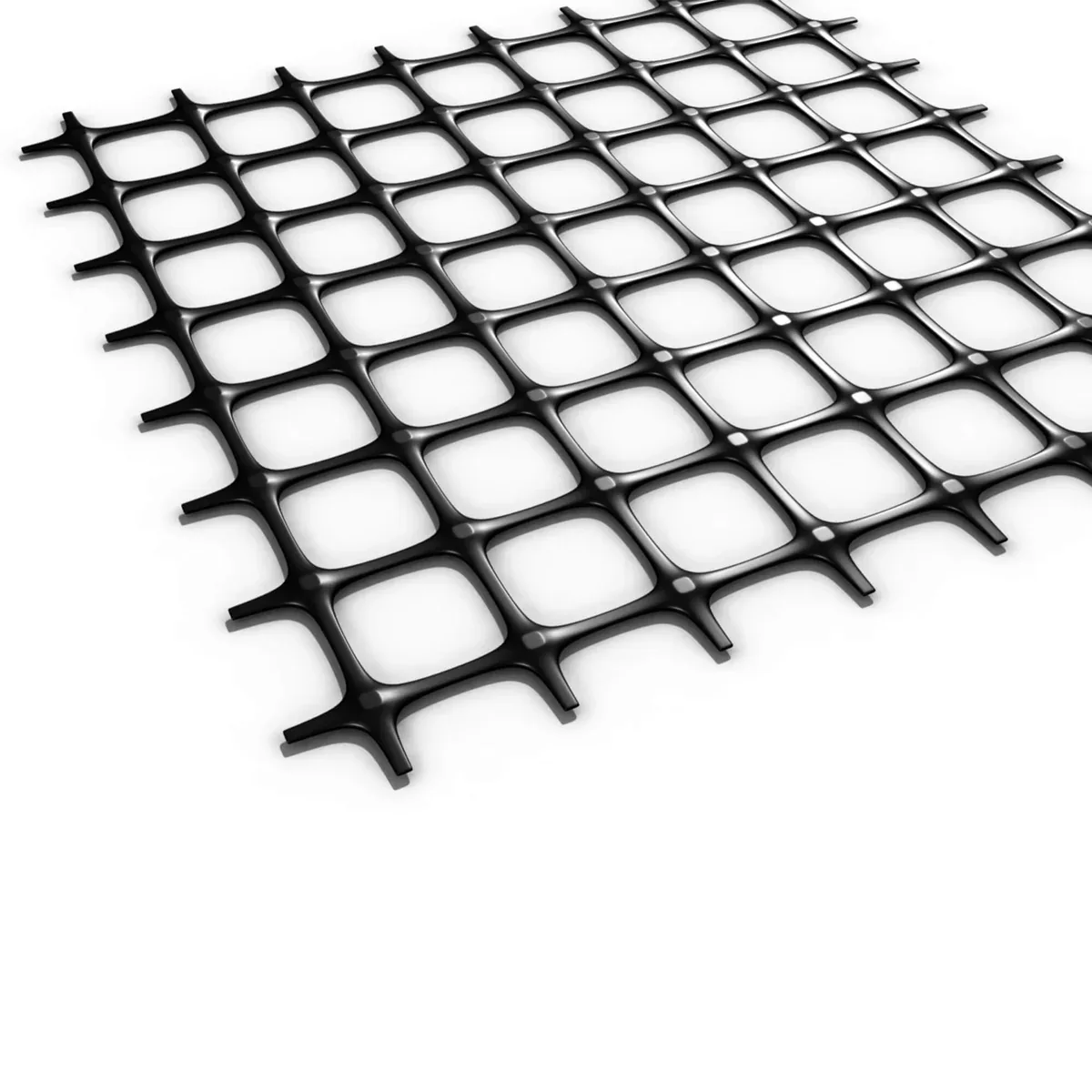
Tensar® Biaxial (SS/TGSG) Geogrid: the original ground stabilisation geogrid, with over 500 million m² installed worldwide. Punched and drawn polypropylene with integral junctions that confine aggregate and stabilise weak subgrades under roads, working platforms and hardstands. Supplied across Africa by Geosynthetics Africa, an official Tensar Associate.
Overview
Tensar® Biaxial (SS/TGSG) Geogrid is the original ground stabilisation geogrid. Invented by Tensar in the early 1980s, it changed how engineers build over weak soils, and more than 500 million square metres have been installed globally since. It remains the reference product for mechanical ground stabilisation, and it is the forerunner to the Tensar® TriAx® and InterAx® geogrids that followed.
The geogrid is a stiff, monolithic structure punched and drawn from polypropylene sheet, so the ribs and the junctions are one continuous piece of oriented polymer rather than woven or welded strands. Laid on a weak subgrade and covered with granular fill, the apertures lock the aggregate particles in place. That interlock creates a stiffened composite layer that spreads wheel loads more widely, reduces rutting and differential settlement, and lets the same job be done with less aggregate or a thinner pavement.
This is why Tensar argues that tensile strength alone is a poor measure of a stabilising geogrid. What matters is how well the grid confines aggregate and how much stiffness the composite layer gains, which depends on aperture geometry, rib profile and junction efficiency. Two geogrids with identical kN/m figures can perform very differently in the ground. Ask us for the Tensar design output rather than comparing datasheet numbers.
The range covers SS20, SS30 and SS40, plus the TGSG2020, TGSG3030 and TGSG4040 grades, with the choice driven by subgrade strength, traffic loading and design life rather than by price per square metre. Typical applications are subgrade stabilisation under roads and pavements, working platforms for piling and cranes, unsurfaced haul roads, hardstands and laydown areas, rail trackbed, and foundation and embankment support.
Geosynthetics Africa is an official Tensar Associate for Africa. That means genuine Tensar product with full traceability, access to Tensar design support and the Tensar+ design software for your project, and delivery to over 30 countries across Africa, with installation by our own crews where required.
Tensar®, TriAx® and InterAx® are registered trademarks of Tensar International Corporation, a division of CMC.
- MaterialPolypropylene (punched and drawn)
- StructureBiaxial geogrid, integral junctions
- ColourBlack
- StandardTensar QMS to ISO 9001
- Roll Width3.8 m and 4.0 m
- Roll Length30 m and 50 m (by grade)
Typical Properties
| Property | Tensar® SS & TGSG | MIRAGRID® GX Biaxial | TechGrid TGB |
|---|---|---|---|
| Polymer | PP | PET | PET |
| Structure | Punched & drawn | Knitted, coated | Knitted, coated |
| Grades | SS20–SS40 · TGSG2020–4040 | GX 20/20 – 80/80 | TGB-20 – TGB-200 |
| Strength, MD & CD (min) | 20–40 kN/m | 20–80 kN/m | 20–200 kN/m |
| Strength at 2% strain (MD) | 7–14 kN/m | 4–15 kN/m | 4–30 kN/m |
| Strength at 5% strain (MD) | 14–28 kN/m | 7–27 kN/m | 7–55 kN/m |
| Aperture | 33–41 mm | 25 mm | 23–27 mm |
| Roll width | 3.8 / 4.0 m | 5.2 m | 5.1 |
| Roll length | 30–75 m | 100 m | 100 m |
| Applications | Road bases, platforms | Subgrade, road bases | Road bases, track-beds |
Note: The above specifications represent the product family properties. Please refer to the product datasheet for individual SKU values.
Typical Applications
View all applicationsRoad Base Reinforcement
Stiffens unbound base and subbase layers, reducing rutting and aggregate thickness on paved and unpaved roads.
Subgrade Improvement
Spreads loads over weak or variable subgrades, avoiding costly excavation and replacement.
Working Platforms
Stable platforms for piling rigs, cranes and heavy plant over soft or saturated ground.
Haul Roads & Access Roads
Reinforces mine haul roads, access tracks and laydown areas carrying heavy, repeated traffic.
Reinforced Foundations
A reinforced granular mattress beneath slabs and foundations reduces differential settlement.
Compatible Systems
View all systemsTensar® SS & TGSG - Polypropylene Biaxial Geogrids
Stiff, monolithic polypropylene geogrids with integral junctions and square-edged ribs for strong aggregate interlock. SS20–SS40 and TGSG2020–TGSG4040 offer minimum strengths of 20–40 kN/m in both directions, with high stiffness at low strain, supplied in 3.8 m and 4.0 m wide rolls. Suited to road bases, working platforms and reinforced foundations.
MIRAGRID® GX Biaxial - Knitted Polyester Biaxial Geogrid
Flat-knitted, high-modulus polyester geogrid with a protective coating, delivering equal strength in both directions. Six grades from GX 20/20 to GX 80/80 offer minimum strengths of 20–80 kN/m, supplied in 5.2 m × 100 m rolls. Suited to subgrade stabilisation and base reinforcement.
TechGrid TGB – Knitted Polyester Biaxial Geogrid
Warp-knitted, high-tenacity polyester geogrid with a durable polymeric coating for dimensional stability and resistance to installation damage. Nine grades from TGB-20 to TGB-200 offer minimum strengths of 20–200 kN/m in both directions, supplied in 3.9 m or 5.1 m × 100 m rolls. Suited to road bases, area stabilisation, track-beds and heavier reinforcement over soft ground.
Installation Guidance
Standard Method Statement
Clear the subgrade of vegetation and sharp objects and grade it to the required level. On very soft or wet ground, place a separator geotextile first if the design requires one. Unroll the geogrid flat and taut, in the direction shown on the drawings.
Overlap adjacent rolls by 300 mm to 1 m, depending on subgrade strength and the manufacturer's guideline, with larger overlaps on weaker ground. Pin or weight the geogrid where needed to keep it flat while the fill is placed.
Keep tracked plant off the exposed geogrid. Place aggregate from the leading edge of previously placed fill and spread it forward, keeping at least 150 mm of cover before trafficking, then compact to the specified density. Always follow the manufacturer's installation guideline and the project specification. Our team provides on-site technical support on every project.
Quality Assurance & Testing
Field QA/QC Checklist
- Delivery & Storage: Rolls identified to ISO 10320, stored flat and protected from UV until installation.
- Material Conformance: Certificates checked against the specified properties: tensile strength (ISO 10319 / ASTM D6637), junction efficiency and aperture size.
- Subgrade Preparation: Subgrade graded and proof-rolled; soft spots treated as directed by the engineer.
- Placement & Overlaps: Geogrid laid flat and tensioned by hand, overlaps to the design (typically increasing on soft subgrades), and pinned where needed.
- Fill Placement: Aggregate end-tipped and spread ahead of equipment; no tracked plant directly on the geogrid; minimum fill thickness before trafficking.
Manufacturing Standards
- ISO 10319 / ASTM D6637 tensile strength
- ISO 10320 identification on site
- Manufacturer QC certificates per roll
- Tensar QMS to ISO 9001
Documents
Product Selection Guide
Compare performance properties across the entire category hierarchy before specifying.
Installation & Method Statement
Standard deployment procedures, installation specifications, and field application method statements.
QA/QC Site Checklist
Field quality control procedures, inspection checklists, and testing standards to verify installation integrity.
Technical Data Sheet (TDS)
Guaranteed minimum average roll values (MARV) and material testing properties.
Chemical Resistance / Accessories Guide
Chemical compatibility matrix and list of auxiliary materials needed for installation.
Projects Using Tensar® Biaxial (SS/TGSG) Geogrids
Submit your BOQ.
Get a quote – not just a price.
Upload your BOQ or speak to our technical team for expert recommendations and support.