
DamSeal - Bituminous Dam Sealing Systems
Stop your dam leaking. DamSeal is a bitumen-impregnated geotextile sealing system for earth dams, oxidation ponds, canals and reservoirs - a continuous waterproof membrane formed on site, moulded to your dam's exact shape. Two grades, 150 and 200 g/m², ASQUAL certified and CE marked. Supplied and installed by our own crews across South Africa, with a watertightness warranty.
Technical Specification of DamSeal - Bituminous Dam Sealing Systems
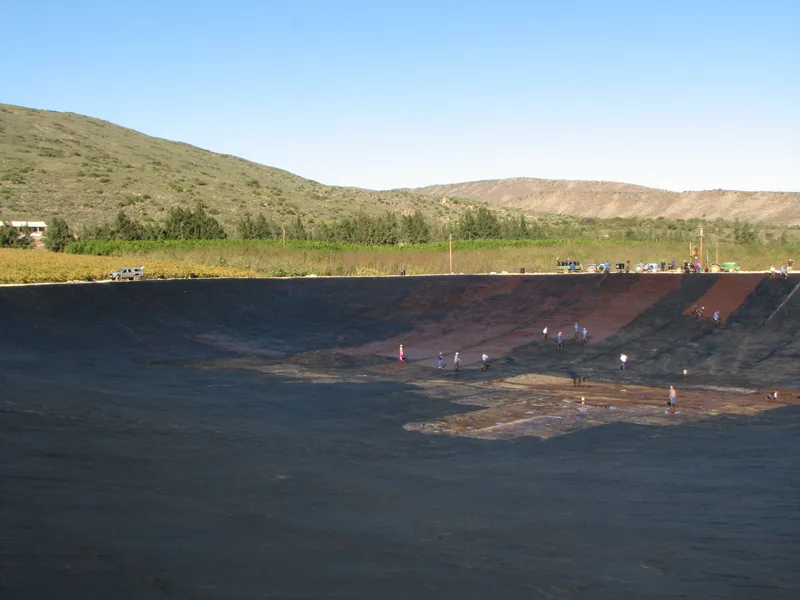
DamSeal is a bituminous dam sealing system for earth dams, ponds and canals. A heavy nonwoven geotextile is laid over the prepared surface and impregnated in place with a mineral-filled, latex-modified bitumen emulsion. The result is a continuous, flexible, waterproof membrane bonded to the ground - not a sheet resting on it. Proven on South African farm dams for over forty years.
Because the membrane is formed on site, it follows the shape of your dam exactly. Inlets, outlets, corners, irregular embankments and existing concrete are all sealed as one continuous surface. No welding, no prefabricated panels, no specialised plant. Overlaps are sealed with the same compound, so the finished lining behaves as a single piece across the whole structure.
DamSeal 150 uses a 150 g/m² continuous filament polypropylene geotextile - 1.60 mm thick, 12 kN/m tensile, 1.75 kN CBR puncture resistance. DamSeal 200 steps up to 200 g/m², 2.00 mm and 2.35 kN for stony subgrades, effluent ponds and industrial water storage. Both are ASQUAL certified and CE marked, supplied in 6 m wide rolls to minimise joints.
Polypropylene does not hydrolyse and stays stable across a pH range of roughly 2 to 13, which suits permanent immersion and effluent storage. Elongation of 80% lets the lining absorb embankment settlement without tearing. The cured bitumen film is unaffected by 30% sulphuric acid at 25°C and imparts no taint or toxicity to stored water.
DamSeal is supplied and installed by our own crews. We inspect the site, prepare the surface, install the lining and stand behind the result with a watertightness warranty - one contractor, one point of responsibility. Repairs are simple: clean, recoat, patch if needed. No welding rigs, no technicians, no waiting. Suitable for dams up to 5 m deep on slopes no steeper than 1:2.5.
Typical Values for GEOMEMBRANE LINERS
Properties & Dimensions
| Property | Test Method | DamSeal 150 | DamSeal 200 |
|---|---|---|---|
| Geotextile | - | Non Woven PP | Non Woven PP |
| Mass per unit area | EN ISO 9864 | 150 g/m² | 200 g/m² |
| Thickness at 2 kPa | EN ISO 9863-1 | 1.60 mm | 2.00 mm |
| Tensile strength MD / CMD | EN ISO 10319 | 12 / 12 kN/m | 16 / 16 kN/m |
| Elongation at max. load MD / CMD | EN ISO 10319 | 80 / 70 % | 80 / 70 % |
| CBR puncture resistance | EN ISO 12236 | 1.75 kN | 2.35 kN |
| Puncture resistance | NF G 38-019 | 700 N | 900 N |
| Dynamic perforation | EN ISO 13433 | 25 mm | 21 mm |
| Roll width × length | - | 6 m × 230 m | 6 m × 180 m |
| Sealing compound | - | Mineral-filled latex-modified bitumen | Mineral-filled latex-modified bitumen |
| Application rate | - | 3.6 ℓ/m² over three coats | 3.6 ℓ/m² over three coats |
| Certification | - | ASQUAL certified · CE marked | ASQUAL certified · CE marked |
Popular Catalogue Items
Related Product Groups
Three Questions To Ask Before You Order
1.Can DamSeal be used on an existing leaking dam?
2.How deep a dam can DamSeal be used in?
3.How long does installation take?
4.How does it compare to an HDPE liner?
5.What happens if it gets damaged?
6.Is the water safe for livestock, irrigation and fish?
7.How long does it last?
8.What does it cost?
Specification For The Design, Installation Of DamSeal - Bituminous Dam Sealing Systems
Site preparation -Shape and compact the dam floor and embankments to a smooth finish, taking out any stones or sharp objects that could rupture the lining under water pressure. Where the surface is coarse, blind it with a sand cushion layer. Remove all reeds, grass and organic material, which would otherwise decompose and form gas bubbles beneath the membrane, then spread a slow-release granular herbicide over the entire surface. The dam floor should sit above the surrounding water table; where it does not, install a subsurface drainage network falling to the lowest point before lining begins.
Anchor trench and fabric placement - Excavate a 300 × 300 mm anchor trench around the full perimeter. Start with the end of a roll in the trench at the midpoint of the embankment, unroll down the slope, across the floor and up the opposite side, cutting off in the opposite trench. Lay the fabric furry side down and allow it to drape loosely rather than pulling it tight. Overlap each successive width by 200 mm, working out creases as you go. Irregular shapes are accommodated by cutting sections to suit and jointing them the same way.
Jointing - Turn back the upper overlap and weight it with bricks or stones. Apply a heavy undiluted coat of sealing compound to the lower overlap, immediately fold the upper overlap back down and press firmly, then broom a diluted coat over the whole joint. Allow joints to set for approximately four hours before coating the main surface. Secure all free edges overnight - wind damage to an uncoated lining is the most common avoidable loss on site.
Coating - First coat: sealing compound diluted 50/50 with water at 1.6 ℓ/m², applied by dipping soft brooms and spreading. Do not pour the diluted product onto the fabric, as it runs straight through. Allow three to four hours to dry. Second coat: undiluted at 1 ℓ/m², which may be poured ahead of the broom and spread. Allow approximately four hours. Third and final coat: undiluted at 1 ℓ/m². Total consumption is approximately 3.6 ℓ/m² excluding joint sealing.
Curing and conditions - Allow 72 hours cure before filling with water. Lay a 250 micron polyethylene underlay over any damp or wet areas beforehand, since free moisture prevents the emulsion from breaking properly. In hot conditions work early morning or late afternoon, particularly for the final coat, when the second coat may be too tacky to walk on during the middle of the day. Keep dust and dirt off the lining, and rinse brooms regularly, storing them in water during any break in work.
Featured Projects Across Africa
Related Resources
Common BITUMINOUS LINERS Applications
Request a Quote for This Product Family
Upload your BOQ, drawings, or specifications and our technical team will provide a detailed proposal.
Have a project? Start with us.
Get expert engineering support, reliable material supply, and best-in-class installation.