Geosynthetic Sand Containers
Sand-filled geotextile containers for coastal revetments, groynes, breakwaters, scour defence and emergency flood response across African coastlines. Filled on site with local sand - no imported rock, no concrete, no formwork. Manufactured in our own Johannesburg facility under the FlowTex GSC range in two engineered fabric constructions: FlowTex GSC NW, needle-punched nonwoven, where puncture resistance, conformability and fine-sand retention govern; and FlowTex GSC W, high-flow woven, where wide-width tensile strength and rapid pore-pressure dissipation govern. Because we cut, stitch and certify in-house, standard grades ship from stock and non-standard dimensions, fabric weights and seam configurations are a production decision rather than an import lead time.
| About Geosynthetic Sand Containers
Geosynthetic sand containers (GSCs) are large geotextile bags filled on site with locally sourced sand to form permeable, high-mass armour units. Placed in stretcher bond on a battered slope, they behave as a monolithic mass-gravity system that absorbs and dissipates wave energy rather than reflecting it - an engineered alternative to rock armour on sites where quarried rock is unavailable or uneconomic to haul. The design basis is the same as rock armour: required unit mass follows from significant wave height, toe embedment from scour depth. What changes is that the mass is local sand and the placement plant is an excavator rather than marine cranage.
Selection is a fabric decision before it is a size decision. Nonwoven where the structure meets irregular, sharp or rocky substrate, where units must deform to interlock, or where fine fill must be retained against wave-induced flow — most revetment, dune-toe and scour work. Woven where the container carries wide-width tensile load between placed units and rapid pore-pressure dissipation through the tidal cycle governs - groyne heads, scour aprons and long structural revetment runs. Filled mass then follows from design wave height, across grades from 40 kg to 4,000 kg.
Every FlowTex GSC is cut, stitched and seam-tested in our own facility, which means container geometry, fabric weight and closure specification are design variables rather than catalogue constraints - a 2.8 × 1.6 m footprint, a heavier cloth on a standard footprint, or a specified seam configuration is a production run. Fabric selection, container sizing, stacking geometry, toe embedment and hydraulic stability design are provided by our engineering team against project-specific design wave height. Every container is supplied with mill test certificates, seam test data and full batch traceability, and installation is executed under IAGI-aligned QA/QC with photographic sign-off at every course.
| Common Applications and Engineering Use Cases
Designed Coastal Protection
Geotextile sand-container systems and sediment-control measures for coastal works. Select the exact product grade and installation detail through the approved project design.
Read More| Properties & Specifications
| Property | FlowTex GSC NW | FlowTex GSC W |
|---|---|---|
| Fabric | Needle-punched continuous filament nonwoven PP | High-flow woven PP slit-tape |
| Coded by | Filled mass (kg) | Wide-width tensile (kN/m) |
| Grades | NW40 · NW70 · NW70HD · NW400 · NW1350 · NW1800 · NW4000 | W30 · W45 · W60 · W105 |
| Filled mass | 40 – 4,000 kg | 400 – 4,000 kg |
| Fabric mass (EN ISO 9864) | 200 – 1,200 g/m² | 145 – 500 g/m² |
| Wide-width tensile (EN ISO 10319) | 16 – 80 kN/m | 30 – 105 kN/m |
| Elongation at max. load | 68 – 105 % | 10 – 20 % |
| CBR puncture (EN ISO 12236) | 2.40 – 11.30 kN | 3.20 – 12.0 kN |
| Cone drop perforation (EN ISO 13433) | 20 – 3 mm | 20 – 3 mm |
| Permeability (EN ISO 11058) | 90 – 10 mm/s | 39 – 25 mm/s |
| Opening size O90 (EN ISO 12956) | 110 – 70 µm | 300 – 600 µm |
| Governing property | Puncture · conformability · fine-sand retention | Tensile · pore-pressure dissipation |
| Specify when | Substrate is sharp or irregular; fill is fine; units must deform to interlock | Container carries structural load between units; rapid drawdown through the tidal cycle |
| Certification | EN ISO 9864 · 10319 · 12236 · 13433 · 11058 · 12956 · ASTM D4355 | As NW, plus EN 12224 weathering · CE 1071-CPR-7027 |
| Types of Geosynthetic Sand Containers
FlowTex GSC NW - Nonwoven Sand Containers
Needle-punched continuous filament polypropylene, engineered for puncture resistance, abrasion performance and conformability against irregular substrates. The three-dimensional entangled fibre structure absorbs point loads across a diffuse contact area rather than transferring them to individual load-bearing yarns, and elongation of 80–105 % lets each unit deform to interlock with the units around it instead of failing at a rigid joint. Seven grades from 40 kg flood-response units to 4,000 kg breakwater core bags, with O90 down to 70 µm for fine-sand retention. Specify where the container meets sharp, rocky or heterogeneous base material, or where site fill is fine - most revetment, dune-toe and scour applications.
FlowTex GSC W - Woven Sand Containers
CE-certified high-flow woven polypropylene delivering substantially higher wide-width tensile strength at a fraction of the fabric mass, with permeability engineered for rapid dissipation of pore-water pressure through the tidal cycle. Four grades from 30 to 105 kN/m, 400 kg to 4,000 kg filled. Low elongation means the fabric carries load rather than stretching under it, so bag geometry can be engineered to align the tensile-strong direction with the design load path. Specify where the container itself carries structural tensile load between placed units - long revetment runs, groyne heads and scour aprons around infrastructure.
| Benefits of using Geosynthetic Sand Containers
No quarried rock required
Containers are filled on site with locally sourced sand, removing quarry supply, long-haul aggregate transport and imported fill from the cost model. On most African coastal sites the fill is already present. Units ship flat and unfilled, cutting freight volume dramatically against equivalent rock armour.
Wave energy dissipated, not reflected.
The permeable, deformable mass-gravity structure absorbs wave energy across a battered face rather than reflecting it into the surf zone. This reduces toe scour and downdrift erosion compared with hard vertical armour, and lets the structure settle and interlock under load instead of failing at rigid joints.
Manufactured here, available now.
Cut, stitched and seam-tested in our own Johannesburg facility. Standard grades ship from stock, not from a container vessel. Non-standard dimensions, heavier cloth on an existing footprint, alternative closure configurations and project-specific seam specifications are production runs on our own machines - typically within days, not the eight to twelve weeks an imported equivalent takes to land.
Engineered to your design wave height.
Fabric selection, container sizing, stacking geometry, toe embedment depth and hydraulic stability design are provided by our engineering team against project-specific conditions - not supplied as an off-the-shelf bag. Installation runs under IAGI-aligned QA/QC with photographic sign-off at every course, giving consulting engineers and municipal specifiers a verifiable record for tender compliance.
One contract, one accountability.
Fabric, fabrication, seam testing, supply, installation and certification under a single scope by our own certified crews. When a seam is queried on site, there is no supplier chain to work back through.
| Frequently Asked Questions about Geosynthetic Sand Containers
Can geotextile sand containers replace rock armour on a coastal revetment?
Should I specify woven or nonwoven?
What size container do I need?
Can you make a size that isn't in the range?
How long do they last in exposed coastal conditions?
Do you supply and install across Africa?
| Specifications for Installing Geosynthetic Sand Containers
Site preparation and underliner. Excavate to firm base material over the full revetment length, remove rocks, stumps and protrusions, backfill cavities with compacted sand, and shape the slope to the design batter, toe and crest elevations before any container is placed - the profile cannot be reshaped afterwards. Lay a nonwoven filter underliner over the full slope and toe trench in a shingle pattern, upper panel beneath lower so downslope flow passes over the joint, with 500 mm minimum overlap on stable subgrades and 1,000 mm on soft or variable ground.
Toe embedment. Placement begins at the toe and proceeds up the slope, with the first container set along the front line, long dimension parallel to the shoreline, establishing the datum for every course above. Toe embedment depth is the single most important design decision: scour at the toe removes lateral support and drives forward rotation and progressive collapse of the whole structure. USACE Coastal Engineering Manual and CIRIA Rock Manual guidance recommends embedding the toe container to a minimum of 1.8 times the significant wave height below design water level. Verify against project design wave height before proceeding.
Filling and closure. Containers are filled on site to approximately 80 % of theoretical volumetric capacity. Overfilling prevents units conforming to each other and destroys interlock; underfilling creates voids that concentrate hydraulic pressure at joints. Fill must be clean, well-graded sand free of sharp debris, organics and material finer than the container's O90 opening size. Fill bottom corners fully without creasing before closing. Closures require a double seam - straight pass followed by zigzag or overlock in UV-stabilised yarn. Single straight-seam closures are not compliant for structural coastal applications.
Stacking and compaction. Successive courses are laid in stretcher bond, each container offset half a bag length from the layer below - never stacked in vertical columns, which create continuous joints that open under repeated hydraulic loading. After a minimum run of three containers, level and compact the course with the back of the excavator bucket or a plate compactor before the next is placed. Double-layer configurations provide around 17 % greater stability than single-layer of the same grade under equivalent wave conditions. Check face alignment against setting-out pegs at every course to prevent progressive drift.
Crest, backfill and sign-off. Crest containers take wave run-up and overtopping in addition to direct attack and are placed last with the greatest care. Bench the rear profile to receive each course, folding the underliner back over completed sections and overlapping at each bench to prevent flanking flow behind the structure. Complete the crest fill, taper off with compacted backfill to design elevation, and level the exposed face with sand. Every stage is documented under IAGI-aligned QA/QC with photographic sign-off before the next course is placed.
| Benefits of Choosing Our Products
- Manufactured in-house in Johannesburg - standard grades from stock, custom sizes and fabric weights to order
- Filled on site with local sand - no quarried rock, no imported aggregate, no concrete or formwork
- Permeable mass-gravity armour that dissipates wave energy rather than reflecting it, reducing toe scour
- Two engineered fabric constructions from 40 kg flood units to 4,000 kg high-energy coastal armour
- Ships flat and unfilled, cutting freight volume dramatically against equivalent rock armour
- EN ISO and ASTM certification with full batch traceability, installed under IAGI-aligned QA/QC by our own crews
| Popular Geosynthetic Sand Containers in our Catalogue
A curated selection of best-selling geosynthetic sand containers. View full specs, request a quote, or add to your BOQ — without leaving this page.
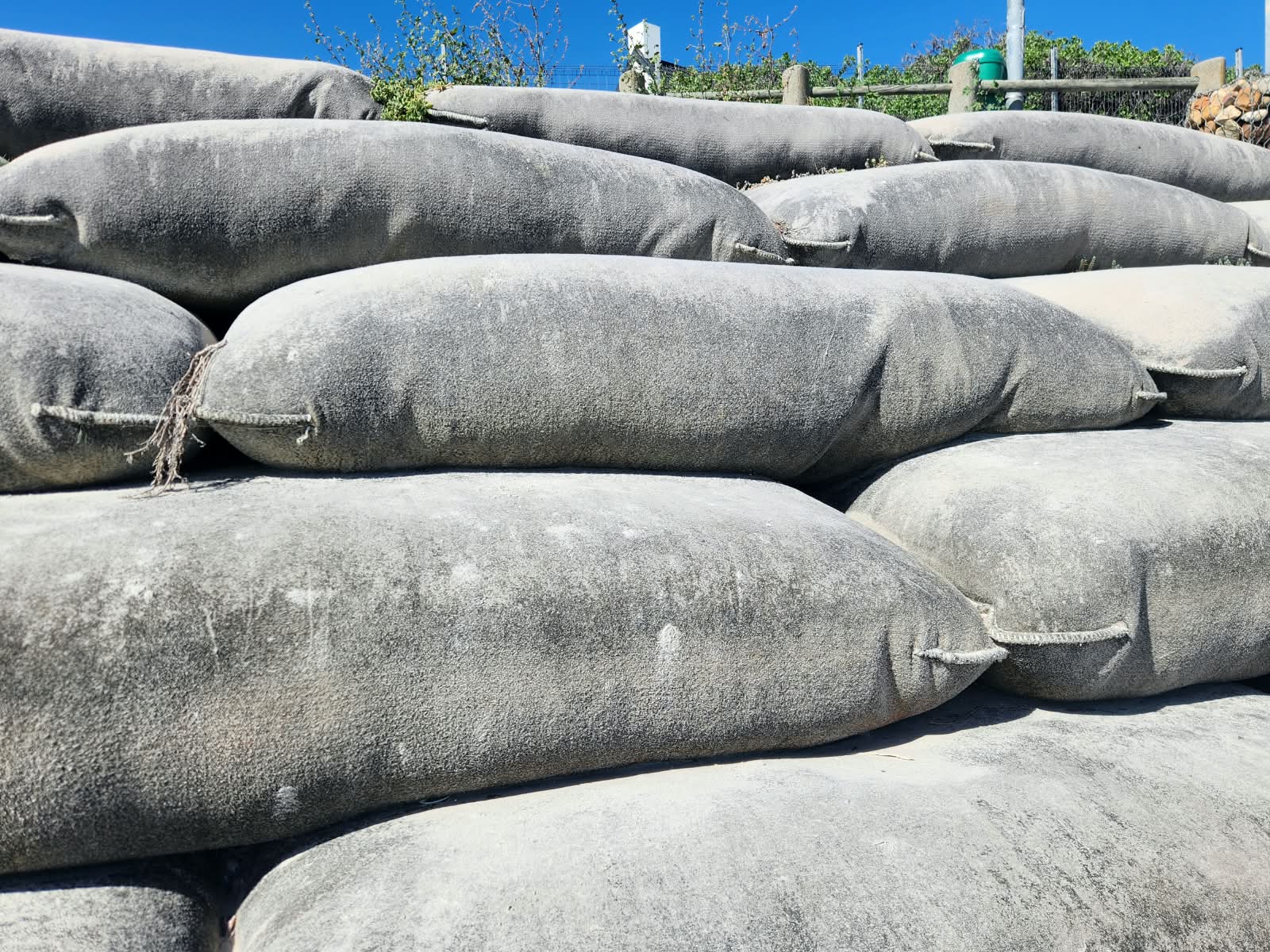
FlowTex™ GSC NW - Nonwoven Geosynthetic Sand Containers
Sand containers fabricated from needle-punched nonwoven geotextile, 200 to 1,200 g/m², in seven sizes from 40 kg to 4,000 kg fill weight. Double lock stitched with Tenara® UV-stable ePTFE thread. For dune revetments, scour protection, temporary works and emergency flood defence, filled with local sand on site.
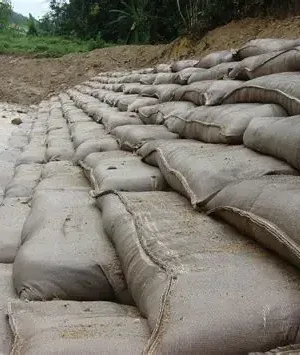
FlowTex™ GSC W - Woven Geosynthetic Sand Containers
Woven polypropylene sand containers in four grades, 30 to 105 kN/m wide-width tensile, 400 kg to 4,000 kg filled. For coastal revetments, groyne construction, scour aprons and structural riverine works. Manufactured, stitched and seam-tested in our own Johannesburg facility.
| Industries that use Geosynthetic Sand Containers
| Specsheets & Installation Guides
Download technical datasheets and step-by-step installation guides for Geosynthetic Sand Containers.
BOQ Upload to Specific Sales
Upload your Bill of Quantities (BOQ) or drawings for a tailored quotation. Our sales team will review your requirements and provide a competitive pricing schedule.
Have a project? Partner with us.
Get expert engineering support, reliable material supply, and best-in-class installation for your next geosynthetic containment project.
Global Best-in-Class Materials
Integrated into engineered systems