Case Study Brief
Technical Independence Statement
The assignment was a testing and technical-review service rather than a material supply or installation scope. Sample identification, laboratory results, method limitations and the findings register supported a traceable review.
Forensic Methodology Protocol
The West African TSF assignment required independent review of ten 1.5 mm HDPE geomembrane samples before material acceptance. Samples were indexed for traceability and tested for standard OIT, tensile properties and stress-crack behaviour. The available stress-crack method differed from the method specified by GRI-GM13, so that limitation needed to remain explicit.
Sample Receipt & Indexing
Ten coupons of 1.5 mm smooth black HDPE geomembrane received from the client, logged and indexed. Each coupon divided into three sub-samples (A/B/C) so a single roll could be assessed across three independent test streams.
Scope Definition Against GRI-GM13
Define the required properties and methods against the project specification. Record that ASTM D1693 was used as an alternative to ASTM D5397 and identify the resulting conformity limitation.
Accredited Laboratory Testing
Testing performed by an accredited third-party analytical laboratory: standard-pressure OIT by DSC (ASTM D3895), tensile strength and elongation in machine and transverse direction (ASTM D6693), and environmental stress cracking at 500 hours (ASTM D1693).
Interpretation & Findings Register
Map results to the originating samples and applicable property requirements. Identify the sample below the OIT requirement and distinguish property-level findings from complete GRI-GM13 conformity.
Laboratory Testing Programme
Standard-pressure Oxidative Induction Time (ASTM D3895) was run by DSC at 200 °C on a Mettler DSC25 calibrated against indium, lead and zinc standards, measuring the antioxidant reserve that governs long-term liner durability. Tensile strength and elongation (ASTM D6693, Type IV dumbbell, 50 mm/min) were measured in machine and transverse direction at five replicates each, capturing yield strength, break strength, yield elongation and break elongation. Environmental stress cracking was assessed to ASTM D1693 - notched specimens held in 10% surfactant solution at 50 °C for 500 hours, monitored across six specimens per coupon. ASTM D1693 was substituted for the originally scoped ASTM D5397, which the laboratory could not perform.
Independent services-only engagement
Forensic Findings Register
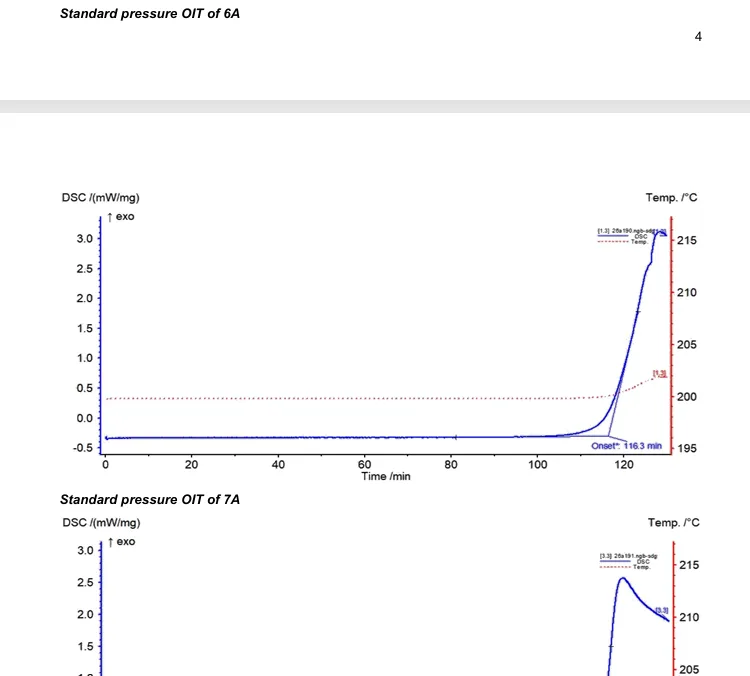
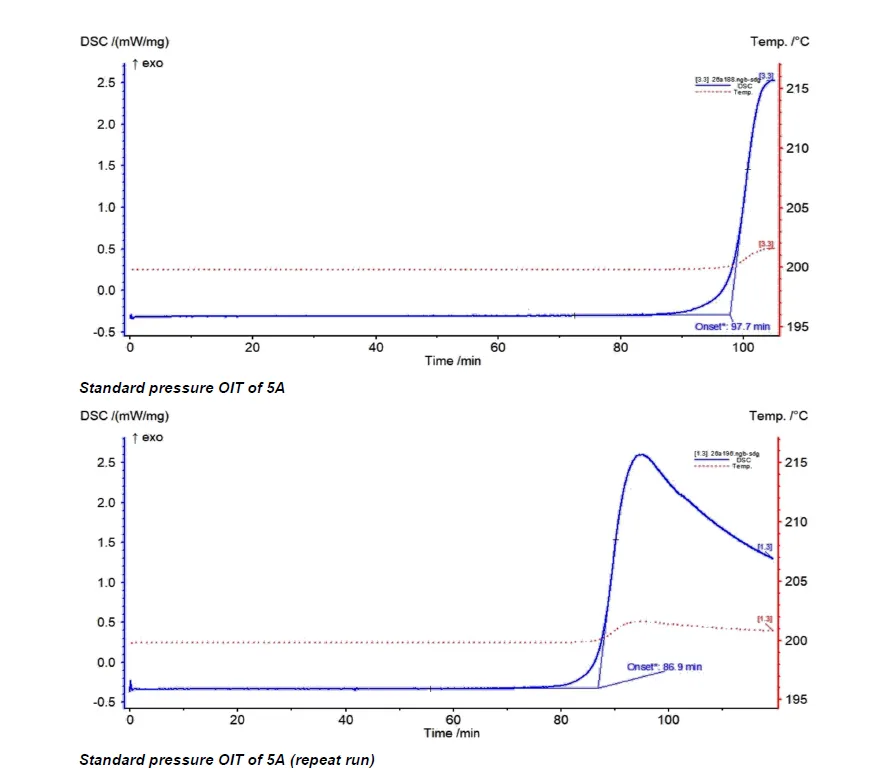
One sample returned standard OIT of 97.7 minutes, with a repeat of 86.9 minutes, below the stated 100-minute requirement. The other nine samples returned 114.8–155.3 minutes. Reported tensile and elongation results supported assessment of the properties tested. ASTM D1693 stress-crack results are supplementary and do not establish ASTM D5397 conformity or complete GRI-GM13 compliance. Final acceptance rests with the client and responsible engineer.
Antioxidant Reserve
Standard OIT of 114.8–155.3 minutes met the stated 100-minute property requirement for these samples. This finding alone does not establish complete GRI-GM13 conformity.
Tensile & Stress Crack
Reported tensile results exceeded the stated property minima. The samples survived 500 hours under ASTM D1693; this alternative method does not establish conformity with ASTM D5397.
Antioxidant Depletion
Standard-pressure OIT of 97.7 minutes, below the 100-minute GRI-GM13 threshold. Confirmed on repeat run at 86.9 minutes. Roll quarantined for supplier resolution prior to placement.
Specification Conformity & Lab Verification
Key properties compared with the project specification.
| Property | Test Method | Specification Minimum | Delivered Value (Average) | Margin Above Spec |
|---|---|---|---|---|
| Tensile Yield Strength (MD) | ASTM D6693 | 22 kN/m | 23.0–27.2 kN/m | PASS |
| Tensile Yield Strength (TD) | ASTM D6693 | 22 kN/m | 24.8–29.0 kN/m | PASS |
| Break Strength (MD/TD) | ASTM D6693 | 40 kN/m | 47.8–56.2 kN/m | PASS |
| Yield Elongation | ASTM D6693 | 12% | 12.9–20.7% | PASS |
| Break Elongation | ASTM D6693 | 700% | 741–813% | PASS |
| Stress-crack resistance — alternative test | ASTM D1693; GRI-GM13 specifies ASTM D5397 | ASTM D5397 required for GRI-GM13 assessment | No failures after 500 h under ASTM D1693 | Alternative method; GRI-GM13 conformity not established |
| Standard-Pressure OIT | ASTM D3895 | ≥100 min | 86.9–155.3 min, including repeat test | 9 samples met OIT requirement; 1 below requirement |
Deliverable: Independent material-test review and findings register
Request a Sample Report“In-house project comment: This review shows why traceable test results and clear method limitations matter. Identifying the sample below the OIT requirement was as important as reporting the stronger results; full conformity must never be inferred from a partial test scope.