
Dewatering Systems
GeoCurtain™ Class 3 Silt Curtain – Marine & High Energy Applications
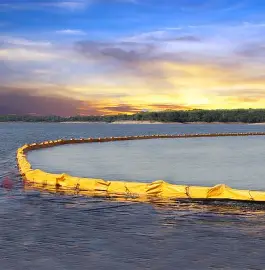
GeoCurtain™ Class 3 Silt Curtains are engineered for high-energy marine and coastal environments, including ports, harbours and open water applications, providing heavy-duty sediment control for long-term dredging, reclamation and port infrastructure projects.
Overview
GeoCurtain™ Class 3 Silt Curtains are the heavy-duty option in the GeoCurtain range, designed for high-risk conditions - strong wind and water forces typical of open ocean, exposed harbours and river mouths. This class is specified for long-term projects and locations with significant vessel traffic, tidal range or wave action, where curtain integrity over extended deployment is critical.
Class 3 curtains use the largest float chambers, heaviest ballast and highest-rated tensile webbing in the range, along with an upgraded load strap and heavy-duty connectors, to maintain performance under sustained hydrodynamic loading. As with all classes, the curtain works by using a permeable geotextile skirt and continuous chain ballast to disrupt water flow and encourage suspended sediment to settle, rather than acting as a dam.
The float chamber is manufactured from UV-stabilised PVC (900gsm) with closed-cell, oil- and crumble-resistant PE foam flotation, sized at 150mm x 150mm or 200mm x 200mm. The standard skirt is a 260gsm non-woven geotextile (approximately 90-micron filtration), with heavier woven geotextile and reinforced casing options available for extreme or extended exposure. High-tensile 50mm webbing rated to 5 tonnes breaking strain is fitted in three strips — above the float chamber, below the float chamber, and above the ballast chain pocket as an upgraded load strap — with skirt depths of up to 20m and an 8mm–13mm ballast chain pocket. Connections use marine-grade #10 zippers along the skirt and heavy-duty ASTM F962 extruded aluminium Z-connectors at the float chamber, with two triangle reinforcement patches fitted. Handles and shackles are standard, with optional anchoring points, external floats, toggle pins and reflective buoys available.
Typical applications include port and harbour development and maintenance; open ocean and river mouth dredging; reclamation works in exposed coastal locations; long-term deployments (12 months plus) in high-traffic or high-energy waterways; and pier, jetty and wharf construction where sea states are variable.
Given the greater skirt depths and higher loads involved, Class 3 deployments should be supported by a full anchoring assessment based on local current speed, wind exposure and tidal range. Curtains are supplied furled in sections up to 100m per pallet and should be towed into position at a maximum of 2–3 knots before the anchoring system is secured and the skirt released. Regular inspection (recommended at least quarterly, more frequently in exposed locations) is advised for any deployment exceeding three months, with particular attention to connector wear, biofouling build-up and ballast chain integrity.
- MaterialPVC (float chamber) with non-woven geotextile skirt
- StructureHeavy-duty floating boom with reinforced geotextile skirt, triple webbing straps and continuous chain ballast
- StandardClass 1 / Class 2 / Class 3
- Roll WidthSkirt Depth: Up to 20m
- Roll LengthStandard Section Length: 100m per section (furled)
Typical Properties
| Property | Class 1 | Class 2 | Class 3 |
|---|---|---|---|
| Float Chamber PVC | 400gsm | 610gsm | 900gsm |
| Float Size | 50mm x 100mm | upto 150mm x 150mm | upto 200mm x 200mm |
| Skirt Depth | Up to 2m | Up to 8m | Up to 20m |
| Skirt Material | 260gsm Geotextile | 260gsm Geotextile | 260gsm Geotextile |
| Ballast Chain | 6mm galvanised | 6mm – 8mm galvanised | 8mm – 13mm galvanised |
| Webbing | 25mm – 1T breaking strain | 50mm – 2T breaking strain | 50mm – 5T breaking strain |
| Connectors | Bowshackles | Standard Z-connectors | Heavy duty Z-connectors |
| Skirt Connectors | Marine grade #10 zipper | Marine grade #10 zipper | Marine grade #10 zipper |
| Standard Section Length | 20m | 20m | 20m |
| UV Resistance- | Up to 5 years | Up to 5 years | Up to 5 years |
Note: The above specifications represent the product family properties. Please refer to the product datasheet for individual SKU values.
Typical Applications
View all applicationsMarine Construction and Dredging
Silt curtains are standard specification on marine construction projects involving seabed disturbance - harbour construction, jetty and pier installation, bridge foundation works, pipeline laying, and capital and maintenance dredging. Suspended sediment generated by these activities can migrate significant distances in tidal and current-driven environments. A correctly classed and positioned silt curtain contains the turbidity plume within the work area and allows sediment to settle before water is returned to the surrounding environment.
Port and Harbour Works
Port expansion, berth deepening, and harbour infrastructure projects operate in enclosed or semi-enclosed water bodies where turbidity control is critical to protecting adjacent users, marine ecosystems, and water quality. Class 2 and Class 3 curtains are typically required depending on exposure and tidal conditions. Vessel traffic management, navigation marking, and waterways authority approvals are standard requirements for curtain deployments in operational port environments.
Coastal and Estuarine Infrastructure
Coastal road crossings, culvert installations, bridge works, and shoreline stabilisation projects in estuarine and tidal environments disturb sediment in ecologically sensitive zones. Mangroves, seagrass beds, and estuarine fish nursery habitats are highly sensitive to elevated turbidity and sediment deposition. Silt curtains deployed upstream of these receptors limit sediment transport and support compliance with coastal and environmental permit conditions that are increasingly standard across African regulatory frameworks.
Coral Reef and Seagrass Protection
Coral reefs and seagrass beds are vulnerable to turbidity through two mechanisms - daylight attenuation that reduces photosynthesis, and physical sediment deposition that buries and smothers organisms. Construction and dredging works near reef and seagrass environments require active turbidity management as a condition of environmental approval across most African coastal jurisdictions. Silt curtains deployed between the work area and sensitive receptors provide the primary barrier against sediment migration toward these habitats.
River and Inland Waterway Works
River bridge construction, culvert installation, bank stabilisation, in-stream infrastructure works, and river crossing pipeline installations all disturb riverbed and bank sediment in flowing water environments. Class 1 curtains suit low-flow inland sites; Class 2 curtains are required where current velocities and flow volumes are moderate. Curtain deployment in rivers must account for flow direction, tidal reversal in tidal reaches, and the need to maintain a gap between the skirt base and riverbed to prevent jet stream formation beneath the curtain.
Compatible Systems
View all systemsClass 1 – Still Water & Sheltered Sites
For low-energy environments with little to no tidal, wave, or wind forces. Typical applications include lagoons, ponds, streams, and enclosed construction zones. Features 400gsm PVC float chamber, 50mm x 100mm floats, 25mm webbing with 1T breaking strain, 6mm galvanised ballast chain, and skirt depths up to 2m. Bowshackle connectors on float chamber with marine grade zipper on skirt. Suitable for short-term deployments in still or near-still water.
Class 2 – Rivers, Ports & Calm Harbours
For medium-energy environments with moderate wind and water forces. Typical applications include rivers, calm harbours, canals, and coastal construction in sheltered water. Features 610gsm PVC float chamber, 100mm x 100mm or 150mm x 150mm floats, 50mm webbing with 2T breaking strain above and below float chamber, 6mm–8mm galvanised ballast chain, and skirt depths up to 8m. Standard ASTM F962 extruded aluminium Z-connectors with 2 triangle patches for added strength.
Class 3 – Open Ocean, Harbour Entrances & River Mouths
For high-energy environments with strong wind and water forces. Typical applications include open ocean, exposed harbour approaches, river mouths, and long-term deployments subject to variable sea states. Features 900gsm PVC float chamber, 150mm x 150mm or 200mm x 200mm floats, 50mm webbing with 5T breaking strain at three positions including above chain pocket with upgraded load strap, 8mm–13mm galvanised ballast chain, and skirt depths up to 20m. Heavy duty ASTM F962 Z-connectors, optional external HDPE floats, reflective buoys, and toggle pins.
Installation Guidance
Standard Method Statement
Silt curtain deployment requires advance planning, correct anchoring, and disciplined handling procedures. The two most common causes of silt curtain failure on African waterway projects are inadequate anchoring that allows the curtain to drift or collapse under tidal load, and incorrect skirt depth that causes the curtain to billow, drag the seabed, or flare under current. Both are preventable with correct specification and competent site supervision.
Pre-Deployment Preparation - Install the anchoring system in the waterway before the curtain arrives at the water's edge. Confirm anchor positions account for tidal rise and fall and allow sufficient mooring line length for the curtain to move vertically without stress. Ensure a clear working area on shore or on the deployment vessel. Join pallet sections in consecutive order on land with the skirt remaining furled. For large deployments across multiple pallets, confirm each pallet is numbered and sequenced correctly before any section enters the water.
Towing to Position – Once the desired curtain length is connected and furled, tow the system to the deployment location at a maximum speed of two to three knots. The curtain must remain furled during towing. Never drag an unfurled curtain with the skirt deployed through water - this places severe and undue stress on the webbing, connectors, and skirt material and will cause damage.
Anchoring and Skirt Release – Secure the furled curtain to the anchoring system before releasing the skirt. Check that the skirt is not twisted around the flotation chamber - a twisted skirt will not deploy correctly and will concentrate stress at the twist point. Once the curtain is anchored in the correct position and confirmed untwisted, remove the ties furling the skirt and allow the curtain system to drop into place under its own ballast weight. Do not attach the curtain directly to piles or poles driven into the seabed under any circumstances.
Confirming Correct Deployment – After the skirt has deployed, visually confirm the curtain is sitting vertically in the water column, the ballast chain is hanging freely and not resting on the seabed, and the freeboard is sitting correctly above the waterline. Check that all connector points are secure and that the curtain forms the intended configuration - closed, open, or maze - relative to the work area and any adjacent structures. Confirm a minimum 0.5m gap exists between the skirt base and the seabed at low tide.
Repositioning if Required – If the curtain needs to be moved after initial deployment, furl the skirt before dragging or towing the system to its new position. Never reposition an unfurled curtain. Disconnect from anchoring points, furl, reposition, re-anchor, and re-release the skirt in sequence.
Ongoing Inspection and Maintenance – For deployments longer than three months implement a scheduled inspection programme. Check curtain position, skirt condition, anchor line integrity, connector and zipper condition, marine growth accumulation, and hardware wear at anchoring points at intervals determined by site exposure - from daily in high-energy environments to quarterly in sheltered stable conditions. Keep a spare curtain section on site. Record all inspections and maintenance actions. Where visual inspection from the surface is insufficient, deploy underwater divers to inspect the submerged skirt and connections - particularly following any observed sediment plume within the protected area.
Recovery – Before removing the curtain, cease all marine works and conduct a visual inspection of water quality within the protected area to confirm no active sediment plume. Disconnect the curtain from anchoring points, furl the skirt, and remove the mooring system. Tow the furled curtain back to the launch site. On land, clean with a high-pressure washer to remove biofouling, silt, and sediment, allow to dry completely, and repack on pallets for storage or disposal. A well-maintained curtain can be redeployed on future projects.
Quality Assurance & Testing
Field QA/QC Checklist
- Delivery & Storage: Materials checked against the delivery note and conformance certificates, stored off the ground, covered from UV and kept clear of sharp objects and fuel.
- Configuration: Curtain type, depth and alignment checked against the design for water depth, current and wave conditions.
- Anchoring: Anchors and mooring lines placed as designed; ballast chain hangs freely.
- Inspection: Inspected daily during works for gaps, damage and anchor drag; turbidity monitored outside the curtain where required.
Manufacturing Standards
- Manufacturer deployment guide
- Project environmental management plan
Documents
Product Selection Guide
Compare performance properties across the entire category hierarchy before specifying.
Installation & Method Statement
Standard deployment procedures, installation specifications, and field application method statements.
QA/QC Site Checklist
Field quality control procedures, inspection checklists, and testing standards to verify installation integrity.
Technical Data Sheet (TDS)
Guaranteed minimum average roll values (MARV) and material testing properties.
Chemical Resistance / Accessories Guide
Chemical compatibility matrix and list of auxiliary materials needed for installation.
Projects Using GeoCurtain™ Class 3 Silt Curtain – Marine & High Energy Applications
Submit your BOQ.
Get a quote – not just a price.
Upload your BOQ or speak to our technical team for expert recommendations and support.