

Geomembrane Liners
GSE HD Smooth Geomembrane Liner - GRI-GM13
GRI-GM13 and SANS 1526 certified smooth HDPE geomembrane from Solmax GSE, 1.0mm to 3.0mm, 100% virgin resin. The standard profile for flat and gently graded containment on slopes to 3H:1V - TSF base liners, landfill cells, reservoirs, canals and process ponds. 7m rolls. Ex-stock supply, IAGI-aligned installation and full QA dossier across 30+ African countries.
Overview
The Series Standard for Flat and Gently Graded Containment
GSE HD is Solmax's high-density polyethylene geomembrane series, manufactured from 100% virgin resin and certified to ASQUAL, KIWA, BAM, DIBt, OENORM and GRI-GM13. The smooth profile is the default specification for containment surfaces that are flat or graded no steeper than 3H:1V - TSF base liners, landfill cells, reservoirs, irrigation canals, aquaculture ponds and process water dams.
Why the certification list matters. Most HDPE liner on this market is sold against GRI-GM13 alone. GSE HD additionally holds BAM and DIBt approval - German federal certifications required for landfill containment in Germany and among the most demanding in the industry - alongside ASQUAL, KIWA and OENORM. Where a project's CQA plan, a lender's environmental conditions or a regulator's approval process requires more than a single standard, that breadth is the difference between a material that qualifies and one that needs justifying.
Thickness selection. 1.0mm suits reservoirs, agricultural dams, irrigation canals, aquaculture and lower-hazard containment where higher grades are over-specified. 1.5mm is the African industry standard minimum for TSF base liners, heap leach pads and hazardous waste cells, and should be treated as the floor for any high-consequence permanent containment. 2.0mm and above are specified where hazard classification, cover stresses, puncture risk from overlying material or a longer design service life demand greater mechanical capacity.
Smooth or textured. Smooth sheet is correct on slopes to 3H:1V. Steeper than that, veneer stability governs and interface friction becomes the design driver - specify single-side textured where friction is needed against one interface only, or double-side textured where both interfaces are critical. The conductive variant enables electrical leak location survey after installation.
What we supply with it. Geosynthetics Africa holds GSE HD ex-stock with pan-African logistics and customs-cleared delivery to more than 30 countries. Installation is executed by our own IAGI-aligned crews to a fixed methodology: subgrade signed off before deployment, dual-track fusion welding on calibrated equipment by qualified welders, 100% non-destructive seam testing to ASTM D5820 and D5641, destructive sampling at minimum one per 150m of seam to ASTM D6392. On completion you receive a full QA dossier - weld log, NDT results, destructive test reports, roll log, as-built drawing and signed handover certificate, under our name rather than a subcontractor's.
- MaterialHigh-Density Polyethylene (HDPE) - 100% virgin resin
- StructureSmooth flat surface · single layer extruded sheet
- ColourBlack · white reflective on request
- StandardGRI-GM13 · BAM · DIBt · ASQUAL · SANS 1526
- Roll Width7.00 m · 1.0mm to 3.0mm
- Roll Length210 m (1.0mm) · 150 m (1.5mm) · 110 m (2.0mm)
Typical Properties
| Testing Properties | Test Method | Unit | 1.0mm | 1.5mm | 2.0mm | 2.5mm |
|---|---|---|---|---|---|---|
| Thickness | ASTM D5199 | mm | 1.00 | 1.50 | 2.00 | 2.50 |
| Density | ASTM D792 | g/cm³ | ≥ 0.940 | ≥ 0.940 | ≥ 0.940 | ≥ 0.940 |
| Tensile strength at break | ASTM D6693 | kN/m | 27 | 40 | 53 | 67 |
| Tensile Strength at Yield | ASTM D6693 | kN/m | 15 | 22 | 29 | 37 |
| Tear resistance | ASTM D1004 | N | 106 | 168 | 224 | 280 |
| Puncture resistance | ASTM D4833 | N | 320 | 480 | 640 | 800 |
| Stress crack resistance | ASTM D5397 | hr | ≥ 500 | ≥ 500 | ≥ 500 | ≥ 500 |
| Roll width | - | m | 7 | 7 | 7 | 7 |
| Roll Length | - | m | 210 | 150 | 110 | 85 |
| Area per roll | - | m² | 1470 | 1050 | 770 | 595 |
Note: The above specifications represent the product family properties. Please refer to the product datasheet for individual SKU values.
Typical Applications
View all applicationsTailings Storage Facility Lining
HDPE lining for tailings cells and embankments, including composite and double liner systems with leak detection.
Heap Leach Pad Lining
HDPE barriers beneath ore stacks and solution ponds for leach solution containment and recovery.
Reservoir & Dam Lining
HDPE lining to control seepage in dams, reservoirs and process water storage, selected for site conditions.
Landfill, Ash & Bund Lining
HDPE barriers for landfill cells, ash facilities and secondary containment, with protection and drainage layers as required.
Compatible Systems
View all systemsHDPE Smooth Geomembranes
The standard profile for flat and gently graded containment surfaces - TSF base liners, landfill cells, reservoirs, canals and process ponds on slopes not exceeding 3H:1V. Virgin resin, GRI-GM13 certified. 1.0 mm – 3.0 mm.
HDPE Textured Geomembranes (Single & Double)
Specified where slope stability and interface friction are design-critical. Single-textured for one-sided friction interfaces; double-textured mandatory on slopes steeper than 3H:1V. GRI-GM13 certified. 1.0 mm – 2.5 mm.
HDPE White / Reflective Geomembranes
Reflective white surface bonded to a black HDPE base - reduces liner temperature in high UV environments where exposed black HDPE can exceed 70 °C. Specified for heap leach pads, exposed caps and long-term surface applications. GRI-GM13 certified. 1.0 mm – 2.5 mm.
HDPE Conductive Geomembranes (ELL-enabled)
Conductive layer enables Electrical Leak Location (ELL) testing through cover soils and under water - pinpointing defects without excavation. Specified for high-consequence TSF, hazardous waste and double-liner systems requiring post-installation leak detection. 1.5 mm – 2.5 mm.
HDPE High-Temperature Geomembranes
Engineered for process fluid temperatures exceeding standard HDPE thermal tolerance - hot leach solutions, thermal heap leach and elevated-temperature industrial ponds above 60 °C. Project-specified. Contact our technical team for application assessment
Installation Guidance
Standard Method Statement
Installation follows the approved project method statement, panel layout and QA/QC plan. The receiving surface is inspected before deployment. Panel overlaps, anchorage, temporary restraint and welding conditions are set for the selected liner and equipment, following manufacturer guidance and the project specification.
Dual-track fusion welding and extrusion welding are used as appropriate to the seam and detail. Non-destructive testing uses the applicable method: pressurised air-channel evaluation to ASTM D5820 for dual seams, and vacuum-chamber evaluation to ASTM D5641 where suitable. Destructive peel and shear testing to ASTM D6392 is performed at the frequency and acceptance criteria defined in the approved project QA/QC plan.
Repairs are recorded and retested using the applicable method before acceptance and covering. Handover documentation is defined in the agreed scope and may include material roll records, panel layouts, weld logs, non-destructive and destructive test records, repair logs, as-built drawings and the handover certificate.
Quality Assurance & Testing
Field QA/QC Checklist
- Subgrade Acceptance: Subgrade signed off before deployment: smooth, compacted, free of stones, roots and protrusions, and no standing water or desiccation cracks.
- Material Conformance: Roll numbers and manufacturer QC certificates checked against GRI-GM13 (HDPE) or GRI-GM17 (LLDPE); conformance samples taken where the CQA plan requires.
- Trial Welds: Trial seams made and peel/shear tested at the start of each shift, for each welder and machine, and whenever conditions change.
- Non-Destructive Seam Testing: 100% of seams tested: air-pressure testing of double-wedge welds (ASTM D5820) and vacuum-box testing of extrusion welds, patches and repairs (ASTM D5641).
- Destructive Seam Testing: Seam samples cut at intervals set by the CQA plan (GRI-GM14) and tested in shear and peel to ASTM D6392 against GRI-GM19 values.
- Leak Location Survey: Electrical leak location survey (ASTM D7007 for covered liners, ASTM D7002/D7703 for exposed liners) where specified, before handover.
- Panel Layout & Repairs Record: As-built panel layout, seam log and repair log kept and signed off, with every repair vacuum-tested.
Manufacturing Standards
- GRI-GM13 (HDPE) / GRI-GM17 (LLDPE) material specification
- GRI-GM19 seam strength requirements
- ASTM D6392 seam strength testing
- ASTM D5820 air channel / ASTM D5641 vacuum box testing
- ASTM D7007 electrical leak location (where specified)
- Manufacturer QC certificates per roll
- GRI-GM13 · BAM · DIBt · ASQUAL · SANS 1526
Documents
Product Selection Guide
Compare performance properties across the entire category hierarchy before specifying.
Installation & Method Statement
Standard deployment procedures, installation specifications, and field application method statements.
QA/QC Site Checklist
Field quality control procedures, inspection checklists, and testing standards to verify installation integrity.
Technical Data Sheet (TDS)
Guaranteed minimum average roll values (MARV) and material testing properties.
Chemical Resistance / Accessories Guide
Chemical compatibility matrix and list of auxiliary materials needed for installation.
Projects Using GSE HD Smooth Geomembrane Liner - GRI-GM13
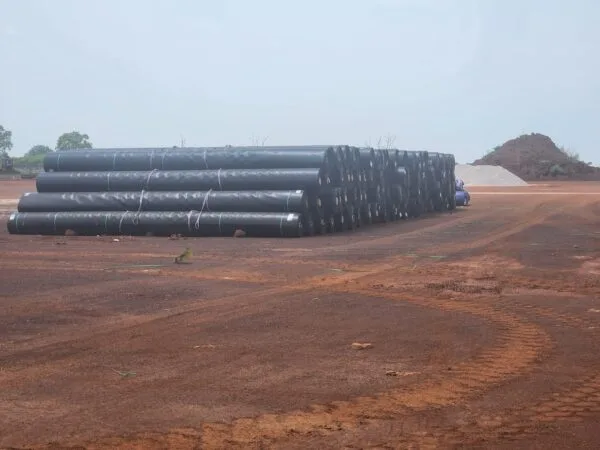
Supply of 61,600 m² of GSE® HDPE geomembrane to Ikongwe Iron Ore Mine in Botswana: 21,560 m² of 1.0 mm liner and 40,040 m² of 2.0 mm liner.
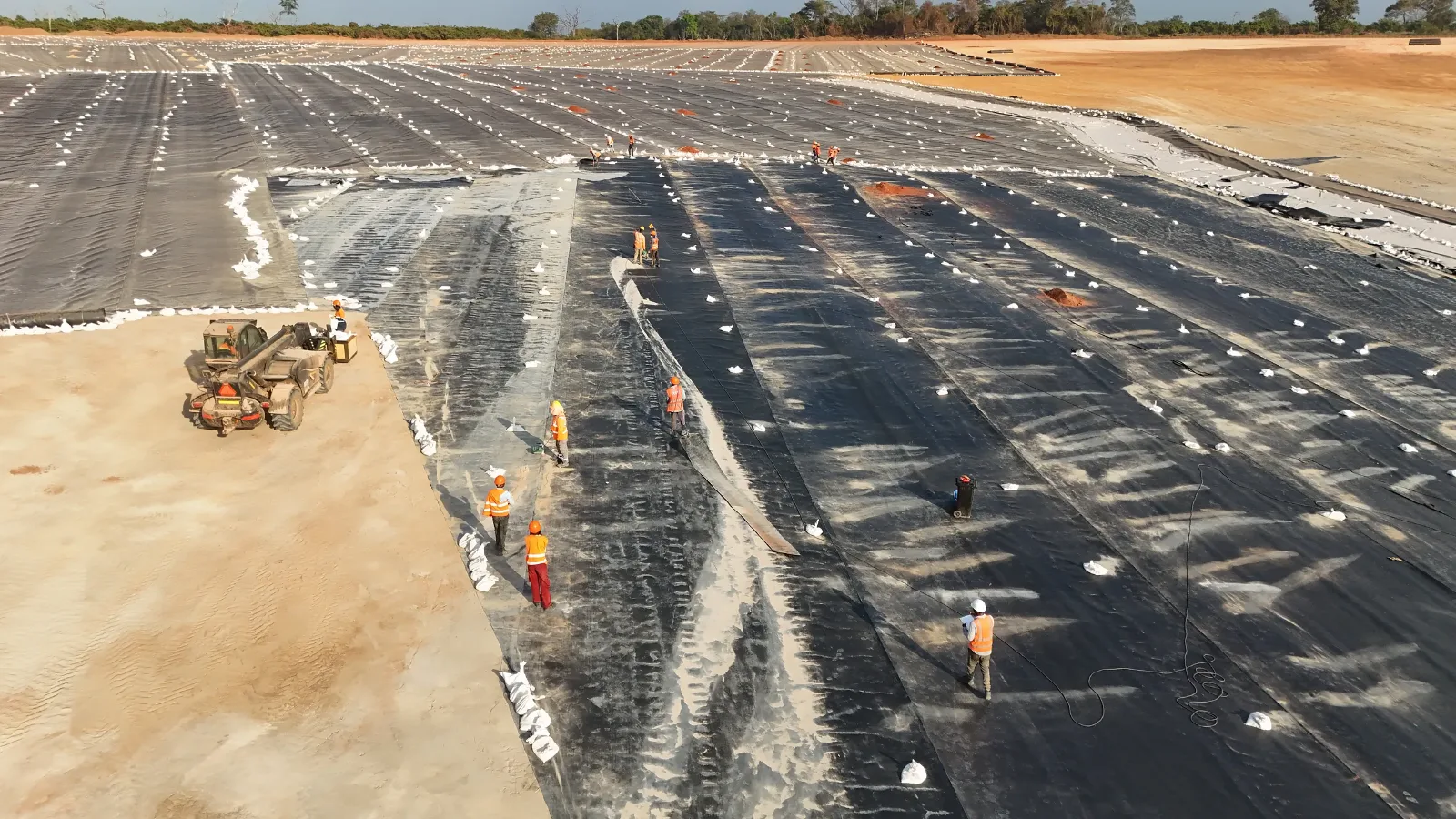
Supply and installation of HDPE geomembrane for a 1.2 million m² tailings-storage facility at a lithium project in Mali, with panel deployment, welded seams and installation QA/QC.
Submit your BOQ.
Get a quote – not just a price.
Upload your BOQ or speak to our technical team for expert recommendations and support.