
Erosion Control & Geocells
PolyCell Geocell – Cellular Fabric Formwork for Liner Protection & Canal Lining
PolyCell is a woven polypropylene geocell that opens into three-dimensional cells and is filled on site with concrete, soil or stone. Used for geomembrane liner protection, canal and channel lining, slope armouring and load support, with no shuttering and no precast panels. Supplied and installed across Africa.
Overview
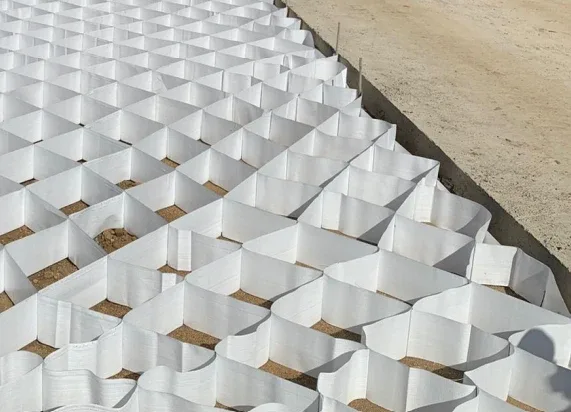
PolyCell is a cellular geocell made from strips of coated, slit-film woven polypropylene tape stitched together so the fabric opens into a honeycomb of three-dimensional cells. Laid over a prepared surface and filled on site with concrete, soil or stone, it forms a continuous, interlocking armour layer that follows the shape of the ground and holds its fill in place on slopes where loose material would wash or creep away.
Liner protection is one of its most common uses in South Africa. On a lined dam, reservoir, tailings facility or landfill, the geomembrane has to survive wave action, UV exposure, stormwater, maintenance traffic and, on mine sites, animals and vandalism. PolyCell filled with concrete or soil provides a heavy, continuous cover over the liner on batters and in the splash zone, holding it down and shielding it from mechanical damage. Where the design requires it, a protection geotextile is placed between the liner and the cells so the fill never bears directly on the membrane.
The same system solves the problem that makes canal and slope lining expensive. Conventional in-situ concrete needs shuttering, screeding and joints, and precast panels need lifting equipment and leave joints that open up. PolyCell arrives as rolls, is cut and positioned by hand, anchored, then filled from a pump or skip. The cells control the layer thickness and stop concrete running down the slope, so an even lining can be cast on gradients where conventional concrete would simply flow away.
Applications include geomembrane and liner protection, canal and channel lining, stormwater channels and spillways, slope and embankment protection, river bank and culvert outlet protection, dam and reservoir batters, load support, low-volume concrete roads, hard standing and access ramps. Cells filled with soil and vegetated give a green armoured surface where appearance or environmental requirements demand it; stone fill gives a permeable surface.
A note on terminology, because it causes confusion at tender stage. In South Africa "geocell" is commonly used for this woven fabric cell system as well as for welded HDPE cellular confinement. They are different products: HDPE geocell is a welded plastic honeycomb generally used to confine granular fill for load support and slope stabilisation, while PolyCell is a fabric formwork designed to be filled and, most often, cast with concrete. We supply both, so tell us the application and we will confirm which one your specification actually needs.
The system has been used in Southern African civil engineering since the early 1980s, on canals, mine infrastructure, roads and erosion works. Because it is woven polypropylene, it is light to transport and store: one roll covers a large area at a fraction of the weight of equivalent precast concrete, which matters on remote sites where crane access and haulage drive the budget.
Installation: trim and compact the subgrade, place a separation, filter or protection geotextile where the design requires it, unroll and position the panels, anchor in a trench at the crest and toe, join adjacent panels, then fill the cells and finish. Our crews install PolyCell across Africa, or we supply the material with installation guidance for your own team, with technical support on cell depth, fill type and anchorage for your specific slope, channel or liner.
- MaterialCoated slit-film woven polypropylene tape
- StructureStitched three-dimensional cellular geocell
- ColourWhite
- StandardISO 9001:2015
- Roll WidthCell depths: 75 mm, 100 mm, 150 mm
- Roll Length10 m (expanded panel length)
Typical Properties
| Property | Test Method | Value |
|---|---|---|
| Base material | - | UV stabilised laminated polypropylene woven slit-film tape |
| Tensile strength | SANS 10221 | 26 kN/m |
| Elongation at break | SANS 10221 | 21% |
| Seam strength | SANS 10221 | 4 kN/m |
| Seam elongation | SANS 10221 | 12% |
| Cell size (square) | - | 200mm x 200mm |
| Cell size (diagonal) | - | 280mm x 280mm |
| Cell heights available | - | 75mm - 100mm - 150mm |
| Panel size expanded | - | 10m x 5m (50m2) |
| Panel size packaged | - | 450mm x 750mm |
| UV stabilisation | - | Yes |
| Chemical resistance | - | Resistant to most chemicals |
| Rot resistance | - | Yes |
| Max velocity (concrete infill) | - | Up to 8 m/s |
| Max velocity (soil/vegetated infill) | - | 1.5 m/s - 2 m/s |
| Infill options | - | Concrete - soilcrete - gravel - stabilised soil - topsoil |
Note: The above specifications represent the product family properties. Please refer to the product datasheet for individual SKU values.
Typical Applications
View all applicationsConcrete Channel & Canal Lining
PolyCell is the standard specification for in-situ concrete channel and canal lining across Africa - covering roadside drains, stormwater channels, irrigation canals, mine dewatering channels, down chutes, spillways, and dam causeways. Filled with concrete, PolyCell withstands flow velocities up to 8 m/s, eliminates conventional formwork, accommodates active clay subgrades, and produces a flexible interlocking concrete lining with built-in hydrostatic relief joints. Faster, cheaper, and more durable than conventionally formed concrete channel lining in African construction conditions.
Rural Concrete Roads & Residential Road Construction
PolyCell acts as permanent in-situ shuttering for cast concrete rural and residential roads, eliminating conventional formwork and joint cutting. The dished road profile channels stormwater, built-in skid resistance is achieved through the concrete surface finish, and the system can be laid on steep grades and in hilly terrain where conventional road construction plant cannot operate. Suited to low-volume residential roads, steep access roads, radio tower access, fuel depot aprons, and low-level river crossings.
Slope Protection & Embankment Stabilisation
PolyCell stabilises slope faces on road embankments, mine waste dump slopes, dam faces, landfill closures, bridge abutments, and road cut slopes. Filled with topsoil and vegetated, PolyCell increases the natural angle of repose, forms mini-cascades that slow surface runoff, and prevents rills and gullies from forming. Filled with concrete or soilcrete, PolyCell provides a hard-armoured slope face for high-energy erosion environments. The buried cellular system is resistant to surface fires - a critical advantage on mine dump and landfill slopes in southern Africa.
Geomembrane Liner Protection
PolyCell is specified as a liner protection cushion layer on dam, reservoir, tailings facility, and containment lining projects where aggregate or concrete is placed directly over the geomembrane. The cellular structure distributes infill point loads, prevents geomembrane puncture and abrasion during infill placement, and provides a stable construction platform over the membrane surface. A purpose-built geocell solution that outperforms standard nonwoven geotextile protection layers in aggressive aggregate infill applications.
Load Support & Road Base Stabilisation
PolyCell strengthens weak subgrades by limiting shearing through frictional interaction between the cell walls and infill material, distributing loads laterally and providing individual hoop strength through each cell. Applications include weak road sub-base and base improvement, high-load parking and storage areas including reach-stackers, retaining wall spread footings, foundation mattresses, underground pipe support, and low-level crossings. Can provide up to 40% reduction in required structural thickness versus unconfined aggregate on weak subgrades.
Compatible Systems
View all systemsPolyCell 75 - Shallow Cell Concrete Road & Light Channel Lining
PolyCell 75 is the 75mm cell height grade suited to cast in-situ concrete rural roads, residential road construction, roadside drains, and light-duty channel lining applications. At 75mm depth the concrete infill produces a robust, jointless, skid-resistant slab that follows existing ground profile without conventional formwork. Panel format: 10m x 5m expanded - 50m2 per panel. Packaged at 450mm x 750mm for compact transport and manual handling on remote sites.
PolyCell 100 - Standard Concrete Channel Lining & Slope Protection
PolyCell 100 is the primary grade for concrete channel and canal lining, slope protection, and load support applications across Africa. The 100mm cell height provides the standard concrete thickness for roadside drains, irrigation canals, stormwater channels, and down chutes on road embankments and mine dumps. Vegetated topsoil infill in PolyCell 100 suits embankment slope protection and landfill closure applications. Panel format: 10m x 5m expanded - 50m2 per panel
PolyCell 150 - Deep Cell High-Velocity Channel & Heavy Load Support
PolyCell 150 is the deepest standard grade, providing 150mm concrete infill depth for high-velocity channel lining, spillways, dam faces, and heavy load support applications. The increased concrete section depth provides greater structural capacity under hydraulic loading and trafficking. Suited to irrigation canal main lines, mine dump down chutes, dam spillways, and retaining wall spread footings. Panel format: 10m x 5m expanded - 50m2 per panel
Installation Guidance
Standard Method Statement
PolyCell installation requires no specialist plant or equipment and is suitable for unskilled labour with competent supervision. The critical requirements are correct anchor trench excavation at all slope crests and toes, sufficient cell tensioning during panel expansion, correct infill drop height control during initial filling, and adequate concrete practice for concrete infill applications.
1. Site Preparation - Remove all vegetation, rocks, and obstructions from the slope or channel surface. Shape and compact the formation as required. For channel lining applications, excavate 300mm x 300mm anchor trenches at the top and bottom of the channel slopes. For slope protection applications, excavate anchor trenches at the crest and toe of the slope. Where a geotextile separation layer is required under the PolyCell - typically for channel lining over erodible subgrades - install and overlap the geotextile in the direction of flow before panel deployment.
2. Panel Deployment and Tensioning - Lay the first PolyCell panel in position and expand using the tension frame, pulling at 1m to 1.5m intervals across the long side of the panel using Y10 or Y12 steel pegs. Ensure cells are sufficiently tensioned so that the cell walls remain upright once vertical pressure is removed. Connect adjacent panels by vertically threading standard wire nails or clipping into existing pegs at corresponding cell positions. Where changes in direction occur, insert binding wire or builders twine centrally through the cell walls at the inflection point and tension and peg along the wire with hooked pegs.
3. Anchor Trench and Boundary Fixing - Place the leading edge of each panel into the prepared anchor trench at the crest and toe. Backfill and compact the trench. For channel applications, peg the straining wire along the top edge of the panel at both sides of the channel to maintain panel position under hydraulic load. Install under-scour protection at regular intervals on channel installations as specified by the engineer. Pegs used during tensioning can be removed after infilling is complete.
4. Concrete Infill - For channel lining and concrete road applications, infill from the crest of the slope to the toe. Limit the drop height of fresh concrete to a maximum of 1m to prevent cell collapse during initial placement. Once the initial platform of concrete is established, work the material into adjacent partially filled cells. Use temporary edge rails and a vibrating screed bar to accelerate finishing. Vibrate, float, and cure the concrete surface to the required finish using standard concrete practice. For dished road profiles, form the road cross-section to channel stormwater away from the carriageway surface.
5. Granular and Soil Infill - For slope protection with topsoil or granular infill, place the first batch of material with caution to prevent cell collapse. Once the initial platform is established, stockpile onto this base and work the material into adjacent partially filled cells. Limit drop height to 1m maximum. For vegetated slope applications, seed the topsoil infill immediately after filling and apply a temporary erosion control blanket or hydroseed mulch over the planted cells to protect germination until vegetation is established.
Quality Assurance & Testing
Field QA/QC Checklist
- Delivery & Storage: Materials checked against the delivery note and conformance certificates, stored off the ground, covered from UV and kept clear of sharp objects and fuel.
- Material Conformance: Certificates checked for cell depth, wall thickness and seam peel strength (ISO 13426-1).
- Expansion & Anchoring: Sections fully expanded to the specified cell size and anchored at the top of slope and at the pin spacing in the design.
- Section Connections: Adjacent sections stapled or connected to the manufacturer's detail.
- Infill: Infill (soil, aggregate or concrete) placed from the top of slope down and slightly overfilled before compaction.
Manufacturing Standards
- ISO 13426-1 strength of geocell junctions
- Manufacturer installation guide
- Manufacturer QC certificates per roll
- ISO 9001:2015
Documents
Product Selection Guide
Compare performance properties across the entire category hierarchy before specifying.
Installation & Method Statement
Standard deployment procedures, installation specifications, and field application method statements.
QA/QC Site Checklist
Field quality control procedures, inspection checklists, and testing standards to verify installation integrity.
Technical Data Sheet (TDS)
Guaranteed minimum average roll values (MARV) and material testing properties.
Chemical Resistance / Accessories Guide
Chemical compatibility matrix and list of auxiliary materials needed for installation.
Projects Using PolyCell Geocell – Cellular Fabric Formwork for Liner Protection & Canal Lining
Submit your BOQ.
Get a quote – not just a price.
Upload your BOQ or speak to our technical team for expert recommendations and support.