
Asphalt Interlayer Composite
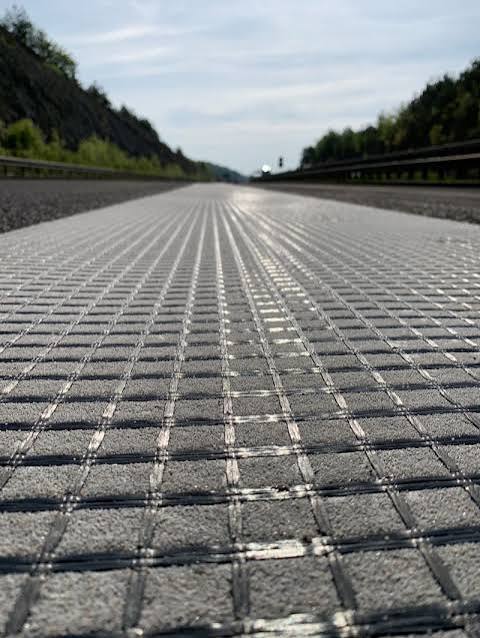
Stop reflective cracks from destroying your new overlay. A fibreglass grid bonded to a nonwoven carrier, laid between old and new asphalt to arrest crack propagation and shield the layerworks from water. Available in 50 and 100 kN/m, bitumen-coated for immediate bond. Supplied and installed across South Africa.
Technical Specification of Asphalt Interlayer Composite
An asphalt interlayer composite is a high-modulus fibreglass grid bonded to a lightweight nonwoven carrier and coated with bitumen. It is laid onto the tack coat between the existing pavement and a new asphalt overlay. The glass strands hold the crack below in tension and spread the stress sideways instead of letting it travel straight up into the new surface.
Reflective cracking is what destroys most overlays. A crack in the old pavement concentrates stress at its tip, and traffic loading and daily temperature swings drive that crack upward until it appears in the new surface, often within a few seasons. An interlayer breaks that path, extending the life of the overlay and pushing the next rehabilitation years further out.
The composite is supplied in 50 and 100 kN/m grid strengths at low strain, so it works at the small movements that actually occur in a pavement rather than needing to stretch before it engages. The bitumen coating gives immediate bond to the tack coat, and the nonwoven carrier holds the grid flat during laying and gives it dimensional stability under the paver. An open grid aperture allows the asphalt layers to interlock through the reinforcement, so the bond between lifts is preserved.
Used in asphalt overlays, road rehabilitation, highway resurfacing, airport pavements and industrial hardstandings. Installed directly onto milled or existing surfaces after crack sealing and patching, with rolls overlapped and rolled before the overlay is placed. Correct tack coat rate and roll orientation matter - we supply an installation method statement and site support with every order.
Typical Values for GEOGRIDS INTERLAYERS
Properties & Dimensions
| Property | Test Method | AICB50 | AIC B100 | AIC U200 |
|---|---|---|---|---|
| Tensile strength ultimate MD × CD | ASTM D6637 / EN ISO 10319 | 55 × 55 kN/m | 115 × 115 kN/m | 115 × 215 kN/m |
| Tensile resistance @ 2% strain | ASTM D6637 / EN ISO 10319 | 46 × 46 kN/m | 95 × 95 kN/m | 95 × 180 kN/m |
| Tensile elongation ultimate | ASTM D6637 / EN ISO 10319 | 2.0 ± 1 % | 2.0 ± 1 % | 2.0 ± 1 % |
| Secant stiffness EA @ 1% strain | ASTM D6637 / EN ISO 10319 | 2200 × 2200 N/mm | 4600 × 4600 N/mm | 4600 × 8600 N/mm |
| Young's modulus | - | 81 GPa | 81 GPa | 81 GPa |
| Mass per unit area | ASTM D5261 / ISO 9864 | ≥ 240 g/m² | ≥ 450 g/m² | ≥ 660 g/m² |
| Asphalt retention | ASTM D6140 / EN 15381 | 0.35 ℓ/m² | 0.35 ℓ/m² | 0.35 ℓ/m² |
| Melting point of glass | ASTM C338 | ≥ 820 °C | ≥ 820 °C | ≥ 820 °C |
| Melting point of coating | ASTM D276 / EN ISO 3146 | ≥ 232 °C | ≥ 232 °C | ≥ 232 °C |
| Grid aperture | - | 25 × 25 mm | 12.5 × 12.5 or 25 × 25 mm | 12.5 × 12.5 or 25 × 19 mm |
| Nonwoven backing | - | 40 g/m² PP | 40 g/m² PP | 40 g/m² PP |
| Roll width × length | - | 1.5 m × 150 m | 1.5 m × 150 m | 1.5 m × 150 m |
| Roll area | - | 225 m² | 225 m² | 225 m² |
Popular Catalogue Items
Related Product Groups
Three Questions To Ask Before You Order
1.What tack coat rate does an asphalt interlayer composite need?
2.Which grade should I specify?
3.Does the composite weaken the bond between asphalt layers?
4.How do I know it's properly bonded before paving?
5.Can it withstand hot mix asphalt temperatures?
6.Is this a waterproofing layer?
7.What surface preparation is required?
8.What roll sizes are available and how much overlap is needed?
Specification For The Design, Installation Of Asphalt Interlayer Composite
Storage and surface preparation - Store and transport rolls flat and dry between −30°C and 80°C at no more than 85% relative humidity, covered and away from mud, wet concrete or asphalt. Before laying, the pavement must be clean, dry and free of dust, debris and organic matter - wire brush and tractor-mounted air compressor. Seal cracks wider than 6 mm with an approved sealant or a levelling course mix. Potholes, surface failures and heavily cracked sections must be repaired as directed by the supervising engineer. Surface temperature must be between 5°C and 60°C; do not proceed outside that range.
Tack coat - Apply 0.6–1.0 kg/m² of residual bitumen, using hot-applied bitumen or bitumen emulsion as the project requires, adjusted for surface roughness, temperature and base layer absorption. Distribute evenly, avoiding overspray and missed areas, and extend the coating 75 mm beyond every edge of the composite. With emulsion in warm conditions, placement may begin almost immediately; in cooler conditions wait until the emulsion fully breaks from brown to black. With hot bitumen, place the composite immediately for best saturation. Do not apply tack coat or install during rainfall or when rain is expected.
Placement - Lay the composite with the nonwoven face in direct contact with the tacked surface, running in the direction of paving. Mechanical laying with a purpose-built laydown frame or a vehicle-mounted roller system is preferred, keeping continuous tension on the roll to avoid wrinkles. For manual laying, unroll onto the tacked surface and press the grid down firmly with a stiff broom or wire brush to achieve full contact. On constrained or curved sections use shorter lengths to reduce misalignment.
Joints and wrinkles - Transverse joints overlap 75–150 mm with the top layer aligned in the direction of the paver's travel so it cannot lift. Longitudinal joints overlap 25–50 mm. Leave a 50–100 mm gap from pavement edges to prevent capillary water ingress. Apply additional tack coat over every overlap. Where wrinkles or wrap-ins occur, cut along the centre of the wrinkle, lay each side flat and secure with extra tack coat or mechanical fastening. If nailing is required, use washers larger than the grid aperture.
Rolling and adhesion check - Allow 20–30 minutes after placement, then roll with a pneumatic tyred roller to remove wrinkles and improve bond, applying vegetable oil to the tyres to prevent lifting. Where traffic over the exposed composite is unavoidable, restrict to 5–10 km/h with no sharp turns, sudden braking or stationary wheel turning. Before paving, verify adhesion: hook a calibrated spring balance into the centre of the laid composite and pull vertically until four to five apertures lift on all sides. Proceed at 9 kg or above; below that, stop and investigate - poor adhesion is usually surface contamination from water or debris.
Paving - Paving may begin only once the tack coat is fully cured and the composite is firmly adhered with minimal lifting or displacement. Protect the laid composite from asphalt delivery trucks with a light cover of 8–12 mm stone chips or a thin asphalt layer over the grid. Feed mix beneath the paver with a shovel rather than allowing it to push the composite. Do not use plant with worn or damaged tyres. Any displacement or damage before or during paving must be repaired or replaced immediately before the overlay continues.
Featured Projects Across Africa
Related Resources
Common ASPHALT INTERLAYER COMPOSITE Applications
Request a Quote for This Product Family
Upload your BOQ, drawings, or specifications and our technical team will provide a detailed proposal.
Have a project? Start with us.
Get expert engineering support, reliable material supply, and best-in-class installation.