
Biaxial Geogrids – Two-Direction Soil Reinforcement for Roads, Platforms & Foundations
Biaxial geogrids reinforce and stabilise soil in two directions beneath roads, working platforms and foundations. Choose from Tensar® SS (extruded polypropylene, 20–40 kN/m), MIRAGRID® GX Biaxial (knitted polyester, 20–80 kN/m) and TechGrid TGB (knitted polyester, 20–200 kN/m), supplied with engineering support across Africa.
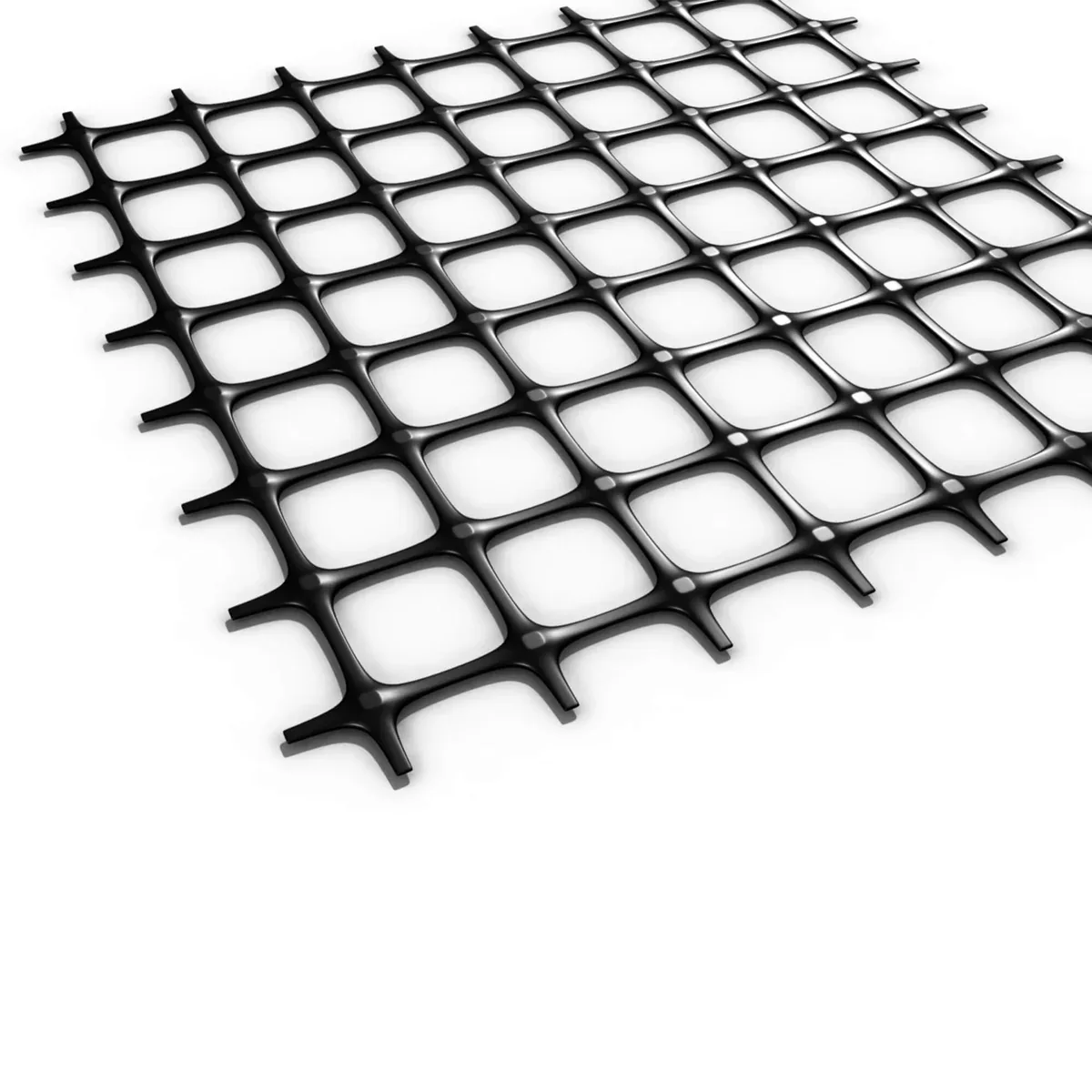
Technical Specification of Biaxial Geogrids – Two-Direction Soil Reinforcement for Roads, Platforms & Foundations
Biaxial geogrids provide tensile strength in both the machine and cross-machine directions, making them suited to applications where loads spread in several directions: stabilising granular layers beneath roads and pavements, building working platforms over weak subgrades, and reinforcing foundations.
Tensar® SS and TGSG geogrids are stiff, monolithic polypropylene grids with integral junctions, punched and drawn in two directions to give ribs with rectangular cross-sections and square edges that interlock efficiently with aggregate. Grades SS20–SS40 and TGSG2020–TGSG4040 offer minimum strengths of 20–40 kN/m in both directions, supplied in 3.8 m and 4.0 m wide rolls.
MIRAGRID® GX Biaxial geogrids are knitted in a flat orientation from high-modulus polyester fibres and protected by a polymeric coating. Designed for subgrade stabilisation and base reinforcement, grades from GX 20/20 to GX 80/80 offer equal strength in both directions, supplied in 5.2 m × 100 m rolls.
TechGrid TGB geogrids are made from high-tenacity, high-molecular-weight polyester yarns, formed into a stable grid with uniform apertures by weft-insertion warp knitting and finished with a durable polymeric coating. Grades from TGB-20 to TGB-200 cover unbound road bases, area stabilisation and track-bed reinforcement, supplied in 3.9 m or 5.1 m × 100 m rolls.
Stiff polypropylene grids interlock strongly with granular fill and are efficient for stabilising aggregate layers under traffic. Knitted polyester grids reach higher strengths with low creep, suiting heavier reinforcement such as platforms and embankments over soft ground. For heavily trafficked stabilisation, also consider Tensar® TriAx® and InterAx® geogrids. Our engineers can help select the right product and grade.
Typical Values for GEOGRIDS INTERLAYERS
Properties & Dimensions
| Property | Tensar® SS & TGSG | MIRAGRID® GX Biaxial | TechGrid TGB |
|---|---|---|---|
| Polymer | PP | PET | PET |
| Structure | Punched & drawn | Knitted, coated | Knitted, coated |
| Grades | SS20–SS40 · TGSG2020–4040 | GX 20/20 – 80/80 | TGB-20 – TGB-200 |
| Strength, MD & CD (min) | 20–40 kN/m | 20–80 kN/m | 20–200 kN/m |
| Strength at 2% strain (MD) | 7–14 kN/m | 4–15 kN/m | 4–30 kN/m |
| Strength at 5% strain (MD) | 14–28 kN/m | 7–27 kN/m | 7–55 kN/m |
| Aperture | 33–41 mm | 25 mm | 23–27 mm |
| Roll width | 3.8 / 4.0 m | 5.2 m | 5.1 |
| Roll length | 30–75 m | 100 m | 100 m |
| Applications | Road bases, platforms | Subgrade, road bases | Road bases, track-beds |
Popular Catalogue Items
Tensar® Biaxial (SS/TGSG) Geogrids
Tensar® Biaxial (SS/TGSG) Geogrid: the original ground stabilisation geogrid, with over 500 million m² installed worldwide. Punched and drawn polypropylene with integral junctions that confine aggregate and stabilise weak subgrades under roads, working platforms and hardstands. Supplied across Africa by Geosynthetics Africa, an official Tensar Associate.Related Product Groups
Three Questions To Ask Before You Order
1.What is the difference between a biaxial and a uniaxial geogrid?
2.Should I choose a polypropylene or a polyester biaxial geogrid?
3.How do biaxial geogrids compare with Tensar® TriAx® and InterAx®?
4.Where should the geogrid be placed in a pavement or platform?
5.What design life can I expect?
6.Can one brand be substituted for another?
7.Can biaxial geogrids be used for retaining walls or slopes?
Specification For The Design, Installation Of Biaxial Geogrids – Two-Direction Soil Reinforcement for Roads, Platforms & Foundations
Clear the subgrade of vegetation and sharp objects and grade it to the required level. On very soft or wet ground, place a separator geotextile first if the design requires one. Unroll the geogrid flat and taut, in the direction shown on the drawings.
Overlap adjacent rolls by 300 mm to 1 m, depending on subgrade strength and the manufacturer's guideline, with larger overlaps on weaker ground. Pin or weight the geogrid where needed to keep it flat while the fill is placed.
Keep tracked plant off the exposed geogrid. Place aggregate from the leading edge of previously placed fill and spread it forward, keeping at least 150 mm of cover before trafficking, then compact to the specified density. Always follow the manufacturer's installation guideline and the project specification. Our team provides on-site technical support on every project.
Featured Projects Across Africa
Related Resources
Common BIAXIAL GEOGRIDS Applications
Request a Quote for This Product Family
Upload your BOQ, drawings, or specifications and our technical team will provide a detailed proposal.
Have a project? Start with us.
Get expert engineering support, reliable material supply, and best-in-class installation.