
Composite Geogrids – Reinforcement Geocomposites for Basal Reinforcement & Load Platforms
Reinforcement geocomposites combine high-strength polyester with a nonwoven geotextile, providing reinforcement, separation and filtration in a single layer. Choose MIRAGRID® PEC (40–230 kN/m, biaxial and uniaxial) or TechGrid TGC-B (55/55–210/210 kN/m) for embankments over soft soil, piled embankments, load platforms and voids, supplied with engineering support across Africa.
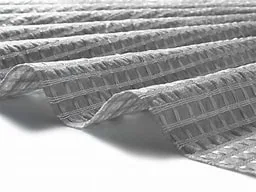
Technical Specification of Composite Geogrids – Reinforcement Geocomposites for Basal Reinforcement & Load Platforms
Composite geogrids, or reinforcement geocomposites, combine high-strength polyester reinforcement with a nonwoven geotextile backing. One layer provides reinforcement, separation and filtration, removing the need for a separate separator beneath the reinforcement. This reduces installation steps, simplifies handling on site and lowers the risk of layers shifting over soft or variable subgrades.
Composites are particularly suited to fine-grained and cohesive fills, where the continuous nonwoven surface develops better soil friction than an open-aperture geogrid, and to wet subgrades, where the geotextile allows water to drain while keeping fines out of the fill. Over coarse granular fill, an open geogrid is often the more efficient choice.
MIRAGRID® PEC geocomposites, formerly known as Rock PEC, combine high-modulus polyester fibres with a continuous filament nonwoven backing. Biaxial grades from PEC 40/40 to PEC 95/95 provide equal strength in both directions, while uniaxial grades from PEC 40 to PEC 230 deliver high strength in the machine direction for heavily loaded embankments. All grades are supplied in 5.3 m × 100 m rolls.
TechGrid TGC-B geocomposites combine knitted high-tenacity polyester yarns, which provide low-creep reinforcement, with a polypropylene needle-punched nonwoven for separation and drainage. Three biaxial grades, TGC-B 55/55, 105/105 and 210/210, cover a range of 55 to 210 kN/m in both directions and are supplied in 5 m × 100 m rolls.
Uniaxial grades suit basal reinforcement where the main load acts across the embankment. Biaxial grades suit load platforms, piled embankments and reinforcement over voids, where loads act in both directions. Grade selection is based on the long-term design strength and stiffness the design requires. Our engineers can match the right product and grade to your project, and full design data is provided in each product datasheet.
MIRAGRID® is a registered trademark of Solmax, the world's largest geosynthetics company. Geosynthetics Africa is authorised by Solmax to supply MIRAGRID® products across Africa.
Typical Values for GEOGRIDS INTERLAYERS
Properties & Dimensions
| Property | MIRAGRID® PEC Uniaxial | MIRAGRID® PEC Biaxial | TechGrid TGC-B Biaxial |
|---|---|---|---|
| Construction | PET- nonwoven | PET- nonwoven | Knitted PET + PP nonwoven |
| Grades | PEC 40 – PEC 230 | PEC 40/40 – 95/95 | TGC-B 55/55 – 210/210 |
| Tensile strength, MD (min) | 40 - 230 kN/m | 40 - 95 kN/m | 55 - 210 kN/m |
| Tensile strength, CMD (min) | 10.9–11.4 kN/m | 40–95 kN/m | 55–210 kN/m |
| Elongation at maximum strength | 11% | 10.5–11% | 10% (±2%) |
| Opening size (O90 / AOS) | 95–120 µm | 95–120 µm | 150 µm |
| Roll size (W × L) | 5.3 × 100 m | 5.3 × 100 m | 5.0 × 100 m |
| Primary applications | Soft-soil embankments, slopes | Soft-soil embankments, slopes | Platforms, soft ground |
Popular Catalogue Items
MIRAGRID® PEC Biaxial Reinforcement Geocomposite
MIRAGRID® PEC biaxial geocomposite from Solmax: high modulus polyester fibres on a continuous filament nonwoven geotextile backing, for subgrade stabilisation and base reinforcement. Full range from PEC 40/40 to PEC 95/95 (42 to 100 kN/m) in 5.3 m × 100 m rolls, delivered across Africa.Related Product Groups
Three Questions To Ask Before You Order
1.What is a composite geogrid, and how does it differ from a standard geogrid?
2.When should I use a composite instead of an open geogrid?
3.Should I use a uniaxial or biaxial composite?
4.How do I choose the right grade?
5.Can one composite product be substituted for another?
6.How is fill placed over a composite geogrid?
7.Can composite geogrids be used over dolomite or old mine workings?
Specification For The Design, Installation Of Composite Geogrids – Reinforcement Geocomposites for Basal Reinforcement & Load Platforms
Clear the subgrade of trees, roots and sharp objects, and level it as far as ground conditions allow. Unroll the geocomposite with the nonwoven side facing down, flat and free of folds, with its main strength direction across the embankment unless the design specifies otherwise.
Overlap adjacent rolls by at least 300 mm, and more on very soft ground, or sew the seams where the design requires. Never overlap in the direction of principal load unless the design specifies it. Cover the material promptly to limit UV exposure.
Keep vehicles off the exposed geocomposite. Back-tip fill from previously placed material and spread it forward with tracked plant, keeping the first layer thick enough to protect the reinforcement before compaction. Always follow the manufacturer's installation guideline and the project specification. Our team provides on-site technical support on every project.
Featured Projects Across Africa
Related Resources
Common COMPOSITE GEOGRIDS Applications
Request a Quote for This Product Family
Upload your BOQ, drawings, or specifications and our technical team will provide a detailed proposal.
Have a project? Start with us.
Get expert engineering support, reliable material supply, and best-in-class installation.