
Multi-Axial Geogrids – Tensar InterAx® NX, the Most Advanced Stabilisation Geogrid
Tensar InterAx® NX geogrids are the highest-performing stabilisation geogrids Tensar has developed. Manufactured from a coextruded composite polymer sheet with three unique aperture geometries - hexagonal, trapezoidal and triangular - InterAx delivers superior aggregate confinement, near-uniform radial stiffness and improved MSL performance across roads, rail, working platforms and trafficked areas. BBA Agrément certified. ISO 9001 · ISO 14001 manufactured. Available in NX750, NX850 and further grades across Africa.
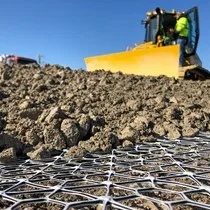
Technical Specification of Multi-Axial Geogrids – Tensar InterAx® NX, the Most Advanced Stabilisation Geogrid
Tensar InterAx® geogrid is the latest and most advanced geosynthetic stabilisation product Tensar has developed. It is the product of 12 global development teams and over 10,000 hours of research and development, combining innovations in material science and geometry optimisation to deliver the most efficient mechanically stabilised layer (MSL) available.
Unlike previous generations of stabilisation geogrids - including TriAx - InterAx is manufactured from a coextruded composite polymer sheet which is then punched and oriented. This unique manufacturing process creates a multi-layer product that accommodates aggregate nesting: the outer layers conform to the shape of aggregate particles and hold them in place under compaction and repeated loading. The result is improved interlock, reduced particle movement and a stiffer, longer-lasting stabilised layer.
The geometry of InterAx is the key to its performance. Three unique aperture shapes - hexagonal, trapezoidal and triangular - are formed across continuous and non-continuous ribs. The open, floating hexagon allows for greater compliance and improved aggregate confinement. The increased number of bearing surfaces resists radial displacement of aggregate under load. The continuous parallel rib pitch of 80 mm and rib aspect ratio of greater than 1.0 provide effective lateral restraint across a wider range of aggregate qualities and gradations than previous geogrid generations.
Tensar InterAx geogrids carry BBA Agrément Certificate 23/7063, independently confirming fitness for purpose to stabilise and increase the modulus of a granular layer and its associated trafficking performance and load bearing capacity. Manufactured under BS EN ISO 9001:2015 and BS EN ISO 14001:2015.
Typical Values for GEOGRIDS INTERLAYERS
Properties & Dimensions
| Property | Test Method | NX750 | NX850 |
|---|---|---|---|
| Radial Secant Stiffness @ 2% strain | EOTA TR041 | 190 kN/m | 270 kN/m |
| Radial Secant Stiffness Ratio | EOTA TR041 | 0.60 | 0.60 |
| Junction Efficiency | EOTA TR041 | 100% (±10%) | 100% (±10%) |
| Node Thickness | - | 3.5 mm | 4.5 mm |
| Roll Dimensions | - | 3.8 m × 50 m | 3.8 m × 50 m |
| Design Life | BBA 23/7063 | 120 years | 120 years |
Popular Catalogue Items
Related Product Groups
Three Questions To Ask Before You Order
1.What is the difference between Tensar InterAx and Tensar TriAx?
2.What does Radial Secant Stiffness mean and why does it matter?
3.What is the difference between NX750 and NX850?
4.What other InterAx grades are available beyond NX750 and NX850?
5.Can InterAx be used on African road and rail projects?
6.How does InterAx save cost and carbon compared to conventional construction?
Specification For The Design, Installation Of Multi-Axial Geogrids – Tensar InterAx® NX, the Most Advanced Stabilisation Geogrid
TriAx installation is straightforward - unroll, align, tension and cover. The key requirement is a minimum 150 mm aggregate cover before any plant travels over the geogrid.
Prepare and proof-roll the subgrade to the specified formation level
Unroll TriAx geogrid with the correct side facing up - confirm orientation per design drawings
Pull taut by hand to remove wrinkles and lay flat - no mechanical tensioning required
Adjacent rolls are butt-jointed - no overlap required for stabilisation applications
Place aggregate immediately - do not leave geogrid exposed for more than 30 days
Maintain minimum 150 mm aggregate cover before trafficking with construction plant
Compact in accordance with contract specification
Featured Projects Across Africa
Related Resources
Common MULTI AXIAL GEOGRIDS Applications
Request a Quote for This Product Family
Upload your BOQ, drawings, or specifications and our technical team will provide a detailed proposal.
Have a project? Start with us.
Get expert engineering support, reliable material supply, and best-in-class installation.