
Uniaxial Geogrids – High-Strength Soil Reinforcement for Walls & Slopes
Proven soil reinforcement for retaining walls, steep slopes, bridge abutments and MSE structures. Choose from four ranges in two polymers: extruded HDPE (Tensar® RE and Tensar® UX) or knitted polyester (MIRAGRID® GX and TechGrid TGU), all supplied with engineering support across Africa.
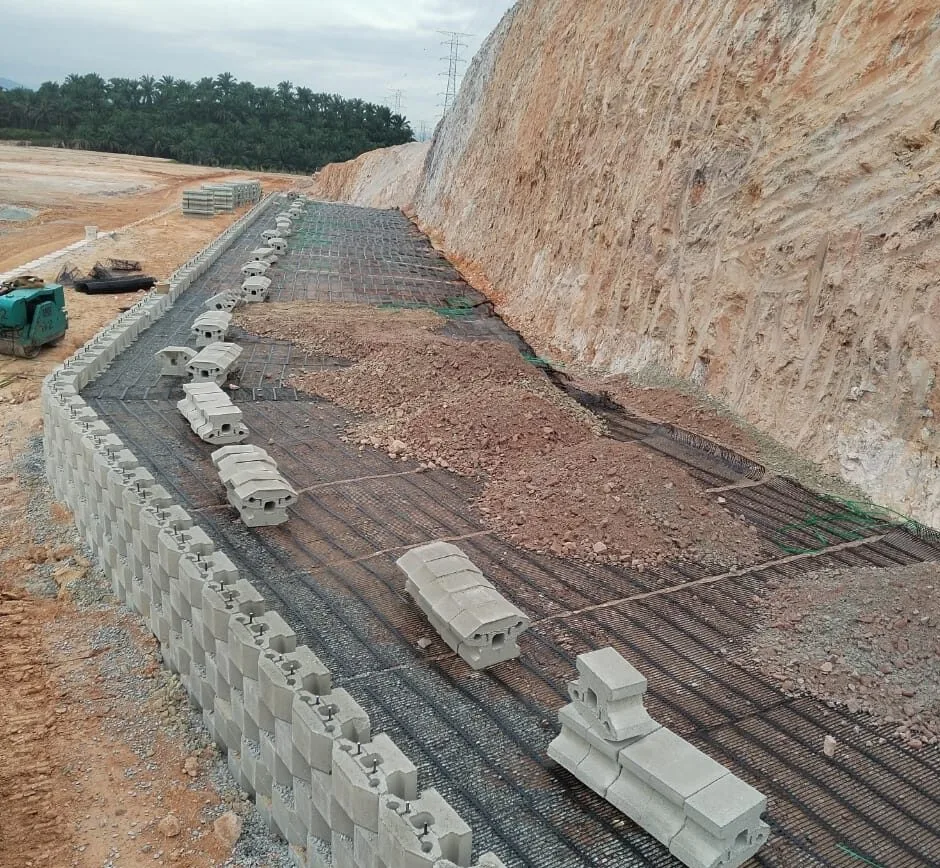
Technical Specification of Uniaxial Geogrids – High-Strength Soil Reinforcement for Walls & Slopes
Uniaxial geogrids carry tensile load in one principal direction, making them the standard reinforcement for retaining walls, reinforced slopes, bridge abutments and embankments. Fill material interlocks with the open apertures, transferring load from the soil into the geogrid.
Tensar® RE and Tensar® UX geogrids are made by extruding, punching and drawing a single homogeneous HDPE sheet, so the product needs no weaving, coating or welding to hold together. This process forms integral junctions with high strength, allowing reliable connections between geogrid rolls and to facing units such as modular blocks and concrete panels.
MIRAGRID® GX geogrids are knitted from high-tenacity polyester yarns and protected by a black polymeric coating. They combine high tensile strength with low creep, and their wide rolls cover large walls, slopes and embankments with fewer overlaps.
TechGrid TGU geogrids, manufactured by TechFab, are formed from high-tenacity polyester yarns into a dimensionally stable grid with uniform apertures using weft-insertion warp knitting, then finished with a durable polymeric coating that resists installation damage. Available in grades from 40 to 600 kN/m and supplied in 5.1 m × 100 m rolls, the range is designed for a 120-year service life.
Choosing between HDPE and polyester depends on the structure and the fill. HDPE grids are typically preferred where connection strength to the facing is critical, and where fills fall outside the pH 5–9 range, such as lime- or cement-treated soils. Knitted polyester grids offer low creep and wide rolls that speed up placement on large walls and slopes. Our engineers can help you select the right range and grade for your design. For high-strength applications such as basal reinforcement of embankments over soft soils, TechGrid TGU is available up to 600 kN/m.
Typical Values for GEOGRIDS INTERLAYERS
Properties & Dimensions
| Property | Tensar RE | Tensar UX | Miragrid GX | TechGrid TGU |
|---|---|---|---|---|
| Polymer | HDPE | HDPE | PET | PET |
| Structure | Punched & drawn | Punched & drawn | Knitted, coated | Knitted, coated |
| Grades | RE510–RE580 | UX1100–UX1800 | GX 35/20–GX 200/30 | TGU 40/20–TGU 600/30 |
| Ultimate tensile strength (MD) | 42–137 kN/m | 58–210 kN/m | 35–200 kN/m | 40–600 kN/m |
| Aperture | Elongated | Elongated | 25 × 25 mm | 30 × 15 to 30 × 25 mm |
| Roll width | 1.3 m | 1.33 m | 5.2 m | 5.1 m |
| Roll length | 50–75 m | 61–76 m | 100 m | 100 m |
| Design life | 120 years | 120 years | 120 years | 120 years |
| Primary applications | Walls, abutments | Walls, slopes | Walls, slopes | Walls, slopes, basal |
Popular Catalogue Items
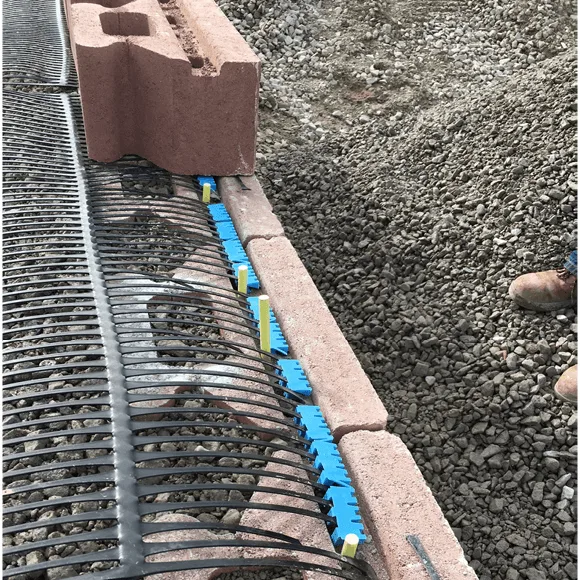

MIRAGRID® GX – Uniaxial PET Reinforcement Geogrid
MIRAGRID® GX uniaxial geogrid from Solmax: knitted high tenacity polyester yarns with a black polymeric coating, giving high tensile strength with low creep for reinforced soil walls, steep slopes and embankments. Full range from GX 35/20 to GX 200/30, with GX 80/30 held in depth as the most specified grade in South Africa.Related Product Groups
Three Questions To Ask Before You Order
1.What is a uniaxial geogrid and when should I specify one?
2.What is the difference between HDPE and polyester (PET) uniaxial geogrids?
3.How do I choose the right grade?
4.Can one brand be substituted for another?
5.Can uniaxial geogrids be used with any facing system?
6.What fill can be used with uniaxial geogrids?
7.How are uniaxial geogrids installed?
8.What is the difference between uniaxial, biaxial and stabilisation geogrids?
Specification For The Design, Installation Of Uniaxial Geogrids – High-Strength Soil Reinforcement for Walls & Slopes
Prepare a level, compacted foundation and remove any soft spots. Lay the geogrid with its strength direction (the roll length) perpendicular to the wall or slope face, in one continuous length with no joints in that direction.
Pull each layer taut to remove slack, then spread and compact fill in layers to the specified thickness. Keep tracked plant off exposed geogrid and maintain at least 150 mm of cover before trafficking.
Connection details, overlaps and fill requirements vary by product and facing system, so always follow the manufacturer's installation guideline and the project specification. Our team provides on-site technical support and IAGI-aligned installation across every range we supply.
Featured Projects Across Africa
Related Resources
Common UNIAXIAL GEOGRIDS Applications
Request a Quote for This Product Family
Upload your BOQ, drawings, or specifications and our technical team will provide a detailed proposal.
Have a project? Start with us.
Get expert engineering support, reliable material supply, and best-in-class installation.