
rLLDPE Floating Cover Liners - FC45 & FC60 | Africa's Floating Cover Specialist
Scrim-reinforced LLDPE floating cover geomembranes for TSF water recovery ponds, potable water reservoirs, effluent dams and biogas digesters - available in FC45 (1.14mm, 20-year) and FC60 (1.52mm, 30-year) grades, each in standard Black/Black or Black/Tan. NSF/ANSI 61 certified. Supplied and installed across Africa by Geosynthetics Africa - one of only 5 IAGI Installer Members on the continent
Technical Specification of rLLDPE Floating Cover Liners - FC45 & FC60 | Africa's Floating Cover Specialist
A floating cover geomembrane is not a liner - it is a membrane that must span large, unsupported liquid surfaces under continuous biaxial stress, wind uplift, rainfall ponding and UV exposure, while rising and falling with the liquid level beneath it. Standard HDPE and unreinforced LLDPE liners are not designed for this duty - they are rigid or insufficiently reinforced for the repeated flexing and spanning loads of floating cover service. Scrim-reinforced LLDPE - a 9×9 weft-inserted polyester scrim fully encapsulated between two layers of UV-stabilised LLDPE - is specified for floating covers because it is engineered for exactly these conditions.
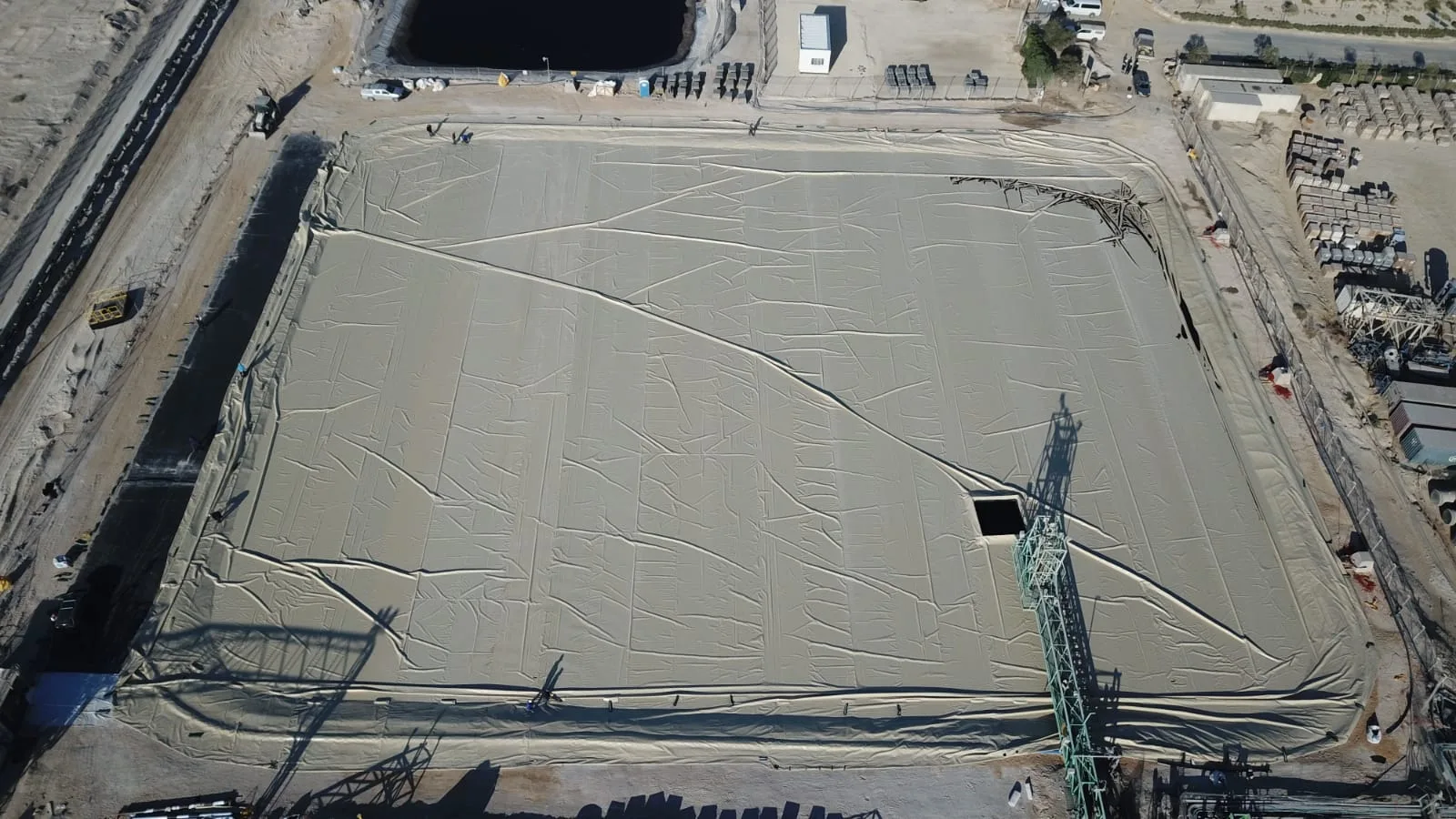
Floating covers are deployed across Africa's most demanding containment applications: TSF water recovery pond covers that contain tailings liquor and prevent evaporation losses; potable water reservoir covers that protect drinking water from algae growth, UV degradation and contamination; effluent pond covers on wastewater treatment facilities; biogas digester covers that capture methane for energy recovery; and evaporation suppression covers on process water dams in arid mining regions. Each application demands a membrane with long-term outdoor durability, biaxial strength and - for potable water - NSF/ANSI 61 certification.
Geosynthetics Africa supplies scrim-reinforced LLDPE floating cover geomembranes in two grades under our FC product range: FC45 (1.14mm, 20-year outdoor service life) and FC60 (1.52mm, 30-year outdoor service life). Both grades are available in black and tan, NSF/ANSI 61 certified for potable water contact, and designed for direct compatibility with standard LLDPE extrusion welding equipment. Floating cover installation is a specialist scope - panel layout must account for liquid level variation, wind uplift forces, rainwater drainage, access hatch positions and anchor system design before a seam is made. Geosynthetics Africa has installed floating cover systems across Southern and West Africa, and executes every floating cover scope under our IAGI-aligned QA/QC system: full panel layout design, certified installation, seam testing and a signed QA dossier on completion.
Typical Values for GEOMEMBRANE LINERS
Properties & Dimensions
| Property | Test Method | FC45 | FC60 |
|---|---|---|---|
| Thickness (typical) | ASTM D5199 | 1.14 mm | 1.52 mm |
| Weight | ASTM D751 | 1,040 g/m² | 1,069 g/m² |
| Tongue tear strength | ASTM D5884 | 601 N | 600 N |
| Grab tensile at break | ASTM D7004 | 1,557 N | 1,602 N |
| Puncture resistance | ASTM D4833 | 556 N | 600 N |
| Outdoor service life | - | 20 years | 30 years |
| Potable water | NSF/ANSI 61 | Certified | Certified |
| Standard | GRI GM25 | GM25 | GM25 Cat. 1 |
| Colours | - | Black, Tan | Black, Tan |
Popular Catalogue Items
rLLDPE Exposed Membrane - Floating Covers & Exposed Lining
FC45 (1.14 mm) and FC60 (1.52 mm), Black /Tan , NSF/ANSI 61 certifiedRelated Product Groups
Three Questions To Ask Before You Order
1.Can I use standard HDPE or LLDPE liner as a floating cover?
2.Which grade should I specify - FC45 or FC60?
3.What is the difference between Black/Black and Black/Tan?
4.Is the FC range certified for potable water contact?
5.Do you supply only, or do you also design and install the floating cover system?
Specification For The Design, Installation Of rLLDPE Floating Cover Liners - FC45 & FC60 | Africa's Floating Cover Specialist
Floating cover installation begins with design. Before any material is cut or seamed, Geosynthetics Africa produces a detailed cover layout drawing accounting for pond geometry, operating liquid level range, maximum and minimum freeboard, wind uplift loads, rainwater drainage design, access hatch positions, and anchor perimeter detail. The installation method - dry or wet - is determined at design stage based on the structure type and liquid level conditions at time of installation.
Two installation methods are used depending on site conditions. Dry installation is carried out in an empty or dewatered structure - the cover is fabricated and laid directly over the base, with foam floats and ballast tubes positioned per the layout drawing. As the structure is filled, the cover rises with the liquid level, taking up its designed floating geometry. Wet installation is used where the structure is in service or cannot be emptied - the cover is fabricated adjacent to the structure and progressively pulled across the liquid surface as additional panels are seamed. Both methods are executed by Geosynthetics Africa using the same QA/QC standards and deliver the same outcome: a fully floating, anchored and tested cover system
Cover deployment is carried out with the pond at or near operating liquid level to allow the cover to float into position under controlled conditions. Panels are deployed sequentially from one end of the pond, weighted temporarily to prevent wind uplift, and progressively seamed as deployment proceeds. The cover perimeter is anchored to the pond wall or anchor trench using the specified detail - ballast tubes, concrete anchor beams or perimeter batten systems depending on the All field seams are made using extrusion or hot-air welding with compatible LLDPE welding rod. Trial welds are produced and tested before production seaming begins. Completed seams are non-destructively tested - vacuum-box (ASTM D5641) or air-channel pressure test - and destructive peel/shear samples taken per the project QA plan to ASTM D6392. The completed cover system includes closed-cell foam floats for buoyancy, sand tube ballast lines to control drainage geometry, rainwater sump and pump or gravity drainage, and access hatches at specified locations. All penetrations, vents and anchor details are installed and sealed as part of the Geosynthetics Africa scope.
On completion, Geosynthetics Africa delivers a full QA dossier: seam log, NDT test results, destructive test records, panel as-built drawing, penetration and anchor detail records, rainwater system commissioning record, and a signed handover certificate. A cover maintenance guide covering inspection frequency, repair procedures and rainwater pump maintenance is included with every handover package.
Featured Projects Across Africa
Related Resources
Common FLOATING COVER GEOMEMBRANES Applications
Request a Quote for This Product Family
Upload your BOQ, drawings, or specifications and our technical team will provide a detailed proposal.
Have a project? Start with us.
Get expert engineering support, reliable material supply, and best-in-class installation.