
fPP Geomembrane Liners
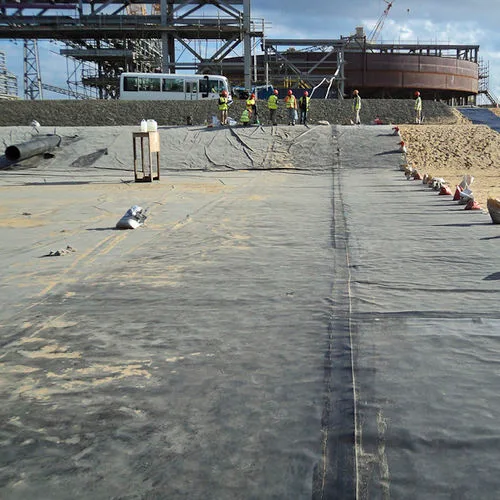
NON-REINFORCED · SETTLEMENT-TOLERANT CONTAINMENT - When the ground moves, the liner has to move with it. fPP stretches to 700% elongation against roughly 25% for a reinforced membrane, so capping systems and pond linings follow differential settlement instead of failing at it. 0.75 to 2.0 mm, supplied and installed by our own certified crews.
Technical Specification of fPP Geomembrane Liners
Flexible polypropylene (fPP) is a thermoplastic geomembrane produced from a resin formulation engineered for flexibility and elasticity rather than raw strength. Unlike scrim-reinforced products, fPP is homogeneous sheet with no internal reinforcement, so its performance comes entirely from the polymer itself. That construction is what allows elongation at break of 700% or more and multiaxial elongation of 120% - figures no reinforced membrane can approach, and the reason fPP is specified where a liner must stretch rather than resist.
The practical consequence is settlement tolerance. Where subgrade is irregular, poorly compacted, or expected to settle differentially over the life of the facility, a stiff liner concentrates stress at the points of deformation and eventually fails there. fPP deforms multiaxially to relieve that stress instead. This makes it the appropriate selection for capping and closure works, building foundation waterproofing, biogas and digester structures, and pond linings over ground that cannot be guaranteed stable.
Two installation characteristics matter on site. fPP has a low coefficient of thermal expansion relative to polyethylene, so it develops fewer wrinkles through the daily temperature swing - and wrinkles, not just seams, are a principal contributor to leakage in installed lining systems. It also welds over a wide temperature window, which means fewer suspended shifts and more consistent seam quality in variable field conditions. Both translate directly into installation programme and QA/QC outcomes rather than being laboratory properties alone.
The material is supplied in 0.75, 1.0, 1.5 and 2.0 mm nominal thicknesses with a ±10% tolerance, in rolls of approximately 7 m width, double-sided smooth. Density is 0.89 g/cm³, appreciably lighter than polyethylene, which reduces transport and handling weight for a given lined area. Carbon black content is 3.0% with dispersion in categories 1 and 2, providing the base protection against ultraviolet exposure. Special thicknesses are available on request.
Typical Values for GEOMEMBRANE LINERS
Properties & Dimensions
| Property | Test Method | fPP075 | fPP1000 | fPP1500 | fPP2000 |
|---|---|---|---|---|---|
| Thickness (mm) | DIN EN ISO 9863-1 | 0.75 | 1.0 | 1.5 | 2.0 |
| Density (g/cm³) | DIN EN ISO 1183-1/A | 0.89 | 0.89 | 0.89 | 0.89 |
| Stress at break (MPa) | DIN EN ISO 527-3 | 16 | 16 | 16 | 16 |
| Elongation at break (%) | DIN EN ISO 527-3 | 700 | 700 | 700 | 700 |
| Tear resistance (N) | DIN ISO 34-1/B | 45 | 60 | 90 | 120 |
| Puncture resistance (N) | DIN EN ISO 12236 | 750 | 1000 | 1500 | 2000 |
| Carbon black content (%) | ASTM D4218 | 3.0 | 3.0 | 3.0 | 3.0 |
| Carbon black dispersion | ASTM D5596 | Category 1/2 | Category 1/2 | Category 1/2 | Category 1/2 |
| Multiaxial elongation at break (%) | similar to ASTM D5617 | 120 | 120 | 120 | 120 |
| Low temperature brittleness (°C) | ASTM D2136 | −40 | −40 | −40 | −40 |
Popular Catalogue Items
Related Product Groups
Three Questions To Ask Before You Order
1.When should I use fPP instead of HDPE?
2.What is the difference between fPP and reinforced RFPP?
3.What is the expected service life?
4.Is fPP suitable for my chemistry?
5.Can it be installed on slopes?
6.What thicknesses and roll widths are available?
Specification For The Design, Installation Of fPP Geomembrane Liners
Installation is carried out to the project CQA plan and the manufacturer's installation guidance. A note on standards: GRI GM18, the specification for flexible polypropylene, was suspended in May 2004 and withdrawn in January 2007 over concerns that oxidative induction time could not reliably predict long-term durability in fPP, although it still appears on the Geosynthetic Institute's published index. Some manufacturers continue to state conformance to its physical property values. Where a project specification cites GM18, we will confirm in writing which edition is intended and what the material actually conforms to, rather than repeating a claim we cannot substantiate. Seam performance is evaluated under GRI GM19a and GM19b, which cover thermally bonded homogeneous and reinforced polyolefin geomembranes respectively - fPP is a polyolefin, so GM19a applies to this material.
Subgrade is proof-rolled and accepted in writing before deployment. It must be free of stones, roots, sharp protrusions, standing water and desiccation cracking beyond the limits in the project specification, and anchor trenches must be cut to profile and cleared of loose spoil. Non-reinforced sheet has no scrim to bridge a defect, so subgrade preparation carries more weight here than on a reinforced installation - the liner will conform to whatever is beneath it, including anything sharp.
Panels are deployed to the approved layout drawing with seams running up and down slopes rather than across them, and are temporarily ballasted against wind uplift from the moment of unrolling. Because fPP has a low coefficient of thermal expansion relative to polyethylene, it develops fewer wrinkles through the daily temperature cycle, but slack must still be managed deliberately: wrinkles combined with leaks are the dominant contributor to leakage in installed lining systems, so deployment aims to place the sheet flat rather than relying on the material's behaviour alone.
Field seaming is by hot wedge fusion for production seams and extrusion welding for details, patches and penetrations. fPP welds across a comparatively wide temperature window, which improves consistency in variable site conditions, but the permitted ambient range, preheat and machine parameters remain those set in the CQA plan and the manufacturer's guidance. Trial seams are produced on offcut material at the start of each shift, after any break exceeding the interval stated in the CQA plan, and following any change of operator, machine or ambient conditions, and each is tested before production welding resumes.
Destructive seam samples are taken at intervals selected under GRI GM14, Guide for Selecting Variable Intervals for Taking Geomembrane Destructive Seam Samples Using the Method of Attributes, or GRI GM20 where control charts are specified. Field integrity is evaluated in accordance with GRI GM29, Practice for Field Integrity Evaluation of Geomembrane Seams (and Sheet) Using Destructive and/or Nondestructive Testing. All production seams receive full-length non-destructive testing: dual-track seams with an air channel are pressure tested to ASTM D5820, and single-track seams, extrusion welds, patches and penetrations are vacuum box tested to ASTM D5641 or air lance tested to ASTM D4437 as appropriate to the detail.
Where the specification requires leak location, method selection follows ASTM D6747, Standard Guide for Electrical Leak Location of Leaks in Geomembranes. Exposed-liner surveys are carried out to ASTM D7002 water puddle, ASTM D7703 water lance, or ASTM D7953 arc testing. Surveys after cover placement follow ASTM D7007 or, preferably, ASTM D8265, which controls site conditions, instrumentation and procedure and requires a voltage map in the final report — the strongest quality-control document obtainable at the conclusion of construction, and reviewable by a third party. On completion the handover package comprises mill certificates traceable to the supplied rolls, the subgrade acceptance record, the as-built panel layout, all trial seam, destructive and non-destructive test results, welder and equipment calibration records, the repair register, and the final QA/QC sign-off certificate that starts the warranty period.
Featured Projects Across Africa
Related Resources
Common FPP GEOMEMBRANE LINERS Applications
Industries Served
Request a Quote for This Product Family
Upload your BOQ, drawings, or specifications and our technical team will provide a detailed proposal.
Have a project? Start with us.
Get expert engineering support, reliable material supply, and best-in-class installation.