
CSPE Geomembranes for Potable Water & Floating Covers
Scrim-reinforced CSPE (chlorosulfonated polyethylene) in 3-ply and 5-ply, NSF/ANSI 61 certified for drinking water and UV-stable for long-term exposed service. Supplied as factory-welded panels and installed by our own crews across Africa for reservoirs, floating covers and desalination cells.
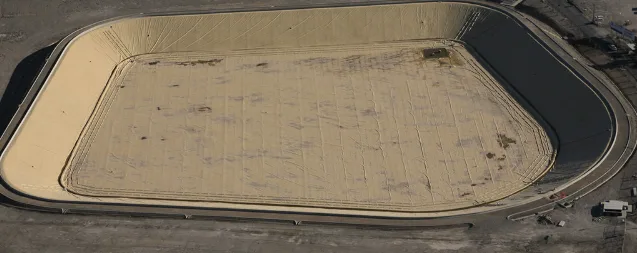
Technical Specification of CSPE Geomembranes for Potable Water & Floating Covers
CSPE geomembranes are made from chlorosulfonated polyethylene, a synthetic rubber known in older specifications by the trade name Hypalon. Unlike extruded polyethylene liners, CSPE sheet is produced by the calendering process: plies of compounded rubber are laminated over one or more polyester scrim layers, then cured. The result is a reinforced flexible membrane that stays dimensionally stable under load and retains its flexibility over a long exposed service life.
The reinforcement is what makes CSPE the default choice for floating covers and exposed reservoir work. A 10x10, 1000 denier polyester scrim carries the tensile load, so the membrane resists wind uplift, level fluctuation and the cyclic movement that would fatigue an unreinforced sheet. Because the scrim controls dimensional change, large factory-welded panels can be prefabricated to shape and deployed with far fewer field seams than a roll-goods liner requires.
We supply the material in two constructions. The 3-ply grade uses a single reinforcing scrim and offers higher elongation, making it the better choice where the liner must conform to irregular subgrade or accommodate movement. The 5-ply grade carries two reinforcing plies and delivers substantially higher strength - roughly a third more breaking strength, over 50% more tear propagation resistance and 60% more puncture resistance - at the cost of elongation. Selecting between them is a design decision, not a budget one, and our technical team will work through it with the design engineer before quoting.
Both constructions are certified under NSF/ANSI Standard 61 for drinking water system components, which is the certification municipalities and water authorities specify for potable storage. The sheet carries a 30-year weathering warranty from the manufacturer for approved CSPE applications. CSPE is also highly UV stabilised and resistant to ozone, tested under ASTM D1149 at 100 pphm for seven days at 40°C without effect, and remains serviceable at low temperature, passing ASTM D2136 mandrel testing at −40°C.
Material is available in black, tan and white, with custom colours to order. White and tan are frequently specified for potable reservoirs and floating covers where reducing heat gain in the stored water matters. Panels are fabricated in a controlled factory environment, accordion folded and rolled on heavy-duty cores so they can be deployed and positioned in a single operation on site. Every panel we install is field-seamed and tested by our own certified crews, with the full QA/QC record - subgrade acceptance, seam testing, as-built panel layout - issued as a single sign-off package on completion.
Typical Values for GEOMEMBRANE LINERS
Properties & Dimensions
| Property | Test Method | CSPE 60-3 (3-ply) | CSPE 60-5 (5-ply) |
|---|---|---|---|
| Thickness, overall | ASTM D751 | 1.47 mm | 1.52 mm |
| Thickness over scrim | ASTM D751 | 0.46 mm | 0.46 mm |
| Breaking strength, grab | ASTM D751 | 1334 N | 1779 N |
| Elongation at break | ASTM D751 | 75% | 30% |
| Tear propagation, tongue tear 8x8 | ASTM D751 | 355 N | 578 N |
| Hydrostatic resistance | ASTM D751 Method A, Proc. I | 2757 kPa | 4136 kPa |
| Puncture resistance | FTMS 101B Method 2031 | 1112 N | 1779 N |
| Bonded seam strength | ASTM D751 modified, 12 in/min | 1201 N | 1601 N |
| Ply adhesion | ASTM D413 Machine Method Type A | 44 N/25 mm | 44 N/25 mm |
| Ozone resistance | ASTM D1149, 100 pphm, 40°C, 7 days | No effect | No effect |
| Low temperature | ASTM D2136, 1/8" mandrel, 4 hr | Pass at −40°C | Pass at −40°C |
| Total plies | - | 3 (1 reinforcing) | 5 (2 reinforcing) |
| Scrim type | - | 10x10, 1000 denier PET | 10x10, 1000 denier PET |
Popular Catalogue Items
Related Product Groups
Three Questions To Ask Before You Order
1.Is CSPE the same as Hypalon?
2.What is the difference between the 3-ply and 5-ply grades?
3.Does the 30-year warranty cover the installation?
4.Can CSPE handle our process chemistry?
5.How does CSPE compare with HDPE for a reservoir?
6.What are the lead times into Africa?
Specification For The Design, Installation Of CSPE Geomembranes for Potable Water & Floating Covers
Installation is carried out to the project CQA plan, referencing GRI GM28, Specification for Test Methods, Test Properties and Testing Frequencies for Reinforced Chlorosulfonated Polyethylene (CSPE-R) Geomembranes. For potable water reservoirs and floating covers, work is additionally governed by ANSI/AWWA D130-11 (R19), Geomembrane Materials for Potable Water Applications, which sets minimum requirements for materials, fabrication, installation and quality assurance, with AWWA Manual M25, Flexible-Membrane Covers and Linings for Potable-Water Reservoirs, as the supporting design and installation reference. Where the project specification conflicts with these documents, the project specification governs and the conflict is raised in writing before deployment.
Subgrade is proof-rolled and formally accepted in writing by the installer before any panel is unrolled. The surface must be free of stones, roots, sharp protrusions, standing water and desiccation cracks exceeding the limits set in the project specification, and anchor trenches must be excavated to profile and free of loose spoil. Panels are deployed from factory rolls in the sequence shown on the approved panel layout drawing, positioned to keep seams running up and down slopes rather than across them, and temporarily ballasted against wind uplift from the moment of deployment until permanent anchorage is complete.
CSPE requires a seaming approach that no polyolefin liner does. The material is manufactured as a thermoplastic but cross-links over time into a thermoset, so newly manufactured sheet can be thermally wedge welded, while cured or aged material must be joined using bodied solvent or contact adhesive systems supplied for the purpose. This governs sequencing: field seams are made while the sheet is still weldable, and any repair, tie-in or extension to previously installed CSPE is treated as an adhesive-bonded seam with the appropriate surface preparation, primer and cure time. Panels are overlapped in accordance with the manufacturer's fabrication instructions, and seaming is suspended outside the ambient temperature and moisture conditions permitted by the CQA plan.
Trial seams are produced on offcut material at the start of each shift, after any break of more than the interval stated in the CQA plan, and following any change of equipment, operator or ambient conditions. Each trial seam is tested before production welding resumes. Destructive seam samples are taken at intervals selected in accordance with GRI GM14, Guide for Selecting Variable Intervals for Taking Geomembrane Destructive Seam Samples Using the Method of Attributes, or GRI GM20 where control charts are specified. Seam shear is evaluated to ASTM D751 in its modified form, consistent with the bonded seam strength property on the manufacturer's data sheet, and ply adhesion to ASTM D413 or ASTM D6636 per GRI GM15. Note that GRI GM19a and GM19b apply to polyolefin geomembranes and do not govern CSPE seams; specifications that cite GM19 for a CSPE liner contain an error worth resolving before award.
All production seams are subject to non-destructive testing across their full length, with methods and acceptance criteria recorded in the CQA plan and evaluated in accordance with GRI GM29, Practice for Field Integrity Evaluation of Geomembrane Seams (and Sheet) Using Destructive and/or Nondestructive Testing. Dual-track seams with an air channel are pressure tested to ASTM D5820. Single-track seams, extrusion welds, patches, penetrations and detail work are vacuum box tested to ASTM D5641, air lance tested to ASTM D4437 or spark tested to ASTM D6365 as appropriate to the detail. Where the specification calls for post-installation leak location, method selection follows ASTM D6747 and exposed-liner surveys are carried out to ASTM D7002.
On completion, penetrations, batten bars, cushion strips and perimeter anchorage are inspected and signed off against the approved details. For potable installations, the reservoir is cleaned and disinfected in accordance with AWWA C652, Disinfection of Water-Storage Facilities, before return to service. The handover package issued to the client comprises mill certificates traceable to the supplied rolls, the subgrade acceptance record, the as-built panel layout, all trial seam, destructive and non-destructive test results, welder and equipment calibration records, the repair register, and the final QA/QC sign-off certificate that starts the warranty period.
Featured Projects Across Africa
Related Resources
Common CSPE GEOMEMBRANES FOR POTABLE WATER FLOATING COVERS Applications
Request a Quote for This Product Family
Upload your BOQ, drawings, or specifications and our technical team will provide a detailed proposal.
Have a project? Start with us.
Get expert engineering support, reliable material supply, and best-in-class installation.