
rFPP Geomembrane Liners
SCRIM-REINFORCED · NSF/ANSI 61 CERTIFIED · EXPOSED SERVICE - Polyester scrim between two layers of UV-stabilised polypropylene, so the liner holds its dimensions under wind uplift and load instead of stretching. NSF/ANSI 61 certified, no plasticisers to leach out. 0.91 to 1.14 mm, supplied and installed by our own certified crews.
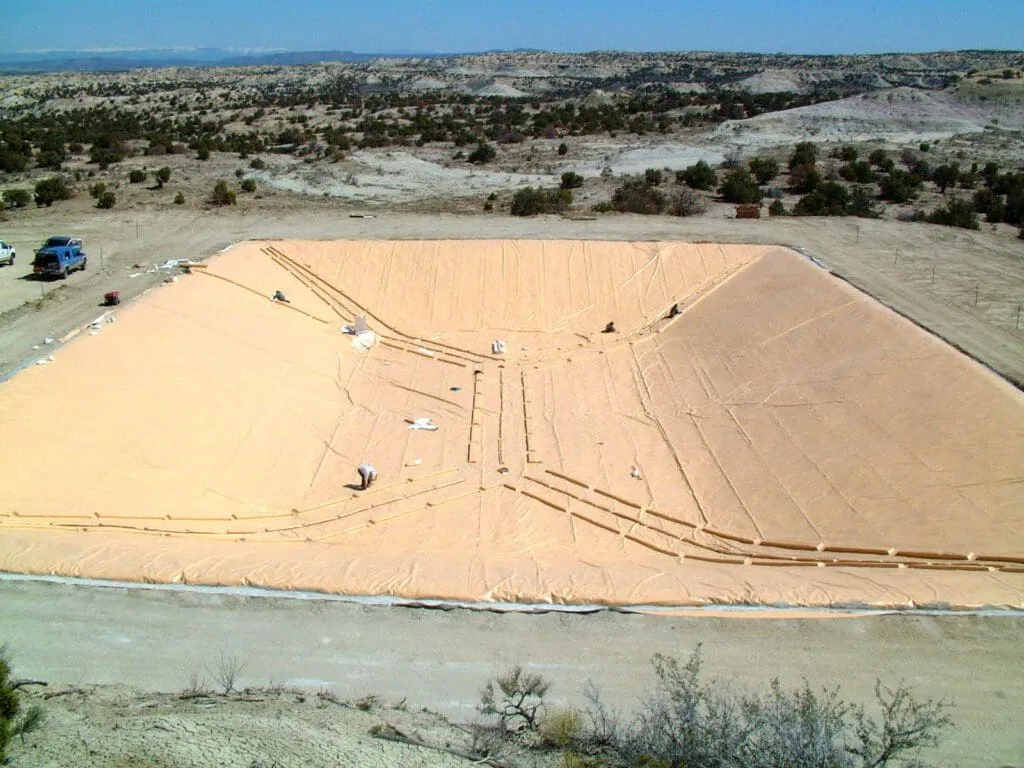
Technical Specification of rFPP Geomembrane Liners
Reinforced flexible polypropylene is built as a composite: a closely knit 9x9 weft-inserted polyester scrim, fully encapsulated between two layers of highly UV-stabilised polypropylene. Flexibility comes from high levels of ethylene propylene rubber incorporated into the polypropylene rather than from added plasticisers, and the dense scrim carries tensile load. The result is a membrane that stays flexible while holding its dimensions - it resists stretching and sagging under mechanical stress instead of deforming to relieve it.
No plasticisers is the point worth understanding. PVC and some other flexible liners achieve their flexibility with plasticisers that migrate out of the sheet over time, leaving the material progressively stiffer and more brittle. RFPP contains none, so its flexibility is a property of the polymer blend itself and does not deplete. For exposed installations expected to serve for decades without a cover layer, that difference matters more than any single figure on a data sheet.
The material offers outstanding resistance to environmental stress cracking, including at elevated temperatures and in chemical environments, and remains serviceable from −57°C to 82°C. It also provides a high friction angle, which reduces concerns about side slope stability and allows steeper slopes than a smooth sheet would support. The outer plies weld well, a characteristic installers and fabricators value directly, because seam consistency is where lining installations succeed or fail.
Both grades are certified under NSF/ANSI Standard 61 for drinking water system components, and both are stated by the manufacturer to meet the physical property values of GRI test method GM18. Material is supplied in a range of widths and lengths, as large-diameter mill rolls for efficient seaming or as custom factory-welded panels produced in a controlled environment, accordion folded and rolled on heavy-duty cores for single-operation deployment. Black is standard; other colours are available to minimum order quantity.
Typical Values for GEOMEMBRANE LINERS
Properties & Dimensions
| Property | Test Method | RFPP36 | RFPP45 |
|---|---|---|---|
| Thickness (mm) | ASTM D5199 | 0.91 | 1.14 |
| Weight (g/m²) | ASTM D751 | 757 | 952 |
| Construction | - | 9x9 1000D PET scrim | 9x9 1000D PET scrim |
| Tongue tear strength (N) | ASTM D5884 | 578 | 534 |
| Grab tensile at break (N) | ASTM D7004 | 1001 | 1334 |
| Tensile elongation at break (%) | ASTM D7004 | 30 | 35 |
| Puncture resistance (N) | ASTM D4833 | 423 | 467 |
| HP-OIT (min) | ASTM D5885 | - | 900 |
| Hydraulic conductivity (cm/sec) | - | 1.39 × 10⁻⁹ | 1.11 × 10⁻⁹ |
| Max static use temperature (°C) | - | 82 | 82 |
| Min static use temperature (°C) | - | -57 | -57 |
Popular Catalogue Items
Related Product Groups
Three Questions To Ask Before You Order
1.Should I use reinforced RFPP or non-reinforced fPP?
2.Why choose RFPP over PVC for an exposed installation?
3.Is it approved for drinking water?
4.Can it be used on steep slopes?
5.What temperature range does it handle?
6.Is RFPP chemically resistant?
Specification For The Design, Installation Of rFPP Geomembrane Liners
Installation is carried out to the project CQA plan and the manufacturer's installation guidance. The manufacturer states that both grades meet the physical property values of GRI test method GM18, the specification for flexible polypropylene. A note on that standard: GM18 was suspended in May 2004 and withdrawn in January 2007 over concerns that oxidative induction time could not reliably predict long-term durability in fPP, although it still appears on the Geosynthetic Institute's published index and manufacturers continue to reference it. Where a project specification cites GM18, we confirm in writing which edition is intended and what the supplied material actually conforms to. Seam performance for reinforced polyolefin geomembranes falls under GRI GM19b, Specification for Seam Strength and Related Properties of Thermally Bonded Reinforced Polyolefin Geomembranes/Barriers, which is the correct seam reference for this material - not GM19a, which covers homogeneous sheet.
Subgrade is proof-rolled and accepted in writing before deployment, free of stones, roots, sharp protrusions, standing water and desiccation cracking beyond the project limits, with anchor trenches cut to profile and cleared of loose spoil. Panels are deployed to the approved layout drawing with seams running up and down slopes rather than across them, and are ballasted against wind uplift from the moment of unrolling. Because the scrim holds the sheet dimensionally stable, factory-fabricated panels arrive at the shape they were built to and can be positioned in a single operation, which is the principal programme advantage of reinforced material over roll goods.
Field seaming is by hot wedge fusion for production seams, with extrusion welding for details, patches and penetrations. The outer polypropylene plies weld well and give a workable temperature window, but permitted ambient conditions, preheat and machine parameters remain those set in the CQA plan and the manufacturer's guidance. Reinforced sheet requires particular attention to weld penetration: the scrim must remain fully encapsulated at the seam, and over-welding that exposes or damages the reinforcement compromises the property the material is specified for. Welding parameters qualified on one grade do not transfer to another without re-qualification.
Trial seams are produced on offcut material at the start of each shift, after any break exceeding the interval stated in the CQA plan, and following any change of operator, machine or ambient conditions. Each trial seam is tested before production welding resumes. Destructive samples are taken at intervals selected under GRI GM14, Guide for Selecting Variable Intervals for Taking Geomembrane Destructive Seam Samples Using the Method of Attributes, or GRI GM20 where control charts are specified. For reinforced material, peel testing is evaluated for scrim delamination rather than for film tear bond, and ply adhesion is assessed under ASTM D6636 per GRI GM15, Test Method for Determination of Ply Adhesion of Reinforced Geomembranes.
All production seams receive full-length non-destructive testing, with methods and acceptance criteria recorded in the CQA plan and field integrity evaluated in accordance with GRI GM29, Practice for Field Integrity Evaluation of Geomembrane Seams (and Sheet) Using Destructive and/or Nondestructive Testing. Dual-track seams with an air channel are pressure tested to ASTM D5820. Single-track seams, extrusion welds, patches, penetrations and detail work are vacuum box tested to ASTM D5641 or air lance tested to ASTM D4437 as appropriate to the detail.
Where leak location is specified, method selection follows ASTM D6747, Standard Guide for Electrical Leak Location of Leaks in Geomembranes. Exposed surveys are carried out to ASTM D7002 water puddle, ASTM D7703 water lance or ASTM D7953 arc testing; surveys after cover placement follow ASTM D7007 or, preferably, ASTM D8265, which controls site conditions, instrumentation and procedure and requires a voltage map in the final report — the strongest quality-control document obtainable at the conclusion of construction. On completion the handover package comprises mill certificates traceable to the supplied rolls, the subgrade acceptance record, the as-built panel layout, all trial seam, destructive and non-destructive test results, welder and equipment calibration records, the repair register, and the final QA/QC sign-off certificate that starts the warranty period.
Featured Projects Across Africa
Related Resources
Common RFPP GEOMEMBRANE LINERS Applications
Request a Quote for This Product Family
Upload your BOQ, drawings, or specifications and our technical team will provide a detailed proposal.
Have a project? Start with us.
Get expert engineering support, reliable material supply, and best-in-class installation.