
Eurobent GCL CS - HDPE Coated Geosynthetic Clay Liner - Dual Barrier System
Eurobent GCL CS is a composite geosynthetic clay liner consisting of granular sodium bentonite needle-punched between a 100 g/m2 PP woven carrier layer and a 200 g/m2 PP nonwoven cover layer, with an additional 0.2mm PE membrane bonded to the carrier layer. The PE membrane renders the composite completely impermeable before bentonite hydration - index flux and permeability are rated as impermeable to ASTM D5887. Total GCL mass 5500 g/m2. Thickness 7.6mm. Self-sealing bentonite secondary barrier - if the membrane is perforated, the bentonite swells and seals the breach. CE marked. Compliant with EN 13361, EN 13491, EN 13492, EN 13493, and EN 15382. Stocked in South Africa for same-week dispatch to 30+ African countries.
Technical Specification of Eurobent GCL CS - HDPE Coated Geosynthetic Clay Liner - Dual Barrier System
Eurobent GCL CS is a dual-barrier composite geosynthetic clay liner that combines the immediate impermeability of a PE membrane with the long-term self-sealing performance of a sodium bentonite clay layer in a single factory-manufactured product. The CS designation stands for Composite with a membrane layer. In comparison to the standard Eurobent reinforced GCL, which achieves its barrier performance after hydration under confining stress, Eurobent GCL CS is completely impermeable immediately upon installation - the PE membrane provides an instant barrier against liquid, gas, and vapour penetration before any hydration of the bentonite layer has occurred.
The construction consists of a 100 g/m2 PP woven carrier layer, a granular sodium bentonite core of 5000 g/m2 net bentonite content with minimum 75% montmorillonite content and swell index exceeding 24 ml/2g, a 200 g/m2 PP nonwoven cover layer, and a 0.2mm PE membrane bonded to the carrier layer by gluing - a technically designed process that ensures permanent adhesion of the membrane to the GCL composite without delamination. The needle-punching process locks the nonwoven fibres through the bentonite layer into the woven carrier layer matrix, providing resistance to peeling and ensuring even bentonite distribution across the full liner surface.
The dual-barrier architecture of GCL CS is its defining performance advantage. The PE membrane is the primary sealing barrier - providing immediate impermeability that is classified as impermeable to both index flux and permeability testing under ASTM D5887. The sodium bentonite layer is the secondary barrier - providing self-sealing redundancy that no geomembrane-only product can deliver. If the PE membrane is perforated or damaged - during installation, by construction plant, or by subgrade movement after installation - the sodium bentonite swells and seals the breach under confining stress from the cover material. This self-healing redundancy is the reason GCL CS is specified on the most demanding containment projects where a single-layer synthetic membrane is considered insufficient.
The PE membrane thickness of 0.2mm provides immediate gas resistance - making GCL CS appropriate for gas barrier applications including landfill capping, contaminated land remediation, and applications where methane or volatile organic compound migration must be controlled from day one of installation before bentonite hydration is complete. The standard Eurobent GCL does not provide gas barrier performance until fully hydrated - GCL CS provides it immediately. This distinction is critical on landfill cap projects and contaminated site redevelopments where gas management is a regulatory requirement from the date of liner completion.
Eurobent GCL CS is also specified for applications over coarse aggregate subgrades - such as drainage blankets, gravel working platforms, and recycled aggregate fill - where the PE membrane provides protection against piping of bentonite through the aggregate pore spaces before hydration occurs. On standard GCL over coarse subgrades, dry granular bentonite can migrate downward through coarse aggregate voids before hydration creates the gel layer that seals the liner - a risk that is completely eliminated by the PE membrane on GCL CS. The membrane also protects the bentonite against desiccation in dry climate applications and against ion exchange with chemically aggressive leachate or saline groundwater that would reduce the swelling capacity of standard sodium bentonite GCL.
Geosynthetics Africa stocks Eurobent GCL CS in South Africa and distributes across 30+ African countries. Supply-only is available for projects with approved third-party installers. Full supply-and-install is provided by experienced IAGI member installation teams with site-specific method statements, CQA inspection support, and post-installation documentation. Every roll is supplied with a manufacturer ITR containing traceable quality data. Material is warranted against manufacturer defects for 25 years from purchase.
Typical Values for GEOSYNTHETIC CLAY LINERS GCL
Properties & Dimensions
| Property | Test Method | EB 3500 |
|---|---|---|
| Carrier layer - PP Woven | EN ISO 9864 | 100 g/m2 |
| Cover layer - PP Nonwoven | EN ISO 9864 | 200 g/m2 |
| PE Membrane | PN EN 1849-2 | 0.2mm |
| Watertightness | EN 1928 | Pass |
| Net bentonite content | EN 14196 | 5000 g/m2 |
| Total GCL mass | EN 14196 | 5500 g/m2 (-200 g/m2) |
| Thickness | EN ISO 9863-1 | 7.6mm (+-1mm) |
| Montmorillonite content | CUR 33 | >=75% |
| Swell index | ASTM D5890 | >=24 ml/2g |
| Index flux | ASTM D5887 | Impermeable |
| Permeability | ASTM D5887 | Impermeable |
| Tensile strength MD | EN ISO 10319 | >=10.4 kN/m (-1kN/m) |
| Tensile strength CD | EN ISO 10319 | >=10.4 kN/m (-1kN/m) |
| CBR puncture strength | EN ISO 12236 | >=1.8 kN (-0.2kN) |
| Roll width | - | 5.1m |
| Roll length | - | 40m (+-1%) |
| Roll area | 204m2 |
Popular Catalogue Items
Related Product Groups
Three Questions To Ask Before You Order
1.What is the difference between Eurobent GCL CS and standard Eurobent GCL?
2.What membrane thickness and type should I specify?
3.Does GCL CS still self-heal if the PE membrane is damaged?
4.Why is GCL CS specified over coarse aggregate subgrades?
5.Is GCL CS suitable for gas barrier applications?
6.What QA documentation is supplied with Eurobent GCL CS?
Specification For The Design, Installation Of Eurobent GCL CS - HDPE Coated Geosynthetic Clay Liner - Dual Barrier System
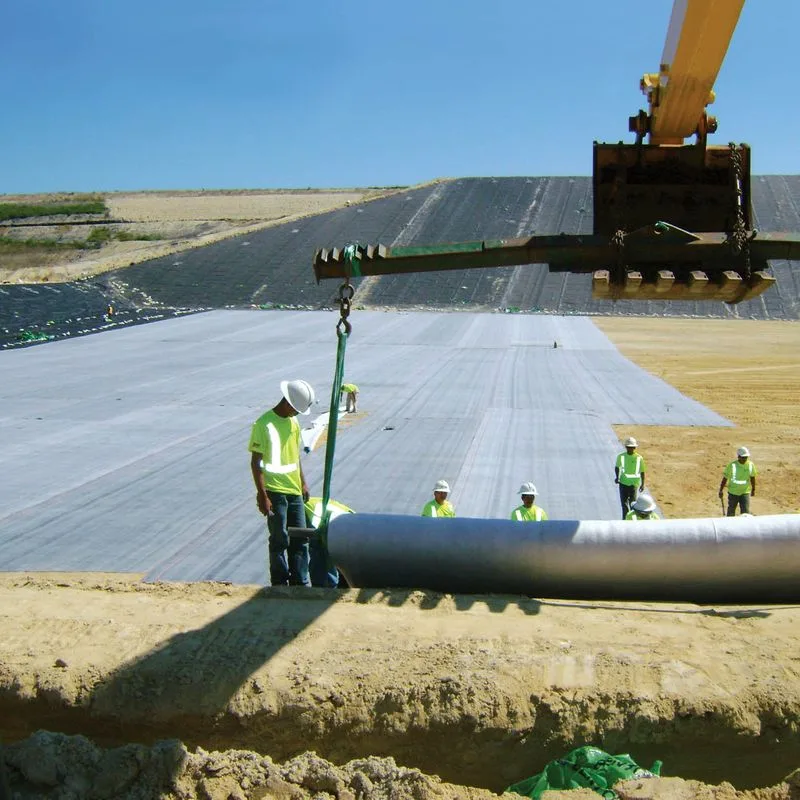
Eurobent GCL CS installation follows the same critical principles as standard GCL installation - correct subgrade preparation, minimum 300mm panel overlaps with bentonite powder at seams, anchor trench construction at all perimeter edges, cover placement within the same working day, and protection from premature hydration. Additional considerations specific to GCL CS relate to membrane orientation, handling of the membrane layer during deployment to prevent delamination, and verification of membrane integrity before cover placement.
1. Subgrade Preparation - Compact the subgrade to minimum 90% Proctor density. Remove sharp rocks, organic matter, and objects larger than 50mm. The finished surface must be smooth and free of ruts deeper than 25mm. Engineer approval of the subgrade must be obtained before deployment. GCL CS may be installed over coarser aggregate subgrades than standard GCL - the PE membrane eliminates the bentonite piping risk over coarse subgrades. However, sharp angular aggregate that could puncture the membrane must be removed or covered with a protective layer before GCL CS is deployed.
2. Roll Orientation and Deployment - Confirm the correct GCL CS orientation with the project engineer before deployment - the PE membrane must face the correct direction relative to the containment side of the liner system, as specified in the project drawings. Do not allow rolls to unroll freely down slopes. Avoid dragging GCL CS across sharp subgrade materials - use a slip sheet or rub sheet to protect the membrane surface during panel adjustment. Equipment must not move directly on unprotected GCL CS - lightweight ATVs with maximum 21.5 kPa bearing pressure only.
3. Panel Overlaps and Bentonite Powder - Overlap all adjacent panels by minimum 300mm. Apply bentonite powder from the supplied 20kg bag across the full overlap width before placing the overlapping panel - ensuring self-sealing of the seam through the bentonite layer even if the membrane overlap is not perfectly sealed. Use the overlap guideline and match-line imprinted on both panel edges to confirm seam accuracy. Do not install panels in standing water or during rain. Seam overlaps must be verified and documented by the CQA inspector.
4. Membrane Integrity and Damage Repair - Visually inspect the PE membrane surface after each panel is placed for punctures, tears, or delamination damage. Mark all damage immediately. Minor damage in the bentonite layer self-seals - damage to the membrane must be patched using a GCL CS patch with minimum 300mm overlap on all edges, with bentonite powder applied to the damaged area. For membrane-only damage, a PE membrane patch may be heat-welded or adhesive-bonded over the damaged area per the project engineer's specification. All damage and repairs must be documented in the CQA record.
5. Anchor Trench and Cover Placement - Construct anchor trenches at all perimeter edges and slope crests and toes to the engineer's specification. Fold the GCL CS edge into the trench, backfill, and compact. Cover material must be placed over the GCL CS at the end of every working day - minimum 300mm cover between equipment and the liner at all times. Move cover soil upslope to minimise tensile forces on the liner. The PE membrane on GCL CS provides immediate barrier performance before cover soil is placed - but unconfined GCL CS must still be protected from wind displacement, UV degradation of the geotextile layers, and physical damage from construction traffic.
Featured Projects Across Africa
Related Resources
Common HDPE COATED BENTONITE GEOSYNTHETIC CLAY LINERS Applications
Request a Quote for This Product Family
Upload your BOQ, drawings, or specifications and our technical team will provide a detailed proposal.
Have a project? Start with us.
Get expert engineering support, reliable material supply, and best-in-class installation.