
FlowTex GSC W Woven Sand Containers
Woven geosynthetic sand containers for coastal revetments, groyne construction, scour aprons and structural riverine works across African coastlines. Four grades from 30 to 105 kN/m wide-width tensile strength, 400kg to 4,000kg filled, manufactured in our own Johannesburg facility from CE-certified high-flow woven polypropylene. Custom dimensions, fabric grades and seam configurations to order.
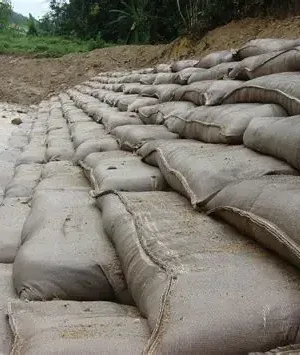
Technical Specification of FlowTex GSC W Woven Sand Containers
Woven geosynthetic sand containers are engineered structural marine and hydraulic armour units, fabricated from high-tenacity woven polypropylene tape geotextile and filled on site with local sand. They are specified for coastal revetments, groyne construction, scour aprons around infrastructure, structural riverine erosion control and shoreline protection. Four grades, 30 to 105 kN/m, 400kg to 4,000kg filled.
Woven is the correct construction wherever the container itself carries tensile load between placed units, and where rapid pore-pressure dissipation through the tidal cycle governs. Two properties drive the selection. Wide-width tensile strength of 30 to 105 kN/m in both machine and cross-machine directions (EN ISO 10319) is delivered at 145 to 500 g/m² - roughly twice the tensile of nonwoven at a third of the fabric mass, which lets bag geometry be engineered to align the tensile-strong direction with the design load path. And elongation of 10 to 20 percent at maximum load means the fabric resists load rather than stretching under it, holding container geometry through repeated hydraulic cycling.
Permeability of 25 to 40 mm/s (EN ISO 11058) allows pore-water pressure to dissipate through the fabric during falling tide before the next hydraulic cycle loads the structure. Where dissipation is too slow, differential head builds behind the bag face and drives progressive displacement of placed units. Opening size is 300 or 600 micron (EN ISO 12956) depending on grade, which must be matched to fill grading: material finer than the container O90 will pass under wave-induced flow and produce gradual mass loss. Send a grading curve before specifying - on fine-sand sites the nonwoven range is usually the correct answer.
Fabric is UV-stabilised virgin polypropylene, CE-certified under Certificate 1071-CPR-7027 and manufactured under ISO 9001:2015, ISO 14001:2015, ISO 50001:2018 and ISO 45001:2018. Published durability assessments indicate service life beyond 50 years for the W30 grade and beyond 100 years for W45, W60 and W105 in soil temperatures above 25°C, with verified resistance to oxidation (EN ISO 13438), microbiological degradation (EN 12225) and chemical ageing (EN 14030 Methods A and B). Weathering resistance is 90 percent retained strength (EN 12224) on W30, W45 and W60.
The range is cut, stitched and seam-tested in our own Johannesburg facility, so container geometry, fabric grade and closure specification are design variables rather than catalogue constraints. All closures are double-seamed - a straight pass followed by an overlock second pass in UV-stabilised polyester yarn, verified to EN ISO 10319. Every container ships with mill test certificates, independent third-party test data and full batch traceability. Installation is executed under IAGI-aligned QA/QC with photographic sign-off at each course.
Typical Values for GEOSYNTHETIC SAND CONTAINERS
Properties & Dimensions
| Grade | Lay-Flat | Filled Mass | Fabric | Tensile MD/CD | CBR Puncture | Permeability | O90 | Application |
|---|---|---|---|---|---|---|---|---|
| W30 | 1.30 × 0.70 m | 400 kg | 145 g/m² | 30 / 30 kN/m | 3.20 kN | 39 mm/s | 300 µm | Riverine · low-energy |
| W45 | 1.60 × 1.10 m | 1,000 kg | 210 g/m² | 45 / 45 kN/m | 5.00 kN | 40 mm/s | 600 µm | Medium-energy coastal |
| W60 | 2.00 × 1.50 m | 1,800 kg | 280 g/m² | 60 / 60 kN/m | 7.30 kN | 27 mm/s | 600 µm | Medium-high coastal |
| W105 | 2.50 × 1.50 m | 4,000 kg | 500 g/m² | 105 / 105 kN/m | 12.00 kN | 25 mm/s | 300 µm | High-energy coastal |
Popular Catalogue Items
FlowTex™ GSC W - Woven Geosynthetic Sand Containers
30 kN/m to 105 kN/m wide-width tensile, 400 kg to 4,000 kg filledRelated Product Groups
Three Questions To Ask Before You Order
1.When should I specify woven instead of nonwoven?
2.Will the fabric retain my site sand?
3.How do I size a container against my design wave height?
4.What should the specification clause actually say?
5.Why does CE certification matter on a sand container?
6.What is the design life?
7.Can you manufacture a size or fabric grade that isn't in the range?
8.How deep does the toe need to be embedded?
Specification For The Design, Installation Of FlowTex GSC W Woven Sand Containers
Site preparation. Excavate to firm base material over the full length of the revetment section. Remove rocks, stumps, root systems and protrusions and backfill the resulting cavities with sand compacted flush - irregular base surfaces prevent uniform bag contact and create stress concentrations under wave loading. Shape the slope to the design batter angle, toe elevation, crest elevation and rear taper before any container is placed; the profile cannot be reshaped afterwards without disturbing installed work. Establish setting-out pegs at toe and crest along the full length.
Underliner. Lay a nonwoven filter geotextile over the prepared section, covering the full slope length and the base of the toe trench, before any container is placed. It separates the woven container structure from native soil to prevent fines migration under pore-pressure cycling, and provides a consistent bearing surface for the first course. Lap panels down the slope in a shingle pattern, upper panel beneath lower so downslope flow passes over the joint. Minimum overlap 500mm on stable subgrades, 1,000mm on soft or variable ground.
Toe embedment. Placement begins at the toe and proceeds up the slope. Set the first container along the front line with its longer dimension parallel to the shoreline - this establishes the datum for every course above, and any misalignment introduced here propagates upward. Embed the toe container to a minimum of 1.8 times the significant wave height below design water level, per USACE Coastal Engineering Manual and CIRIA Rock Manual guidance. Toe scour removes lateral support and drives forward rotation and progressive collapse. Verify against project design wave height before placing any course above the toe.
Filling and closure. Fill to approximately 80% of theoretical volumetric capacity. Overfilling prevents units conforming to each other and destroys interlock; underfilling produces excessive deformation and creates voids that concentrate hydraulic pressure at joints. Fill must be clean, well-graded sand free of sharp debris, organic contamination and material finer than the container O90 - 300 micron for W30 and W105, 600 micron for W45 and W60. W30 and W45 are filled by hopper or mechanical equipment; W60 and W105 may be hydraulically filled in place. All closures are double-seamed, a straight pass followed by an overlock second pass in UV-stabilised polyester yarn. Single straight-seam closures are not compliant for structural coastal applications.
Stacking and compaction. Lay successive courses in stretcher bond, each container offset half a bag length from the course below. Never stack in vertical columns: continuous vertical joints open progressively under repeated hydraulic loading, where staggered placement distributes wave-induced force across multiple units. After a minimum run of three containers, level and compact the course with the back of the excavator bucket or a plate compactor before the next is placed. Double-layer configurations provide approximately 17% greater stability than single-layer of the same grade under equivalent wave conditions. Check face alignment against setting-out pegs at every course.
Crest, backfill and sign-off. Crest containers take wave run-up and overtopping in addition to direct attack; place them last and with the greatest care. Bench the rear profile to receive each successive course, folding the underliner back over completed sections and overlapping at each bench to prevent flanking flow behind the structure. Complete the crest fill, taper off with specified compacted backfill to design elevation, and level the exposed face with sand. Photographic records are taken of each course before the next is placed under IAGI-aligned QA/QC.
Featured Projects Across Africa
Related Resources
Common WOVEN GEOTEXTILE SAND BAGS Applications
Request a Quote for This Product Family
Upload your BOQ, drawings, or specifications and our technical team will provide a detailed proposal.
Have a project? Start with us.
Get expert engineering support, reliable material supply, and best-in-class installation.