
PolyTape™ Woven Geotextile Fabrics
High-flow woven geotextiles engineered for roads, haul roads, railways, working platforms, embankments and drainage infrastructure. PolyTape™ WG slit-film polypropylene wovens deliver separation, filtration and reinforcement in a single layer, with tensile strengths from 30 to 105 kN/m. Supplied across 30+ African countries with design support, take-offs, QA/QC documentation and installation backup from Geosynthetics Africa.
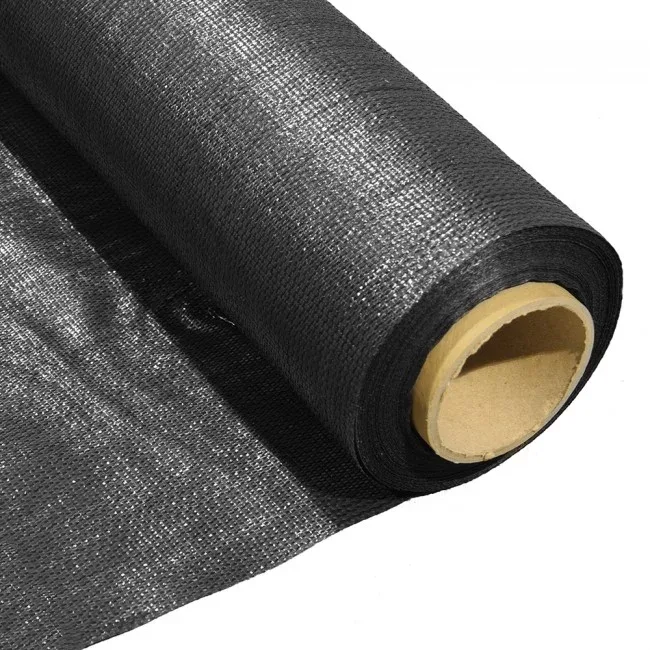
Technical Specification of PolyTape™ Woven Geotextile Fabrics
Geosynthetics Africa supplies PolyTape™ WG High Flow woven geotextiles - high-strength polypropylene fabrics engineered for separation, filtration, drainage and reinforcement across civil, mining, water and environmental works throughout Africa.
PolyTape™ WG-HF is woven from flat slit-film polypropylene tapes rather than round yarns. The tape construction produces a dense, dimensionally stable fabric with low elongation under load, while the high-flow weave keeps water moving through the plane of the fabric instead of ponding behind it - the combination that lets a single layer separate, filter and reinforce at the same time.
The range spans five grades from 30 kN/m to 105 kN/m tensile strength (EN ISO 10319), with CBR puncture resistance from 3.2 kN to 12 kN (EN ISO 12236) and mass from 145 to 500 g/m². Characteristic opening sizes of 300–600 µm (EN ISO 12956) are matched to typical African subgrade and fill gradings, and water permeability reaches 40 mm/sec on the lighter grades, giving flow rates around 40 l/m²/sec where drainage governs the design.
All grades are UV stabilised, CE marked and manufactured in ISO 9001, 14001, 45001 and 50001 certified facilities. Independent assessment against EN ISO 13438 (oxidation), EN 12225 (microbiological degradation) and EN 14030 (acid and alkaline ageing) supports predicted durability in excess of 100 years in natural soils above 25°C - 50 years for WG30HF - provided the fabric is covered within one month of installation.
Beyond supply, Geosynthetics Africa provides design assistance, grade selection against project specifications, quantity take-offs, project logistics, QA/QC documentation and on-site installation support, backing the material through the full project lifecycle.
Typical Values for GEOTEXTILE FABRICS
Properties & Dimensions
| Property | Test Method | WG 30 HF | WG 45 HF | WG 60 HF | WG 105 HF |
|---|---|---|---|---|---|
| Polymer Type | - | Polypropylene | Polypropylene | Polypropylene | Polypropylene |
| Primary Function | EN 13249–13265 | F, S, R | F, S, R | F, S, R | F, S, R |
| Tensile Strength (MD) | EN ISO 10319 | 30 kN/m | 45 kN/m | 60 kN/m | 105 kN/m |
| Tensile Strength (CMD) | EN ISO 10319 | 30 kN/m | 45 kN/m | 60 kN/m | 105 kN/m |
| Elongation MD/CD | EN ISO 10319 | 15 / 10 % | 20 / 15 % | 18 / 11 % | 18 / 10 % |
| Characteristic Opening Size O₉₀ | EN ISO 12956 | 300 µm | 600 µm | 600 µm | 300 µm |
| Water Permeability VI₅₀ | EN ISO 11058 | 39 mm/s | 40 mm/s | 27 mm/s | 25 mm/s |
| Static Puncture (CBR) | EN ISO 12236 | 3.2 kN | 5.0 kN | 7.3 kN | 12 kN |
| Dynamic Perforation | EN ISO 13433 | 20 mm | 10 mm | 10 mm | 3 mm |
| Mass per Unit Area | EN ISO 9864 | 145 g/m² | 210 g/m² | 280 g/m² | 500 g/m² |
| Thickness (2 kPa) | EN ISO 9863-1 | 0.6 mm | 0.9 mm | 1.4 mm | 2.0 mm |
| Standard Roll Width | - | 5.3 m | 5.3 m | 5.3 m | 5.3 m |
| Standard Roll Length | - | 100 m | 100 m | 100 m | 100 m |
Popular Catalogue Items
Related Product Groups
Three Questions To Ask Before You Order
1.Which grade do I specify for a given subgrade?
2.Is tensile strength or puncture resistance the governing property?
3.How do I check filtration compatibility?
4.What overlap and jointing should I allow?
5.What is the design life, and what governs it?
6.What partial factors should I apply for reinforcement design?
Specification For The Design, Installation Of PolyTape™ Woven Geotextile Fabrics
Subgrade Preparation - Prepare a smooth, stable subgrade free from sharp objects, large stones, roots and debris that could damage the geotextile during installation.
Geotextile Placement - Unroll directly onto the prepared surface without wrinkles or folds, ensuring full contact with the underlying ground and correct panel orientation.
Overlaps & Seaming - Provide overlaps in accordance with project specifications and ground conditions. Increase overlap widths or use sewn seams where very weak subgrades are encountered.
Aggregate Placement - Place cover material carefully to prevent displacement or damage to the geotextile. Do not allow construction traffic directly on exposed geotextile unless specified by the engineer.
Featured Projects Across Africa
Related Resources
Common POLYPROPYLENE WOVEN GEOTEXTILES Applications
Request a Quote for This Product Family
Upload your BOQ, drawings, or specifications and our technical team will provide a detailed proposal.
Have a project? Start with us.
Get expert engineering support, reliable material supply, and best-in-class installation.