
PolyTape Root Barrier
PolyTape RB340 is a UV-stabilised, double-coated polypropylene needlepunched nonwoven root barrier - tested to CEN/TS 14416 root penetration resistance standard. Engineered to redirect tree root development downward, protecting buildings, concrete paths, walls, pipelines and underground infrastructure from structural root damage. 340 g/m², 1.6 mm thick, resistant to soil chemicals, mildew and insects, with an assessed service life exceeding 100 years in buried conditions. Available coated on both sides for full impermeability or non-coated where water permeability to surrounding land drains must be maintained. Supplied across 30+ African countries - the continent's only specified, tested and certified PP root barrier system.
Technical Specification of PolyTape Root Barrier
PolyTape RB340 PP Root Barrier is a UV-stabilised, double-coated polypropylene needlepunched nonwoven geotextile engineered specifically for root control in urban infrastructure, landscaping, civil construction and horticultural applications. Tested to CEN/TS 14416 root penetration resistance standard, PolyTape RB340 physically redirects tree and shrub root development downward - preventing lateral root migration that causes wall cracking, concrete path failure, pipeline damage and building foundation undermining. At 340 g/m² and 1.6 mm thickness, it combines high root penetration resistance with the mechanical robustness required for vertical installation in hard urban environments.
PolyTape RB340 is available in two configurations: PP-coated on both sides for applications requiring full water impermeability - retaining walls, building perimeters and hardscape protection; and non-coated for applications where water permeability to surrounding land drains must be maintained. Both configurations are resistant to soil chemicals, mildew, insects and biological agents, with an assessed service life exceeding 100 years in buried conditions at soil temperatures above 25°C. Weathering resistance, acid and alkaline resistance, oxidation resistance and microbiological resistance are all certified at 90% retained strength (EN 12224, EN 14030, EN ISO 13438, EN 12225).
Geosynthetics Africa supplies PolyTape RB340 PP Root Barrier across 30+ African countries - the continent's only specified, tested and CEN/TS 14416-certified root barrier system available with pan-African logistics and technical selection support. Available in widths of 1 m and 2 m in 25 m and 50 m rolls, sized for urban streetscape, residential, commercial and infrastructure applications. Where root control is a structural requirement - not an afterthought - PolyTape RB340 is the specified solution.
Typical Values for GEOTEXTILE FABRICS
Properties & Dimensions
| Property | Test Method | PolyTape RB340 |
|---|---|---|
| Root Penetration Resistance | CEN/TS 14416 | Certified Pass |
| Assessed Service Life | TÜV Austria | 100+ Years Buried |
| Mass per Unit Area | EN ISO 9864 | 340 g/m² |
| Static Puncture Resistance | EN ISO 12236 | 3,250 N |
| Chemical & Biological Resistance | EN 14030 · EN 12225 | 90% Retained Strength |
| Standard Roll Width | - | 1.0m |
| Standard Roll Length | - | 50.0m |
Popular Catalogue Items
Related Product Groups
Three Questions To Ask Before You Order
1.What is the difference between a root barrier and a standard geotextile?
2.How deep should the root barrier be installed?
3.Coated or non-coated - which do I specify?ength?
4.Will PolyTape RB340 last in African soil conditions?
5.Can PolyTape RB340 be used for tree pit lining in paved urban areas?
6.Is PolyTape RB340 suitable for protecting underground pipelines and services?
Specification For The Design, Installation Of PolyTape Root Barrier
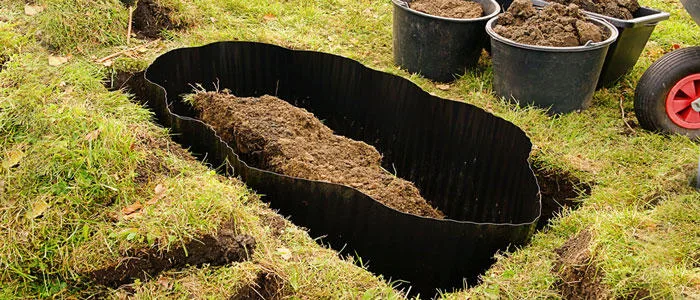
Excavation & Preparation - Excavate the barrier trench or tree pit to the specified depth - minimum 600 mm for shrubs and small trees, 1,000 -1,500 mm for large canopy trees. Ensure trench walls are clean, stable and free of sharp stones, roots and debris that could damage or puncture the barrier during installation. Confirm drainage requirements before selecting coated or non-coated configuration.
Barrier Placement - Unroll PolyTape RB340 vertically into the prepared trench with the full specified depth achieved. Maintain barrier in vertical position against the trench wall - do not fold or crease at the base. For tree pit installations, wrap continuously around the full perimeter of the pit with no gaps. The 1 m width suits standard tree pit depths; the 2 m width suits deep installations and pipeline protection corridors without field cutting.
Overlaps & Joining - Overlap all joins by a minimum of 150 mm. Secure overlaps with ground staples or pins before backfilling — unsecured overlaps can open during compaction and create root pathways. For coated configuration, tape overlaps with compatible PP tape for full impermeability at joins. For non-coated configuration, standard stapled overlaps are sufficient.
Backfilling & Completion - Backfill in compacted layers — do not use mechanical compaction directly against the barrier face. Ensure the top edge of the barrier is at or slightly above finished ground level to prevent root bypass over the top of the barrier. Do not cut the barrier below specified depth to accommodate utilities or services — reroute services or increase barrier depth. Record installation depth and configuration in project documentation.
Featured Projects Across Africa
Related Resources
Common PP ROOT BARRIER Applications
Request a Quote for This Product Family
Upload your BOQ, drawings, or specifications and our technical team will provide a detailed proposal.
Have a project? Start with us.
Get expert engineering support, reliable material supply, and best-in-class installation.