
GeoStruct™ – HDPE Structured Wall Pipes
GeoStruct™ is a high-performance HDPE structured wall pipe system for gravity sewer, stormwater, culvert and large-diameter drainage applications across Africa. Available in internal diameters from 300 mm to 1500 mm at ring stiffness classes 4 kN/m² and 8 kN/m², GeoStruct™ combines a smooth hydraulic bore with a spirally wound structured wall profile to deliver exceptional ring stiffness at a fraction of the weight of equivalent concrete pipe. Supplied in 6 m and 12 m lengths with a full system of coupling seals, extrusion weld sleeve joints and clamp joints. Approved for installation in dolomite risk areas in accordance with SANS 1936-3.
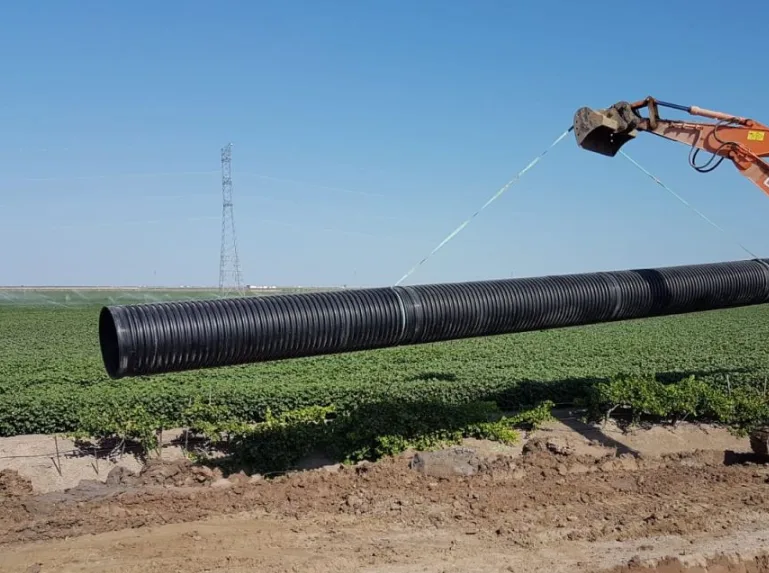
Technical Specification of GeoStruct™ – HDPE Structured Wall Pipes
GeoStruct™ is manufactured through a purpose-engineered spiral winding process. A square or rectangular HDPE profile is extruded and wound onto a precision mandrel - the overlapping edge fused homogeneously in the hot plastic state to create a continuous, smooth internal bore. The result is a lightweight engineered pipe with the hydraulic and mechanical performance of a solid-wall HDPE pipe, delivered at substantially reduced weight and with significant handling and transport cost savings.
GeoStruct™ is specified in two ring stiffness classes. The 4 kN/m² class suits standard municipal sewer, stormwater and gravity drainage installations under moderate cover and traffic loading. The 8 kN/m² class is specified where deeper burial, higher traffic loading, or dolomite ground conditions demand greater structural performance. Both classes share identical internal diameters - the choice between them is driven by the structural design of the installation, not the hydraulic design.
The internal bore of GeoStruct™ carries a Manning's roughness coefficient of n = 0.01, delivering flow rates 20–25% greater than equivalent concrete pipes of the same internal diameter. At the largest available sizes - 1000 mm to 1500 mm ID - this hydraulic advantage translates directly into reduced pipe size requirements and lower excavation volumes on large infrastructure projects.
GeoStruct™ HDPE structured wall manholes are prefabricated to the same ID range as the pipe system - 300 mm to 1500 mm - eliminating the dimensional mismatch common with concrete manhole rings. Manholes are factory-fabricated with benching, HDPE ladders and pipe stubs welded in situ, delivered to site ready to lower into the excavation. All weld joints are executed by trained HDPE welders and the complete manhole assembly is pressure-tested before dispatch.
Typical Values for PIPES DRAINAGE DUCTING
Properties & Dimensions
| Property | Test Method | Unit | GeoStruct 4 kN/m² | GeoStruct 8 kN/m² |
|---|---|---|---|---|
| Material | - | - | HDPE | HDPE |
| Ring Stiffness - Standard | ISO 9969 | kN/m² | 4 | 8 |
| Nominal Diameter Range (DN) | - | mm | 300 – 1500 | 300 – 1500 |
| Outer Diameter Range | - | mm | 328 – 1624 | 338 – 1650 |
| Standard Length | - | m | 6 | 6 |
| Manning's Roughness Coefficient (n) | - | - | 0.01 | 0.01 |
| Density | ISO 1183-1 | g/cm³ | ≥ 0.950 | ≥ 0.950 |
| Flexural Modulus | ISO 178 | MPa | 1 000 – 2 000 | 1 000 – 2 000 |
| Melt Flow Index (190 °C / 5 kg) | ISO 1133 | g/10 min | ≤ 1.6 | ≤ 1.6 |
| Oxidation Induction Time (200 °C) | ISO 11357-6 | min | ≥ 20 | ≥ 20 |
| Impact Strength (TIR) | ISO 3127 | % | ≤ 10 | ≤ 10 |
| Longitudinal Reversion | ISO 2505 | % | ≤ 3 | ≤ 3 |
| Creep Ratio (2-year extrapolation) | ISO 9967 | - | ≤ 4 | ≤ 4 |
| Min. Weld Tensile Strength | ISO 13262 | N | 380 – 1 020 (size dependent) | 380 – 1 020 (size dependent) |
| Standard Compliance | - | - | SANS 21138 | SANS 21138 |
Popular Catalogue Items
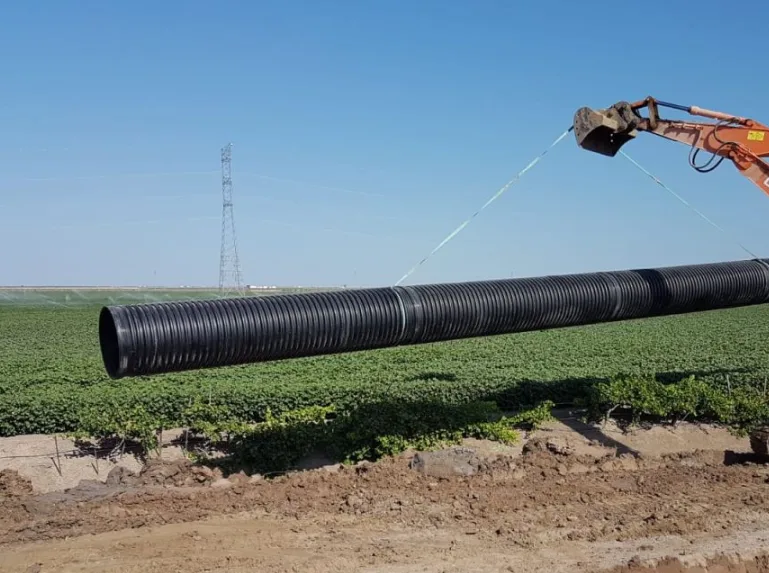
GeoStruct™ HDPE Structured Wall Pipe
Spirally wound HDPE structured wall pipe for gravity sewer, stormwater, culvert and bulk drainage. DN300 to DN1500 in SN4 and SN8, manufactured to SANS 21138. Around 90 % lighter than equivalent concrete pipe, with a smooth bore holding Manning's n = 0.01 across a design life of up to 100 years.Related Product Groups
Three Questions To Ask Before You Order
1.What is the difference between GeoStruct™ KN4 and KN8?
2.Is GeoStruct™ approved for use in dolomite areas?
3.What jointing methods are available for GeoStruct™?
4.What sizes does GeoStruct™ come in?
5.How does GeoStruct™ compare to concrete pipe?
6.What is the minimum order quantity for GeoStruct™?
7.Are GeoStruct™ HDPE manholes available to match the pipe system?
Specification For The Design, Installation Of GeoStruct™ – HDPE Structured Wall Pipes
Excavate & Prepare Trench - Excavate to the required depth and grade. Trench width should allow 150 mm clearance each side of the pipe for embedment compaction. Lay a 100 mm compacted sand or gravel bedding layer at the trench bottom to the design gradient before pipe placement.
Place & Joint Pipes - Lower pipes into the trench and align vertically and horizontally. For coupling and seal jointing, clean pipe ends, fit the rubber seal, apply lubricant to the coupling interior and push to insertion depth. For extrusion weld jointing on dolomite projects, the HDPE sleeve is pre-welded to the first pipe - insert the second pipe on site and complete the extrusion weld in accordance with SANS 10268-1.
Haunch & Initial Backfill - Place selected granular embedment material in 75 mm layers up to the crown of the pipe, compacting each layer by hand tamper. Ensure no voids form under the pipe haunches. Leave all joints exposed at this stage for inspection and testing.
Test & Final Backfill - Conduct leak testing with all joints exposed. Once testing is passed, complete backfill in 300 mm compacted layers to the required surface level. The final backfill level should be slightly above natural ground to allow for consolidation.
Featured Projects Across Africa
Related Resources
Common STRUCTURED WALL PIPES Applications
Request a Quote for This Product Family
Upload your BOQ, drawings, or specifications and our technical team will provide a detailed proposal.
Have a project? Start with us.
Get expert engineering support, reliable material supply, and best-in-class installation.