
A geotextile specification usually names a mass, sometimes a function, occasionally a strength figure. It rarely names a polymer. That's an odd gap, because polypropylene and polyester are different materials with different failure mechanisms, and the choice between them changes how the fabric performs and how long it lasts.
Neither is better. They're suited to different jobs, and the useful thing is knowing which is which.
Where PP has the advantage
Hydrolysis resistance. This is the significant one. Polyester is susceptible to hydrolytic degradation - water attacking the ester linkages in the polymer chain, breaking them and reducing molecular weight and therefore strength. The rate rises with temperature and with alkalinity.
That matters because alkaline conditions are common in construction. Concrete kerbs and edge restraints, cement-bound bases, lime-stabilised subgrade, fresh concrete in contact with fabric, and naturally calcareous soils all raise pH at the interface. Polypropylene has no hydrolysable groups in its backbone. It's unaffected by that mechanism entirely.
For anything sitting against cementitious material or in high-pH ground, PP is the lower-risk specification, and the argument is chemistry rather than preference.
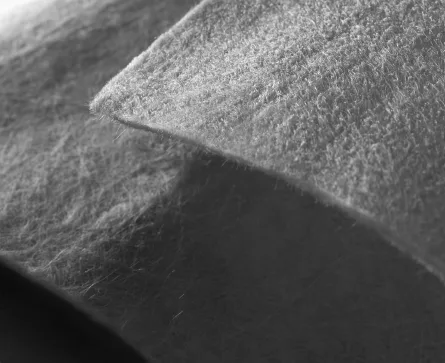
More fabric per gram. Polypropylene has a density around 0.91 g/cm³ against polyester's 1.38. At the same mass per unit area, a PP nonwoven gives you appreciably more fibre volume and greater thickness.
Where the fabric's job is bulk - cushioning a geomembrane, maintaining separation under load, retaining thickness for in-plane drainage - that difference is performance you get for free. It's why polypropylene dominates protection geotextiles.
Chemical breadth. PP resists a wider range of acids and alkalis in the concentrations found in soil and groundwater. It doesn't absorb moisture, and it's unaffected by rot and mildew.
Single-polymer assemblies. Where a geotextile is laminated to another PP component - a cellular grid, a drainage core - the whole product is one polymer and recyclable as one stream. Mixed-polymer composites have to be separated or landfilled.
Where PET has the advantage
Being straight about this matters, because a post that claims one polymer wins everything isn't worth reading.
Tensile modulus. Polyester carries load at lower strain. Where the geotextile is a structural element - basal reinforcement, reinforced soil, embankments over soft ground - that stiffness is the property being bought, and PP doesn't match it.
Creep resistance. Under sustained load over decades, polyester deforms less. For reinforcement designs with long service lives and permanent loading, that governs.
Temperature. PET has a higher melting point and holds properties better at elevated temperature.
This is why manufacturers who carry both keep a high-modulus polyester line specifically for reinforcement while using polypropylene for protection, separation and filtration. The split isn't marketing - it follows from the polymer physics.
Choosing
| Duty | Polymer |
|---|---|
| Geomembrane protection / cushioning | PP |
| Separation under granular layers | PP |
| Filtration and drainage | PP |
| Permeable paving and gravel stabilisation | PP |
| Contact with concrete, lime or cementitious base | PP |
| High-pH or calcareous soils | PP |
| Basal reinforcement over soft ground | PET |
| Reinforced soil structures and steep slopes | PET |
| Sustained-load reinforcement, long design life | PET |
Most geotextile applications are separation, filtration, drainage and protection - which is why PP covers most of the market. Reinforcement is where polyester earns its place, and it earns it decisively.
A separate question: recycled content
Recycled and virgin feedstock is a different axis, and worth not confusing with the polymer choice. Both PP and PET are produced in recycled and virgin grades, and recycled content isn't in itself a performance problem - well-controlled recycled PP is used in demanding structural products.
What matters is consistency. Recycled feedstock can vary in molecular weight distribution, contamination and residual additives, and controlling that is a manufacturing quality question. The right question to a supplier isn't "is it recycled" but "can you show me batch-to-batch conformance data."
What to put in the specification
- The polymer, named
- The construction - needlepunched nonwoven, spunbond, woven, monofilament
- Mass per unit area with the test method
- The governing property for the duty: protection efficiency and puncture for cushioning, permeability and opening size for filtration, tensile modulus for reinforcement
A specification with all four can't be substituted against. One that says "geotextile, 200 g/m²" can be met by materials that will behave quite differently in ten years.
We supply polypropylene nonwoven geotextiles across the full weight range, with polymer and construction stated on every datasheet. Talk to our technical team about the right specification for your application.