
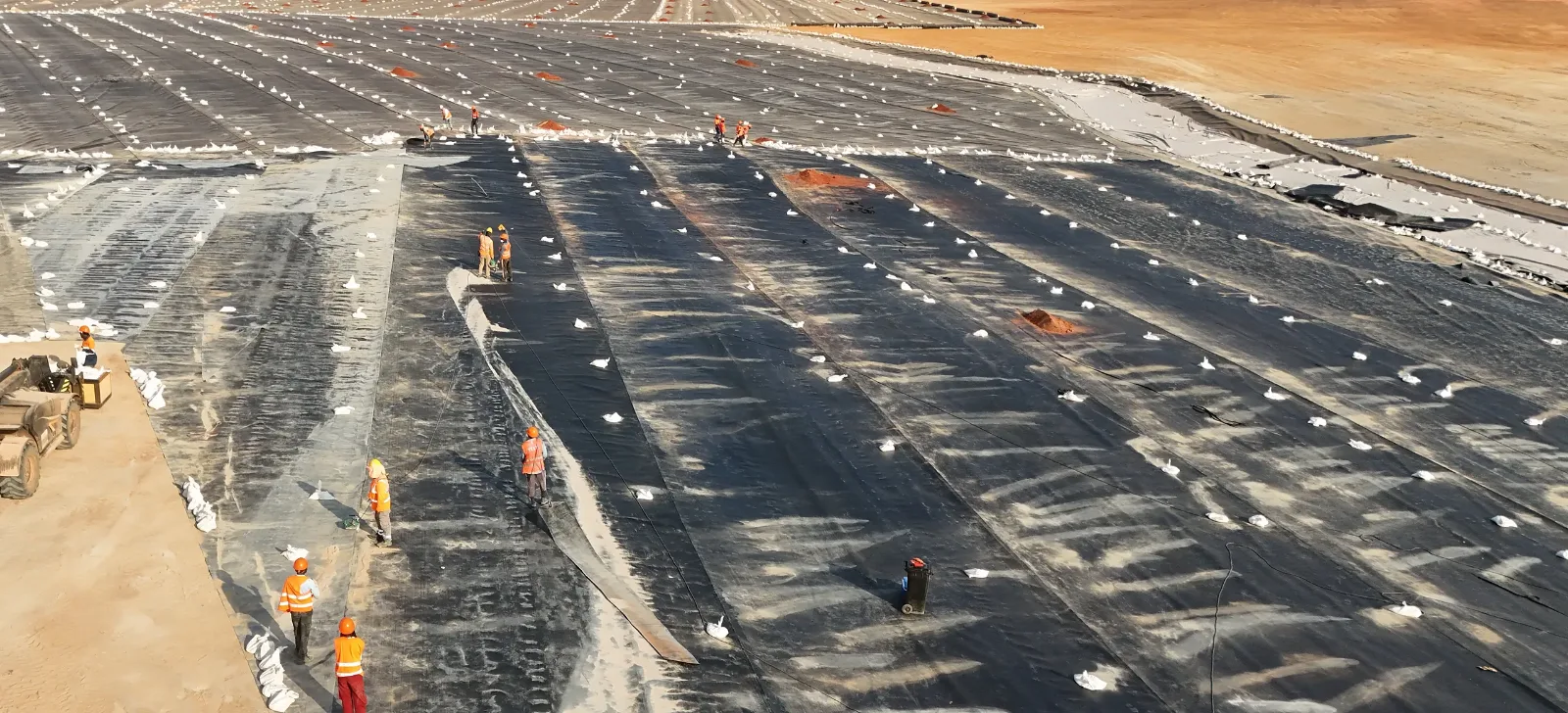
Most TSF liner specifications name a thickness, a surface type, and GRI-GM13. That combination is where the specification usually stops, and it's where the interesting questions actually start.
What GM13 does and doesn't tell you
GRI-GM13 sets minimum property requirements - density, carbon black content and dispersion, oxidative induction time, stress crack resistance - but a datasheet stating that a product "meets GM13" is not enough to approve material for a project. The applicable revision, surface type, nominal thickness, test method, acceptance value, testing frequency and traceability of the submitted results all still need confirming.
It's a manufacturing quality floor. It tells you the formulation is not defective. It does not tell you the material suits your tailings chemistry, your operating temperature, or your design life.
The two properties that govern service life
Stress crack resistance. GM13 requires a minimum of 500 hours under the ASTM D5397 single-point notched constant tensile load procedure. That threshold was raised from 200 to 300 hours in 2003, and from 300 to 500 in 2014 - and even so, investigations into field failures found that most of the geomembranes involved met GM13 when tested. Some practitioners now recommend specifying above 1000 hours, and above 2000 for critical facilities.
Slow crack growth is the failure mode that matters most in a TSF, because it happens at stresses well below yield, at locations you can't inspect once the facility is filling — gravel indentations, wrinkles, penetrations, seam edges.
Antioxidant depletion. GM13 sets OIT minimums of 100 minutes standard or 400 minutes high-pressure. HDPE oxidative degradation runs in three stages: antioxidants deplete first, with no significant change in engineering properties; then an induction period before oxidation begins; then property degradation through to nominal failure. Nominal failure is conventionally taken as the point where a selected property falls to 50% of its initial or specified value.
Stage one is the one you can influence at specification stage.
Why "the same resin" isn't the same product
This is the finding that should change how these specifications get written. Five 2 mm textured geomembranes made from the same nominal resin were tested in simulated leachate. Their initial properties and antioxidant depletion rates differed substantially, and at an expected liner temperature of 10°C the projected time to antioxidant depletion ranged from 125 years to over 2000 years.
Same thickness. Same nominal resin. A sixteenfold spread in projected durability. Related work has shown that geomembranes made from nominally the same resin but different production lots also degrade at different rates.
Nothing on a purchase order that says "2.0 mm HDPE, GM13" distinguishes the 125-year material from the 2000-year one.
Temperature is the driver, not UV
For covered liners, lifetime prediction is governed primarily by average field temperature. Elevated temperature is the most aggressive accelerator of oxidative ageing, and depletion is fastest in leachate, slower in water, and slowest in air.
Which is why any quoted service life without a stated temperature is meaningless — the difference between an Arrhenius projection at 20°C and one at 40°C is not marginal.
Solar exposure matters, but mostly during construction and on exposed slopes. Field measurement of a black 1.5 mm geomembrane found interface temperatures up to 40°C above ambient on sunny days, and temperatures at wrinkles up to 15°C higher again than where the liner was in intimate contact with the layer below. Wrinkles themselves are buckles formed by restrained thermal expansion under solar heating, and at one instrumented site as much as a third of the liner area corresponded to a wrinkle under peak solar radiation.
For African installations the practical implications are about scheduling and cover, not about buying a different polymer: deploy and cover within a controlled window, and expect elevated operating temperatures in your durability assumptions.
A note on thickness
Thickness governs puncture resistance and construction survivability, and it should be selected against subgrade grading, cover material, applied stress and settlement. It is not, however, a reliable proxy for durability. Studies covering nominal thicknesses from 0.5 to 2.4 mm of the same resin show the relationship between thickness and antioxidant depletion is not straightforward - thicker material is not automatically longer-lived material.
What to specify
- Stress crack resistance above the GM13 floor, sized to the consequence of failure
- HP-OIT rather than standard OIT alone, since it correlates better with service conditions
- The design temperature your durability assumption rests on, stated explicitly
- Formulation traceability: resin grade and producer, stabiliser package, carbon black source, plant, production lots
- Chemical compatibility assessed against your actual tailings chemistry, not a generic acid-alkali statement
And then verify it
Specification and delivery are different things. Conformance testing on the material actually arriving on site - not the manufacturer's type-test certificate from a previous production run - is what closes the gap. Because GM13 links stress crack testing frequency to formulation rather than requiring it on every roll, a stress crack report loses its relevance if the resin or additive package has changed.
The material that turns up is the material you get for the next forty years. It's worth the fortnight it takes to check.
We supply and install geomembrane containment systems across 30+ African countries, with full conformance testing and CQA documentation. Talk to our technical team before your specification is finalised.