
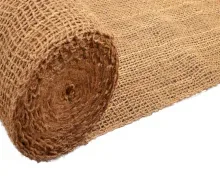
Erosion control blankets get specified the way few other geosynthetics do: by what they're made of. "Jute netting." "Coir blanket." Nobody would specify "a geomembrane" and leave it there, but natural-fibre erosion products are routinely bought on material alone.
The problem is that the material name spans a wide range of products, and the thing that separates them - mass per unit area - is invisible on site. Two rolls, same fibre, same weave, same colour. One is 40% heavier than the other. You cannot tell by looking, and neither can the contractor rolling it out.
What mass actually does
Mass per unit area isn't a proxy for quality. It's the direct driver of four things the blanket exists to do.
Ground contact. An erosion blanket works by intercepting raindrop energy before it reaches bare soil and by slowing sheet flow across the surface. Both depend on the blanket sitting on the soil, following its irregularities rather than bridging them. A heavier blanket drapes; a lighter one tents over hollows and clods, and every gap is a place where flow concentrates and starts scouring underneath.
Moisture retention. The blanket shades the soil surface and slows evaporation, which is what gets seed germinated and roots established. More fibre means more shading and more moisture held at the interface. On a slope where establishment is the whole point of the exercise, this is the difference between a green face in one season and a rescue job in the next.
Strength that survives installation. Blankets are handled, dragged, pegged and walked on. Tensile strength scales with fibre mass, and the strength that matters is what's left after installation, not what was measured on a lab coupon. A lighter blanket tears at peg points and along the roll edge, and a torn blanket concentrates the flow it was meant to spread.
Functional life. Natural fibres biodegrade - that's the point, and it's why they're specified over synthetics where the vegetation is the permanent solution. But the blanket has to outlast the establishment period. More fibre means a longer functional life before the mat opens up, which is the entire basis on which coir is chosen over jute for slower-establishing sites.
None of those four are marginal effects. All four scale with the number on the datasheet.
The grades that exist
Jute, 292 g/m². The established grade for jute erosion netting, and the benchmark the market was built on. Suited to slopes with moderate gradient and reasonably rapid vegetation establishment, where the fibre needs to hold for one growing season rather than several.
Coir, 350 g/m². Coir's advantage over jute is a slower breakdown rate, from higher lignin content. The 350 grade covers sites needing longer protection than jute provides, at moderate slope and flow conditions.
Coir, 450 g/m². The heavy grade, for the demanding end.
The move from 350 to 450 is driven by three things together, and any one of them can be the deciding factor:
- Slope gradient - steeper faces mean higher flow velocity, less stable ground contact and more mass needed to stay in place
- Expected flow velocity - channels, swales and concentrated-flow paths need more fibre than diffuse sheet flow across an open face
- Establishment period - the longer vegetation takes to take hold, the longer the blanket must remain functional, and the more fibre it needs to start with
Where two or three of those point upward, the heavier grade is the correct specification rather than the cautious one.
Why the material name isn't a specification
Write "coir erosion blanket" into a bill of quantities and you have specified a fibre, not a product. Anything from a light mat to a heavy one satisfies that wording, and the version that gets quoted will be the one that prices best - which is, necessarily, the lightest that can be described by those two words.
That isn't a supplier problem. It's a specification problem, and it's fixable in one line.
How to write it so it can't be substituted
Four elements, and all four are needed:
- The mass, stated as a minimum in g/m² - not "approximately," not a range
- The test method the mass is measured to, so there's no argument about how it was determined
- A mill certificate required with delivery, referencing the batch supplied
- The right to test a sample from the delivered rolls against the stated figure
The last two are what make the first two real. A specification with a number in it but no verification requirement is a number that gets met on paper.
Where SoilLock sits
SoilLock is our own erosion control range, specified at 292 g/m² for jute and 350 or 450 g/m² for coir. The grades are stated up front, not implied, and datasheets and mass certificates are available on request for any grade before you order or after you take delivery.
That last point is the one worth carrying into every quotation you compare, not just ours. Ask for the mass figure. Ask for the certificate. A supplier holding a genuine grade will send both without hesitation - and the ones that can't tell you what's on the pallet have answered the question anyway.
Speak to our technical team about grade selection for your slope, or request SoilLock datasheets and mass certificates.