
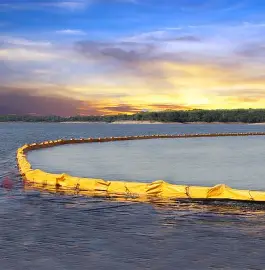
Silt curtains get ordered by depth and length. Those are the two numbers on the purchase order, and they're the two that matter least.
The class matters most, because a curtain specified below its site conditions doesn't contain less sediment — it distorts, drags, or tears away from its anchors, and then it contains nothing at all.
What the classes are
Type 1, 2 and 3 is a classification that came out of US state DOT practice and has been adopted worldwide. It isn't an ASTM or EN standard, which is worth knowing for two reasons: local regulators may specify differently, and published thresholds vary between suppliers. Check the figures against whatever product you're actually being quoted.
The mainstream convention:
Type 1 - protected water. No appreciable current, sheltered from wind and wave action. Ponds, small lakes, canals, enclosed basins. Light-duty fabric and connections.
Type 2 - moving water. Moderate current, typically rated to around 3.5 ft/s (roughly 1 m/s, or 2 knots), with light wave and tidal action. Rivers, harbours, ports. Higher-strength fabric and heavy-duty tension members.
Type 3 - demanding conditions. Considerable current, typically to around 5 ft/s (1.5 m/s, or 3 knots), with tidal movement, wind and significant wave activity. Heavy fabric, full tension cable, reinforced stress points.
Above roughly 5 ft/s, no standard class applies. That's a site-specific engineering problem and needs the manufacturer involved directly.
What actually changes between classes
The differences are structural, and they're not visible in a quotation line.
The tension member. Type 1 curtains generally rely on the fabric and flotation. Type 2 and Type 3 carry a tension cable along the top that takes the hydrodynamic load, so the fabric isn't structural. Without it, current load goes straight into the skirt and the seams.
Stress plates and corner reinforcement. Where the curtain connects to anchors and to adjacent panels, higher classes add aluminium stress plates and reinforced skirt corners. Those connections are where curtains fail under load.
Fabric strength. Higher class means heavier fabric and stronger seams, sized to the loads the class expects.
Skirt permeability. This is the one specifiers most often get backwards, and it's covered below.
Impermeable or permeable — and why higher current means permeable
Instinct says an impermeable skirt contains more sediment. In moving water, that instinct causes failures.
An impermeable PVC skirt in a current is a sail. The full hydraulic load lands on the barrier, and above modest velocities that pressure distorts the curtain, drags it out of position, or ruptures it. Heavy-duty curtains for high-current sites therefore use permeable geotextile skirts or filter panels: water passes through while sediment is retained, and the hydraulic pressure on the barrier bleeds off rather than building.
So the rule is roughly the inverse of intuition. Still water: impermeable, for maximum containment. Moving water: permeable, so the barrier survives long enough to contain anything at all.
The filtration performance then comes from the fabric's opening size relative to your sediment, which is a separate specification question worth asking about.
The three questions that set the class
Current velocity. Measure it, at the depth the skirt will occupy, at the worst state you expect. Peak flow after rain, or peak tidal flow, not the average on a calm day.
Wave and wind exposure. Fetch, prevailing wind, and vessel wake. A sheltered harbour with heavy boat traffic is not calm water.
Duration. A curtain deployed for three days and one deployed for six months face different cumulative loads, UV exposure and fatigue at connections. Long deployments justify a class above what the current alone would suggest.
Where two of the three point upward, go up a class. The cost difference between classes is small against the cost of a failed barrier and a turbidity exceedance.
The things that fail
Not the fabric, usually.
Anchoring. Curtains fail at their anchors more often than anywhere else. Anchor capacity has to match the hydrodynamic load on the full curtain area, and it must hold at peak flow, not average.
Bottom gap. A skirt that doesn't reach the bed lets sediment pass underneath. A skirt that's too long drags on the bottom, wears through, and pulls the flotation under. Skirt depth should suit the water depth at the state the curtain sees, allowing for tide.
Panel joins. Sediment escapes at connections between panels far more readily than through fabric. Joining method and hardware matter as much as the fabric class.
What to specify
- Class, with the current velocity and wave exposure it's being selected against
- Skirt permeability - impermeable or permeable, chosen for the flow condition
- Skirt depth, against water depth at the relevant tidal or flow state
- Tension member and stress plate details for Type 2 and 3
- Panel connection method and anchoring arrangement
- Deployment duration
A specification with all six can be quoted accurately and installed correctly. One that says "silt curtain, 3m deep, 200m" will be quoted as the cheapest thing that fits the description - which will be Type 1.
We supply silt curtains in Class 1 to 3 across Africa, with permeable and impermeable skirt options. Talk to our technical team about class selection for your site conditions.