
Open almost any road or working platform specification in Africa and you will find a line like: "Provide biaxial geogrid, minimum tensile strength 30 kN/m in both directions."
It looks rigorous. It gives the contractor a number, it gives the QS something to price, and it lets three suppliers quote on the same basis. The problem is that for a geogrid whose job is stabilisation, that number tells you almost nothing about how the road will perform.
This is not a contrarian view from a supplier. It is Tensar's own position, published for years. Many geogrid specifications focus on tensile strength, equating high ultimate tensile strength with better performance, when in reality UTS is irrelevant, particularly where a geogrid is used in the design of roads or temporary working platforms.
Two different jobs, two different products
The confusion comes from treating "geogrid" as one product category. It isn't. There are two distinct functions, and they need different properties.
Reinforcement is what a geogrid does in a retaining wall, a steep reinforced slope or a basal reinforcement layer over soft ground. The grid carries tensile load, so tensile strength genuinely matters, along with long-term design strength after creep, installation damage and durability reductions.
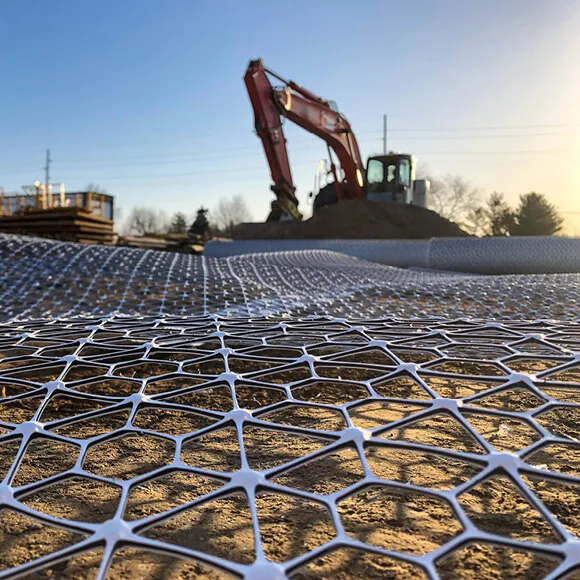
Stabilisation is what a geogrid does under a road, a haul road, a working platform or a rail trackbed. Here the grid is not primarily a tension member. It confines the aggregate placed on top of it so the granular layer behaves as a stiffer composite. An aggregate layer incorporating a stabilising geogrid performs as a composite through interlock and particle confinement between aggregate and geogrid, which prevents lateral movement of the granular material.
Specify the second job using the first job's criterion and you have measured the wrong thing.
The hammock problem
Tensar uses an analogy worth repeating, because it makes the mechanism obvious to anyone on site.
If a geogrid works by tension alone, it has to stretch before it does anything. The geogrid must be stretched to work, and when load is applied it curves to accommodate that load, much as a hammock does under a person, so the pavement deforms at the level where the geogrid sits. That deformation then shows up at the surface as rutting, cracking and potholes, shortening the road's operational life.
In other words, a high-strength grid relying on the tensioned membrane effect only mobilises its strength once the road has already deformed. On a haul road or a working platform, by the time the grid is working, you have the rut you were trying to prevent.
Confinement works differently. The aggregate locks into the apertures and cannot move laterally, so the layer stiffens without waiting for deformation to develop.
What actually governs stabilisation performance
If not tensile strength, then what? Tensar names the properties that matter for stabilisation: junction efficiency, rib height and radial stiffness, plus aperture geometry matched to the aggregate being used.
Junction efficiency is the one most often confused with junction strength. It is the strength of the node compared with the strength of the rib, expressed as a percentage, and it indicates how well the grid transfers load from one rib to ribs running in other directions. That distinction matters in specification writing: junction efficiency, not junction strength, is the parameter the European Assessment Document associates with stabilisation geogrid performance, and EOTA confirms these parameters are specific to the stabilisation function.
Radial stiffness matters because traffic loads spread radially from the wheel. A grid that is stiff in two directions but weak in between does not confine aggregate uniformly.
Rib profile and aperture size govern whether the aggregate actually interlocks. A grid with apertures poorly matched to the aggregate grading cannot confine it, whatever its datasheet says.
And critically: for roads, platforms, rail and other trafficked applications, geogrid strength does not correlate with in-ground performance, and the enhanced performance of a mechanically stabilised layer can only be measured through full-scale in-ground trafficking testing.
That last point is the crux. Stabilisation benefit is not a property you can read off a tensile test. It has to be measured by running loaded axles over real layers, thousands of times.
How a stabilisation geogrid should be specified
Tensar derives Stabilisation Factors from extensive full-scale trafficking trials and project experience, and applies them through its roadway design software; Tensar+ then calculates the benefit of the geogrid in unsurfaced and surfaced roads, covering both construction-phase and in-service traffic loading. T
he conclusion is that geogrid performance should be assessed as part of the whole system, because the benefit lies in how the geogrid interacts with the layers around it, and a geogrid stabilising ground beneath a road or a working platform needs different characteristics from one reinforcing a retaining wall.
Practically, that means writing the specification around the outcome rather than a tensile number. Three approaches work:
- Specify the required performance. State the design traffic, subgrade CBR, rut criterion and design life, and require the supplier to submit a design demonstrating the layer meets them, with the test basis for any claimed benefit.
- Specify by product and design. Name the geogrid and the design that produced the layer thickness, with "or approved equivalent" defined by equivalent full-scale trafficking evidence, not equivalent kN/m.
- If you must list properties, list the ones that govern the function: junction efficiency, rib geometry, aperture size relative to the aggregate grading, and radial stiffness.
Why this matters more in Africa than anywhere else
Two reasons.
First, aggregate. On most African projects, good crushed material is hauled long distances, and the cost of the pavement is dominated by the cost and cartage of that aggregate. Stabilisation converts directly into a thinner layer or a longer life, so the value of getting the geogrid right is far higher than the price difference between two products. Tensar states that incorporating a triaxial geogrid can result in aggregate savings of up to 50%, with corresponding reductions in cost, transport, construction time and emissions.
Second, substitution. A specification written as "minimum 30 kN/m biaxial geogrid" invites a supply of any grid that meets that number, including products with weak junctions, flat ribs or apertures that do not suit the local aggregate. The imported product meets the spec on paper, the road ruts in its first wet season, and nobody can point to a clause that was breached. The spec was the failure, not the delivery.
The practical takeaway
Before the next spec goes out, ask one question: is this geogrid reinforcing or stabilising?
If it is reinforcing a wall or slope, tensile strength and long-term design strength are the right criteria, and you should be comparing strength at working strain, not at break.
If it is stabilising a road, platform or trackbed, tensile strength is the wrong criterion. Ask for the design, the stabilisation factors and the trafficking evidence behind them.
Geosynthetics Africa is an official Tensar Associate for Africa. We can run your road, haul road or working platform through Tensar+ and return a design that quantifies the aggregate saving for your project. Tensar® is a registered trademark of Tensar International Corporation, a division of CMC.