
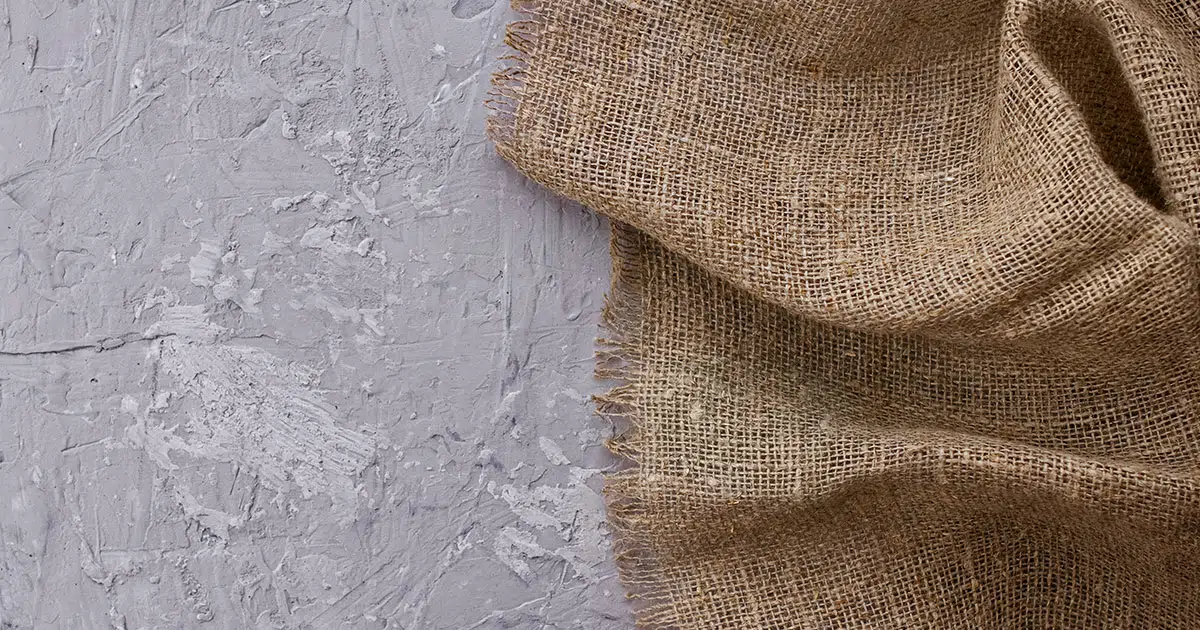
Curing burlap is a specified material
Burlap used to cure concrete has its own specification. The Portland Cement Association's Design and Control of Concrete Mixtures points directly to AASHTO M 182, the specification for burlap cloths made from jute or kenaf, and to ASTM C 171 for white burlap-polyethylene sheeting. Curing practice itself is governed by ACI 308.
That matters because the cloth is not packaging. It is the thing holding water against concrete while the cement hydrates, and the strength, durability and surface quality you specified depend on it doing that continuously for days.
Contamination is the real risk
PCA's guidance on this is blunt: burlap must be free of any substance that is harmful to concrete or that causes discolouration, and new burlap should be rinsed thoroughly in water to remove soluble substances and to make it more absorbent.
Two things follow from that single sentence.
Even new cloth needs rinsing before its first use. Jute is processed with batching oil during spinning, and there are soluble substances in new cloth that will otherwise end up on your concrete surface. Oil on fresh concrete means staining, and on a slab due to take a screed, tiles or paint, it means a bonding problem discovered by the next trade.
Used sacks carry whatever they carried. Fertiliser residue puts salts against fresh concrete. Cement residue hardens into lumps that print into the surface. Oil, mould and soil stain. Nobody can tell you what was in a bag bought second-hand, which means nobody can sign for it, and the consultant who asks the question is entitled to reject the pour's curing on that basis alone.
Weight is not a detail
The other habit worth breaking is buying by the piece rather than by the gram.
Curing works because a film of water remains on the concrete surface throughout the curing period. That is the standard PCA sets: the coverings should be kept continuously moist so that a film of water remains on the concrete surface for the whole period. A heavier, denser cloth holds more water and takes longer to dry out. A light, loose-woven sack dries in an hour of African sun, and a dry cloth on concrete does nothing.
Worse, it does harm. PCA warns that alternate cycles of wetting and drying during the early curing period may cause crazing of the surface. So a cloth that keeps drying between waterings is not merely failing to cure; it is actively producing a crazed, dusty finish. That is the mechanism behind most "we cured it and it still cracked" complaints on site.
This is why a specification should name a grade in g/m² rather than calling for "hessian". Lighter grades suit columns, beams and smaller slabs where rewetting is easy and frequent. Heavier grades belong on large slabs, pavements and any pour in hot, dry or windy conditions, where the interval between waterings is the thing that will defeat you.
What proper curing requires
The cloth is only half of it. The method is equally specified:
- Place it at the right moment. Wet coverings go on as soon as the concrete has hardened enough to prevent surface damage. Until then the surface must be protected from drying by other means, such as fogging.
- Cover everything, including the edges. PCA is explicit that care should be taken to cover the entire surface with wet fabric, including the edges of slabs. Slab edges are routinely left bare and are among the first surfaces to dry.
- Never let it dry and then rewet it. Continuous moisture, not intermittent soaking.
- Cure long enough. For slabs on ground and structural concrete at ambient temperatures above 5°C, the curing period should be a minimum of 7 days, with additional time as needed to reach 70% of the specified strength. Mass concrete needs far longer: unreinforced sections at least 2 weeks, extended to 3 weeks where the mix contains a pozzolan, and heavily reinforced mass sections a minimum of 7 days.
- Use polythene over the wet cloth where water is scarce. PCA describes this as good practice: a polyethylene film over wet burlap eliminates the need for continuous watering, and periodic rewetting of the fabric beneath the plastic before it dries is sufficient.
Why the window closes
If curing is interrupted, the concrete does not simply pause and resume.
PCA sets it out plainly: when moist curing is interrupted, strength development continues for a short period and then stops once the concrete's internal relative humidity drops to about 80%. If moist curing resumes, strength development reactivates, but the original potential strength may not be achieved. It can be done in a laboratory; in the field, it is difficult to resaturate concrete.
So the cloth that dried out over a weekend has not delayed your strength gain. It may have capped it.
The same guidance notes that wet coverings also cool the concrete through evaporation, which is a real benefit in hot weather and one that curing compounds do not provide.
Three questions for your supplier
- What grade is it, in g/m²? If the answer is "standard hessian", they do not know what they are selling.
- Can I see the mill certificate? Certified cloth has one. Sacks from a market do not.
- Is it new and unused? Anything else brings unknown contaminants onto your pour.
For a consultant or client, one question covers the same ground: is there a curing record for this pour, showing when the cloth went on, when it was rewetted and when it came off? Curing is the easiest step on site to skip and the hardest to prove afterwards, which is why it should be recorded as it happens rather than reconstructed at handover.
The cost comparison nobody runs
Curing cloth is one of the cheapest materials on a concrete job. The concrete it protects is one of the most expensive.
A slab that lost strength because the cloth dried out cannot be topped up. A surface that stained or crazed has to be ground, screeded or lived with. Set against that, the difference in price between proper curing burlap and a pile of used sacks is a rounding error on the pour.
Geosynthetics Africa supplies CureLock concrete curing hessian with mill certificates on every order, and installs it with documented daily curing records, across Africa.