
Resurfacing buys you a smooth road. It doesn't buy you a sound one. Within two to four years the cracks in the layer underneath work their way up through the new asphalt and reappear on the surface — same position, same spacing, same problem you thought you'd paved over. That's reflective cracking, and it's why overlays budgeted for twelve years get resurfaced again in five.
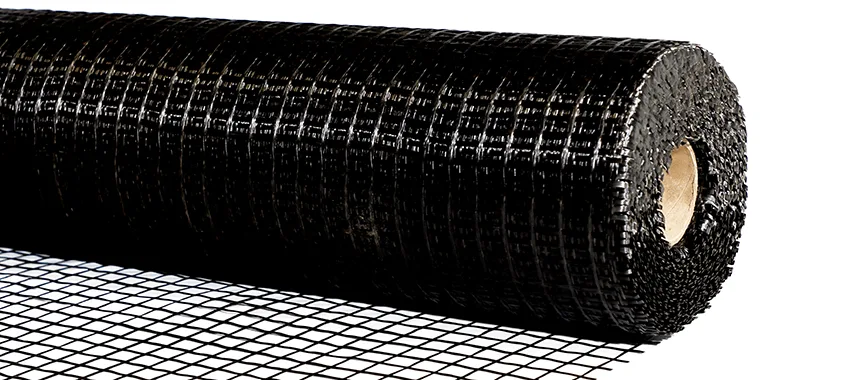
A fibreglass geogrid interlayer, laid between the old pavement and the new wearing course, changes that arithmetic.
Why the cracks come back
Every crack or joint below an overlay concentrates stress directly above itself. Two forces do the damage. The slab beneath expands and contracts with temperature, pulling the new asphalt horizontally. Wheel loads passing over the discontinuity flex each side independently, working the overlay vertically. Both funnel strain into a narrow band of fresh material, and that band goes first. Once water gets in you're no longer losing a surface - you're losing the structure.
Why fibreglass, and not polymer
The property that matters is stiffness, not ultimate strength.
Fibreglass reaches its working load at very low strain - it carries almost its full design capacity before the surrounding asphalt has stretched far enough to crack. A polymer grid at the same nominal tensile rating has to elongate several times further to mobilise the same resistance, and by then the overlay above it has already failed. High modulus at low strain is the entire mechanism, and it's the reason fibreglass remains the default interlayer for asphalt reinforcement.
Temperature is the second argument. Hot mix goes down at 140–160°C. Glass filaments and the polymer-modified coating both operate comfortably above that. Polyester and polypropylene interlayers are working much closer to their limits under the paver.
Our Fibreglass Geogrid SA range is manufactured to EN 15381, the European standard for geosynthetics in asphalt, and is CE marked.
Choosing a grade
The range runs in three grades, and the choice comes down to traffic loading, overlay thickness and the condition of what's underneath.
GG SA 50 - thin overlays, lightly trafficked roads, and general anti-crack duty where the pavement below is in fair condition.
GG SA 100 - the highway workhorse. Equal strength in both directions, so site orientation isn't critical, with the stiffness for heavy commercial traffic.
GG SA 200 - the demanding end. Airfield pavements, concrete joint reflection, and heavy rehabilitation where the crack pattern is directional. This grade is stronger in one direction than the other, so it must be laid with the strong direction running across the line of the crack. Get that wrong and you've paid for capacity you aren't using.
Standard rolls are 1.5 m wide and can be supplied up to 3 m, with lengths altered to suit the job. Full technical data is available on request.
Self-adhesive changes the site work
The SA is a pressure-activated adhesive backing. Unroll it, press it down, and it stays where you put it - no separate fixing, no waiting, and no grid lifting behind the paver, which is the single most common way interlayer installations go wrong.
What still has to be right:
- Surface preparation - clean, dry, free of loose material. Ruts and depressions get a regulating course before the grid goes anywhere near them
- Laying - flat and tensioned, with overlaps running in the direction of paving
- Orientation - critical on GG SA 200, where the strong direction has to cross the crack
- Traffic - paving plant only on the exposed grid, nothing else
Get the material right and the installation wrong, and you've bought an expensive separation layer.
Where it earns its cost
- Concrete pavement overlays - joints are the dominant crack source and the most predictable to reinforce against
- Fatigued asphalt rehabilitation - comprehensively cracked surface, structurally intact base
- Widening joints - the seam where new construction meets old
- Bridge approaches - differential settlement concentrating movement over a short length
- Airfields - high load intensity, short closure windows, expensive failures
The assessment that comes first
Fibreglass geogrid works when the pavement below is cracked but structurally sound. If the base has failed, no interlayer will save it - that's a reconstruction, and specifying reinforcement instead just delays the diagnosis. Getting that call right before you write the specification is the difference between a twelve-year overlay and an expensive lesson.
Fibreglass Geogrid SA is supplied ex-stock and installed by our own crews across 30+ African countries. Speak to our technical team about grade selection for your rehabilitation project.