
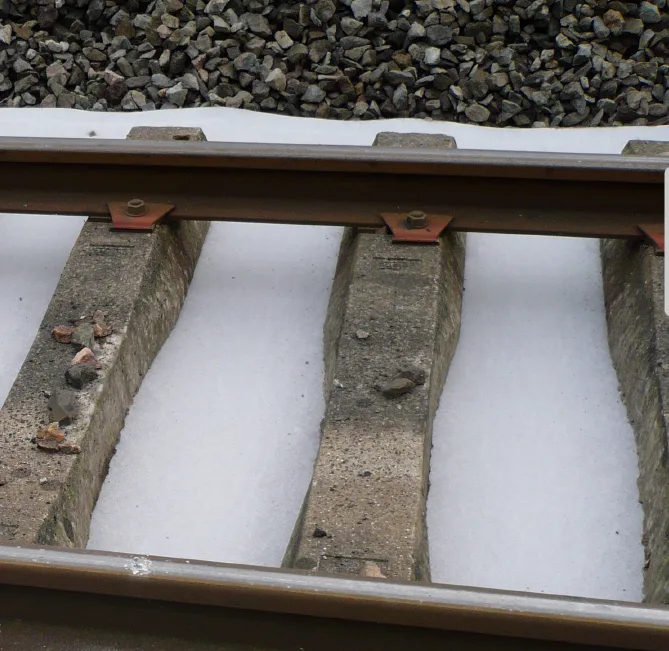
Geotextile Fabrics
Mirafi® AR20 - Abrasion Resistant Geotextile
Continuous filament needle-punched nonwoven with an abrasion-resistant additive and UV stabiliser, developed with European railway authorities for ballast separation. Vibrogir testing with SNCF to 200 hours - equivalent to 20 years at 100,000 load tons per day - confirmed no loss of puncture resistance and no major decrease in permeability or flow rate.
Overview
Mirafi® AR20 is a mechanically bonded continuous filament nonwoven incorporating an abrasion-resistant additive and UV stabiliser. It was developed together with major European railway authorities to meet the extreme mechanical stresses generated at the ballast interface, and combines the separation, filtration and drainage behaviour of a conventional nonwoven with substantially higher abrasion resistance.
Railway structures built over cohesive subgrades degrade in a predictable way. Water percolates through the ballast to the subgrade, dynamic traffic loading forms a slurry at the interface, and that slurry migrates upward into the ballast. The polluted ballast loses inter-particle friction, and bearing capacity and elasticity fall with it. Full rehabilitation of blanket and capping layers is slow, energy-intensive and usually has to be done around live traffic.
AR20 addresses this by acting as a separator between ballast and filter blanket. The ballast stays clean and retains its friction properties, so ballast-cleaning frequency drops. Ballast particles are held firm in the geosynthetic layer, reducing relative settlement, particle displacement and consequent track deflection, which in turn reduces tamping. Long-term drainage characteristics allow free water circulation, dissipation of pore-water pressure and evacuation of water rising from the subgrade.
Performance was validated using the vibrogir test developed with SNCF, in which the product is installed between ballast and blanket layers and loaded by a 20 tonne beam with eccentric wheels running at 50 Hz. Ten hours of vibrogir corresponds to one year of real traffic at 100,000 load tons per day. After 200 hours of testing - the equivalent of 20 years - pyramid-puncture testing to NF G 38 019 confirmed no loss in puncture resistance, with no major decrease in permeability or flow rate. Abrasion testing to ASTM D3884 on the same specimens supports a maximum working life of up to 20 years under that loading.
The practical consequence is that optimum bearing capacity can often be maintained by simple ballast cleaning rather than total layer refurbishment, with soft rehabilitation sufficient for more than 20 years.
Geosynthetics Africa supplies Mirafi AR20 across Africa, with delivery to more than 30 countries, technical support and installation by our own certified crews.
- MaterialUV-stabilised polypropylene with abrasion-resistant additive
- StructureContinuous filament needle-punched nonwoven
- ColourGrey
- StandardCE marked · ISO 9001 / 14001 / 45001
- Roll WidthContact for roll dimensions
- Roll LengthContact for roll dimensions
Typical Properties
| Property | Test Method | MIRAFI® S | MIRAFI® F | MIRAFI® P | MIRAFI® AR |
|---|---|---|---|---|---|
| Mass per Unit Area | EN ISO 9864 | 90–385 g/m² | 400–800 g/m² | 200–1,200 g/m² | - |
| Tensile Strength MD | EN ISO 10319 | 5–30 kN/m | 30–40 kN/m | 16–80 kN/m | - |
| CBR Puncture Resistance | EN ISO 12236 | 0.7–4.5 kN | 4.6–7.0 kN | 2.4–11.3 kN | |
| Opening Size O90 (CMD) | EN ISO 12956 | 85–135 µm | 80–90 µm | 70–110 µm | 55 µm |
| Permeability | EN ISO 11058 | 55–180 mm/s | 30–60 mm/s | 10–90 mm/s | 10 mm/s |
| Abrasion Resistance | ASTM D3884 | - | - | - | Tested |
| Mechanical Sustainability | Vibrogir (SNCF) | - | - | - | Up to 20 yrs @ 100,000 t/day |
| Liner Protection Efficiency | EN 13719 | - | - | 0.6–1.7% @ 300 kPa | - |
| ASQUAL Certification | - | ✓ S21–S82 | ✓ F60–F80 | ✓ P20–P120 | - |
| Roll Width | - | 2–6 m | 6 m | 6 m (5.2–5.4 m heavy grades) | 3.5–4 m |
Note: The above specifications represent the product family properties. Please refer to the product datasheet for individual SKU values.
Typical Applications
View all applicationsRoad and pavement separation
Separation of fine-grained subgrade from coarse aggregate in road and pavement construction, preventing intermixing so the load-distributing and drainage properties of the sub-base are retained. Reduces aggregate requirement and prevents the pumping that shortens pavement life. MIRAFI S, grade selected from subgrade strength, traffic loading and aggregate particle size.
Subsoil and trench drainage
Filter wrapping to French drains, fin drains, blanket drains and trench systems. The filter must pass water freely while retaining fines, with O90 between 0.08 and 0.12 mm and permeability of at least 50 l/m²s proven effective in practice. MIRAFI S for standard duty; MIRAFI F where clogging risk is high or the drain cannot be maintained.
Geomembrane liner protection
Cushioning geomembrane liners against puncture from the subgrade below and the drainage or ballast layer above. MIRAFI P is certified to EN 13719 for protection efficiency, the figure a liner designer specifies against, with deformation at 300 kPa from 1.7 % to 0.6 % across the range.
Tailings and heap leach facilities
Protection layers to TSF and heap leach pad liner systems, where liner integrity under placement and operational loading determines containment performance. MIRAFI P in heavy grades from P60 to P120, supported by MIRAFI S for underdrainage filtration.
Landfill capping and lining
Protection and separation layers in landfill basal lining and capping systems, including protection of the geomembrane from the leachate drainage stone above. MIRAFI P for protection, MIRAFI S for separation of cover soils.
Compatible Systems
View all systemsMIRAFI® S - Separation & Filtration
Mechanically bonded continuous-filament UV-stabilised PP nonwoven with a 50-year track record in separation and filtration of trafficked areas on weak soils. Nine grades from S21 to S82 (90–385 g/m²) cover garden paths and light access roads through to heavy vehicle platforms and road or rail formation, all ASQUAL certified. Permeability 55–180 mm/s, O90 85–135 µm.
MIRAFI® F - Anti-Clogging Filtration
Two-layer continuous-filament PP nonwoven - one layer engineered as the filter, the other as integral protection against filter damage. The construction delivers 25–40 constrictions through the filter layer, giving extremely low clogging risk and high soil retention security. Three grades: F60, F70 and F80 (400–800 g/m²), O90 80–90 µm. Resistant to chemical agents and microorganisms occurring in seas and rivers
MIRAFI® P - Geomembrane Liner Protection
Needle-punched continuous-filament PP nonwoven developed specifically for geomembrane protection efficiency. Nine grades from P20 to P120 (200–1,200 g/m²), certified to EN 13719 with deformation at 300 kPa from 1.7 % down to 0.6 %. CBR puncture 2.4–11.3 kN. Specified for tailings storage facilities, heap leach pads, landfill cells, reservoirs and dams.
MIRAFI® AR20 - Abrasion Resistance
Continuous-filament PP nonwoven with abrasion-resistant additive and UV stabiliser, developed with European railway authorities for the mechanical stresses at the ballast interface. Validated by vibrogir testing with SNCF: 200 hours of loading, equivalent to 20 years at 100,000 load tons per day, with no loss of puncture resistance and no major decrease in permeability or flow rate.
Installation Guidance
Standard Method Statement
Subgrade Preparation - Prepare a smooth, stable subgrade free from sharp objects, large stones, roots and debris that could damage the geotextile during installation.
Geotextile Placement - Unroll directly onto the prepared surface without wrinkles or folds, ensuring full contact with the underlying ground and correct panel orientation.
Overlaps & Seaming - Provide overlaps in accordance with project specifications and ground conditions. Increase overlap widths or use sewn seams where very weak subgrades are encountered.
Aggregate Placement - Place cover material carefully to prevent displacement or damage to the geotextile. Do not allow construction traffic directly on exposed geotextile unless specified by the engineer.
Quality Assurance & Testing
Field QA/QC Checklist
- Delivery & Storage: Rolls identified, stored and handled to ASTM D4873: wrapped, off the ground and protected from UV until installation.
- Material Conformance: Roll labels and certificates checked against the specified class (e.g. AASHTO M288) and properties: mass, tensile strength (ISO 10319 / ASTM D4632), CBR puncture (ISO 12236) and opening size.
- Subgrade Preparation: Surface cleared of sharp objects and graded so the geotextile lies flat without folds or bridging.
- Placement & Overlaps: Overlaps or sewn seams to the specified minimum; geotextile anchored against wind and placed in the direction of fill placement.
- Cover & Damage Check: Covered within the UV exposure limit stated by the manufacturer; tears or holes patched with an overlapping piece before covering.
Manufacturing Standards
- ASTM D4873 identification, storage and handling
- ASTM D4759 conformance to manufacturer specification
- ISO 10319 / ASTM D4632 tensile strength
- ISO 12236 CBR puncture resistance
- AASHTO M288 (where specified)
- CE marked · ISO 9001 / 14001 / 45001
Documents
Product Selection Guide
Compare performance properties across the entire category hierarchy before specifying.
Installation & Method Statement
Standard deployment procedures, installation specifications, and field application method statements.
QA/QC Site Checklist
Field quality control procedures, inspection checklists, and testing standards to verify installation integrity.
Technical Data Sheet (TDS)
Guaranteed minimum average roll values (MARV) and material testing properties.
Chemical Resistance / Accessories Guide
Chemical compatibility matrix and list of auxiliary materials needed for installation.
Projects Using Mirafi® AR20 - Abrasion Resistant Geotextile
Submit your BOQ.
Get a quote – not just a price.
Upload your BOQ or speak to our technical team for expert recommendations and support.