
Erosion Control & Geocells
Wood Wool Erosion Control Blanket – EnviroWool SoilLock 440
Wood wool erosion control blanket (excelsior), Type 3B, 440 gsm, for medium to high risk slopes up to 1.5:1. Populus canescens wood wool stitched between two photodegradable nets, with a functional longevity of 12 to 24 months. Rolls cover 125.9 m². Stocked in South Africa, delivered across Africa.
Overview
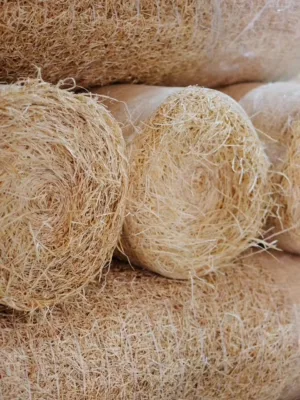
The EnviroWool SoilLock 440 is a Type 3B wood wool erosion control blanket for short to medium term slope and channel protection. The core is Populus canescens wood wool, also called excelsior: long, curled wood fibres that interlock to form a dense, three-dimensional mat. The fibres are sewn in place between two lightweight, photodegradable polypropylene nets, stitched with biodegradable yarn on 50 mm centres.
Laid over a freshly seeded slope, the blanket absorbs the impact of falling rain, slows sheet flow across the surface, and holds seed and topsoil in place long enough for vegetation to take hold. Curled wood fibre holds moisture against the soil surface, which helps germination on hot, exposed sites, and the dense mat gives better ground contact and more surface roughness than a straw blanket.
Under the FHWA FP-03 specification, a Type 3B blanket is rated for slopes with gradients not exceeding 1.5:1 (h:v). That makes this the grade to use where erosion risk is medium to high and slopes are steeper than a straw blanket can handle: road and rail cuttings, embankments, mine rehabilitation, landfill caps, pipeline reinstatement, dam and canal banks, and stormwater channels with light to moderate flows.
Functional longevity is 12 to 24 months, depending on climate, soil and UV exposure, which is roughly double that of a straw blanket. That extra life matters where vegetation is slow to establish: low rainfall areas, poor or acidic soils, high altitude, winter planting, or slopes that face into the sun. The blanket then degrades into the soil and leaves nothing to remove.
Each roll is 2.45 m wide by 51.4 m long, covering 125.9 m², at a mass of 440 g/m². Rolls are tightly rolled and wrapped for transport and site storage.
Installation: shape, track and seed the slope first, then dig an anchor trench at the crest. Roll the blanket down the slope in the direction of flow, never across it, with adjacent rolls overlapped and pinned. Fix with steel staples or biodegradable stakes at the spacing the slope gradient requires, and keep the blanket in continuous contact with the soil surface, since water running beneath a blanket erodes as fast as water on bare ground.
Where slopes are steeper than 1.5:1, flows are heavier, or establishment will take longer than two years, move up to a coir (coconut fibre) Type 4B blanket. On flatter, lower-risk slopes, a straw blanket is the more economical choice. Send us the slope geometry, soil and flow conditions and we will recommend the right grade rather than the most expensive one.
Stocked in South Africa with delivery across Africa, supplied with technical data, installation guidance and project support from our engineering team.
- MaterialPopulus canescens wood wool (excelsior)
- StructureDouble-net, stitched on 50 mm centres
- ColourNatural wood fibre
- StandardType 3B (FHWA FP-03), 440gsm
- Roll Width2.45 m
- Roll Length51.4 m roll (125.9 m² per roll)
Typical Properties
| Property | Test Method | Value |
|---|---|---|
| Material | - | Populus canescens wood wool (excelsior) |
| Construction | - | Wood wool matrix - sewn between two photodegradable PP nets - 50mm centres |
| ECTC Classification | - | Type 3B |
| Mass per unit area | ASTM D6475 | 440 g/m2 |
| Roll width | - | 2.45 |
| Roll length | - | 51.4 |
| Roll area | - | 125 |
| Roll weight | - | +/- 53kg |
| Material thickness | ASTM D6525 | +/- 9mm |
| C-Factor | ASTM D6459 | Less than 0.05 |
| MD tensile strength | ASTM D6818 | 2.4 kN/m |
| TD tensile strength | ASTM D6818 | 1.2 kN/m |
| Light penetration | ASTM D6567 | +/- 36% |
| Water absorption | ASTM D1117 | 171% |
| Shear stress | ASTM D6460 | Greater than 100Pa |
| Netting | - | Photodegradable polypropylene - both sides |
| Stitching | - | Biodegradable yarn - 50mm centres |
| Seed content | - | 100% seed-free - sterile |
| Functional longevity | - | Up to 24 months - climate and soil dependent |
| Residue | - | Zero - fully organic |
Note: The above specifications represent the product family properties. Please refer to the product datasheet for individual SKU values.
Typical Applications
View all applicationsSteep Embankments & High-Rainfall Slopes
EnviroWool SoilLock 440 is specified on steep cut and fill embankments on road, highway, and infrastructure projects where standard straw blankets are insufficient by gradient or rainfall intensity. The 440 g/m2 wood wool matrix withstands higher hydraulic loads while providing a protected microenvironment for vegetation establishment. Type 3B classification and certified C-factor satisfy road authority specifications that require demonstrated performance data.
Mine Rehabilitation & Tailings Closure
EnviroWool SoilLock 440 is widely used on mine waste dump slopes, tailings dam embankments, and disturbed land rehabilitation where 24-month functional longevity is required to support slower-establishing indigenous vegetation and meet environmental closure compliance requirements. The 100% seed-free and sterile construction introduces no weed seed to sensitive rehabilitation surfaces - a critical requirement on mining closure projects across sub-Saharan Africa
Low to Moderate Velocity Channels & Drainage
With shear stress capacity exceeding 100Pa tested to ASTM D6460, EnviroWool SoilLock 440 is appropriate for low to moderate velocity drainage channel lining, stormwater outlet protection, and canal bank stabilisation where straw blankets would be displaced under flow. The dense wood wool matrix reduces overland flow velocity and prevents soil particle migration during the vegetation establishment period.
Environmental Rehabilitation & Conservation Areas
EnviroWool SoilLock 440 is the correct specification for environmentally sensitive rehabilitation projects, riparian zones, and conservation areas where weed introduction and chemical contamination are compliance risks. 100% seed-free, sterile, and free of adhesives and chemicals - the blanket biodegrades fully in service, leaving zero plastic residue on the rehabilitated surface.
Compatible Systems
View all systemsEnviroWool SoilLock 440 - Steep Embankments & High-Rainfall Slopes
The primary application for EnviroWool SoilLock 440 is steep embankment protection on road, highway, and infrastructure projects where standard straw blankets are insufficient by specification or site conditions. At 440 g/m2 and Type 3B classification, the wood wool matrix withstands higher rainfall intensities and slope gradients while providing a protected microenvironment for vegetation establishment. Certified C-factor of less than 0.05 satisfies road authority and consultant specifications that require demonstrated performance data.
EnviroWool SoilLock 440 - Mine Rehabilitation & Tailings Closure
EnviroWool SoilLock 440 is well suited to mine waste dump slopes, tailings dam embankments, and disturbed land rehabilitation where 24-month functional longevity is required to support slower-establishing indigenous vegetation and meet environmental closure compliance requirements. The 100% seed-free and sterile construction introduces no weed seed or unpredictable organic material to sensitive rehabilitation surfaces - a critical requirement on mining closure projects across sub-Saharan Africa.
EnviroWool SoilLock 440 - Low to Moderate Velocity Channels & Drainage
With a shear stress capacity exceeding 100Pa tested to ASTM D6460, EnviroWool SoilLock 440 is appropriate for low to moderate velocity drainage channel lining, stormwater outlet protection, and canal bank stabilisation where straw blankets would be displaced under flow. The dense wood wool matrix reduces overland flow velocity and prevents soil particle migration during the vegetation establishment period.
Installation Guidance
Standard Method Statement
EnviroWool SoilLock 440 installation requires no specialist tools or equipment. The critical requirements are correct surface preparation, proper anchor trenching at the top and toe of each slope run, and consistent pegging at specified centres. Poor soil contact and inadequate anchorage are the two primary causes of installation failure - both are preventable with correct procedure.
1. Surface Preparation - Grade and compact the slope surface and remove all rocks, debris, and loose material. Fine-grade to ensure full contact between the blanket and soil throughout. Apply topsoil to adequate depth to provide a seedbed and distribute seed consistently across the surface before blanket installation.
2. Anchor Trenches - Excavate anchor trenches at the top and toe of each slope run to a minimum depth of 500mm. Fold the blanket into the trench, backfill with compacted soil, and peg through the blanket at the trench edge. This anchorage is non-negotiable - unanchored blanket ends are the most common cause of installation failure on steep slopes.
3. Direction of Installation - On slopes up to 1:3 (18 degrees), install rolls horizontally along the contour working from the base of the embankment upward, with each upper roll laid on top of the lower roll. On slopes steeper than 1:3, unroll from the top of the embankment down to the toe.
4. Pegging - Peg through the blanket face at approximately 1m centres using wood pegs or steel U-pins with a minimum leg length of 270mm, driven flush with the blanket surface. Increase peg density near the toe of long slopes and in drainage channel applications where peak flow velocities are higher.
5. Overlaps and Joints - Maintain a minimum 100mm overlap between adjacent rolls. On steep slopes, shingle overlaps downslope so the upper roll overlaps the lower roll, preventing water ingress beneath the joint. Peg through all overlap zones at maximum 500mm centres. Average installation rate is 4-5 rolls per hour - allow for overlap deductions when calculating quantities.
Quality Assurance & Testing
Field QA/QC Checklist
- Delivery & Storage: Materials checked against the delivery note and conformance certificates, stored off the ground, covered from UV and kept clear of sharp objects and fuel.
- Material Conformance: Product category checked against the design (e.g. ECTC classification); tensile strength (ASTM D6818) and performance data (ASTM D6459 slopes / ASTM D6460 channels).
- Seedbed Preparation: Slope graded smooth, topsoiled and seeded before installing the blanket; clods and stones removed.
- Anchor Trench & Stapling: Top anchor trench, overlaps (upslope over downslope) and staple pattern to the manufacturer's guide.
- Contact & Inspection: Blanket in full contact with the soil; inspected after rainfall and repaired where undermined.
Manufacturing Standards
- ASTM D6818 tensile properties
- ASTM D6459 slope erosion performance
- ASTM D6460 channel erosion performance
- Erosion Control Technology Council (ECTC) specifications
- Type 3B (FHWA FP-03), 440gsm
Documents
Product Selection Guide
Compare performance properties across the entire category hierarchy before specifying.
Installation & Method Statement
Standard deployment procedures, installation specifications, and field application method statements.
QA/QC Site Checklist
Field quality control procedures, inspection checklists, and testing standards to verify installation integrity.
Technical Data Sheet (TDS)
Guaranteed minimum average roll values (MARV) and material testing properties.
Chemical Resistance / Accessories Guide
Chemical compatibility matrix and list of auxiliary materials needed for installation.
Projects Using Wood Wool Erosion Control Blanket – EnviroWool SoilLock 440
Submit your BOQ.
Get a quote – not just a price.
Upload your BOQ or speak to our technical team for expert recommendations and support.