
EnviroWool SoilLock 440 - 440gsm Wood Wool Erosion Control Blanket
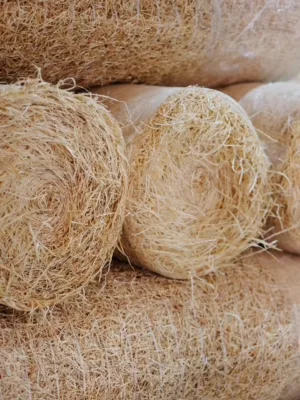
EnviroWool SoilLock 440 is a 440gsm Type 3B wood wool erosion control blanket made from Populus canescens excelsior sewn between two photodegradable polypropylene nets. Supplied in 2.45m x 51.4m rolls for demanding slope stabilisation, embankment protection, and vegetation establishment where higher mass, extended longevity, and certified C-factor performance are required. Functional longevity up to 24 months. C-factor less than 0.05 tested to ASTM D6459.
Technical Specification of EnviroWool SoilLock 440 - 440gsm Wood Wool Erosion Control Blanket
EnviroWool SoilLock 440 is a high-performance biodegradable erosion control blanket engineered from Populus canescens wood wool (excelsior) - shredded branch and trunk material - sewn between two lightweight photodegradable polypropylene nets on 50mm centres using biodegradable yarn. Classified as a Type 3B erosion control blanket, it is designed for projects where standard straw blankets are insufficient and higher erosion resistance, greater mass, and longer functional life are required by the specification.
At 440 g/m2 and 9mm thickness, EnviroWool SoilLock 440 delivers a denser, more robust protective layer than straw alternatives. The wood wool fibre matrix intercepts rainfall impact, dramatically reduces overland flow velocity, and retains surface moisture through the critical vegetation establishment period. With a certified C-factor of less than 0.05 (ASTM D6459) and shear stress capacity exceeding 100Pa (ASTM D6460), it satisfies performance-driven tender specifications where demonstrated erosion control data is required by engineers and environmental authorities.
EnviroWool SoilLock 440 is 100% seed-free and sterile - it imports no unpredictable organic material or weed seed onto site, making it the correct choice for environmentally sensitive rehabilitation projects, conservation areas, and sites where invasive species introduction is a compliance risk. No adhesives or chemicals are used in manufacture.
EnviroWool SoilLock 440 has a functional longevity of up to 24 months, degrading progressively in service as vegetation establishes. The photodegradable PP net breaks down under UV exposure and the wood wool matrix biodegrades into the soil, adding organic matter. No removal is required. No plastic residue remains. Supplied tightly rolled and wrapped in 2.45m x 51.4m rolls - 125m2 coverage per roll - for transport to remote and site-restricted locations across Africa.
Typical Values for EROSION CONTROL GEOCELLS
Properties & Dimensions
| Property | Test Method | Value |
|---|---|---|
| Material | - | Populus canescens wood wool (excelsior) |
| Construction | - | Wood wool matrix - sewn between two photodegradable PP nets - 50mm centres |
| ECTC Classification | - | Type 3B |
| Mass per unit area | ASTM D6475 | 440 g/m2 |
| Roll width | - | 2.45 |
| Roll length | - | 51.4 |
| Roll area | - | 125 |
| Roll weight | - | +/- 53kg |
| Material thickness | ASTM D6525 | +/- 9mm |
| C-Factor | ASTM D6459 | Less than 0.05 |
| MD tensile strength | ASTM D6818 | 2.4 kN/m |
| TD tensile strength | ASTM D6818 | 1.2 kN/m |
| Light penetration | ASTM D6567 | +/- 36% |
| Water absorption | ASTM D1117 | 171% |
| Shear stress | ASTM D6460 | Greater than 100Pa |
| Netting | - | Photodegradable polypropylene - both sides |
| Stitching | - | Biodegradable yarn - 50mm centres |
| Seed content | - | 100% seed-free - sterile |
| Functional longevity | - | Up to 24 months - climate and soil dependent |
| Residue | - | Zero - fully organic |
Popular Catalogue Items
Wood Wool Erosion Control Blanket – EnviroWool SoilLock 440
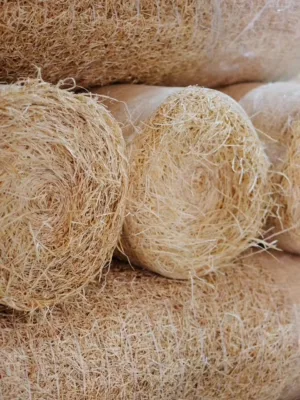
Wood wool erosion control blanket (excelsior), Type 3B, 440 gsm, for medium to high risk slopes up to 1.5:1. Populus canescens wood wool stitched between two photodegradable nets, with a functional longevity of 12 to 24 months. Rolls cover 125.9 m². Stocked in South Africa, delivered across Africa.Related Product Groups
Three Questions To Ask Before You Order
1.What is EnviroWool SoilLock 440 and how does it differ from straw erosion blankets?
2.What is wood wool and where does it come from?
3.What does the Type 3B classification mean and why does it matter for tenders?
4.Is EnviroWool SoilLock 440 suitable for environmentally sensitive and conservation sites
5.How long does EnviroWool SoilLock 440 last and does it need to be removed?
6.What anchorage and overlap is required during installation?
Specification For The Design, Installation Of EnviroWool SoilLock 440 - 440gsm Wood Wool Erosion Control Blanket
EnviroWool SoilLock 440 installation requires no specialist tools or equipment. The critical requirements are correct surface preparation, proper anchor trenching at the top and toe of each slope run, and consistent pegging at specified centres. Poor soil contact and inadequate anchorage are the two primary causes of installation failure - both are preventable with correct procedure.
1. Surface Preparation - Grade and compact the slope surface and remove all rocks, debris, and loose material. Fine-grade to ensure full contact between the blanket and soil throughout. Apply topsoil to adequate depth to provide a seedbed and distribute seed consistently across the surface before blanket installation.
2. Anchor Trenches - Excavate anchor trenches at the top and toe of each slope run to a minimum depth of 500mm. Fold the blanket into the trench, backfill with compacted soil, and peg through the blanket at the trench edge. This anchorage is non-negotiable - unanchored blanket ends are the most common cause of installation failure on steep slopes.
3. Direction of Installation - On slopes up to 1:3 (18 degrees), install rolls horizontally along the contour working from the base of the embankment upward, with each upper roll laid on top of the lower roll. On slopes steeper than 1:3, unroll from the top of the embankment down to the toe.
4. Pegging - Peg through the blanket face at approximately 1m centres using wood pegs or steel U-pins with a minimum leg length of 270mm, driven flush with the blanket surface. Increase peg density near the toe of long slopes and in drainage channel applications where peak flow velocities are higher.
5. Overlaps and Joints - Maintain a minimum 100mm overlap between adjacent rolls. On steep slopes, shingle overlaps downslope so the upper roll overlaps the lower roll, preventing water ingress beneath the joint. Peg through all overlap zones at maximum 500mm centres. Average installation rate is 4-5 rolls per hour - allow for overlap deductions when calculating quantities.
Featured Projects Across Africa
Related Resources
Common ENVIROWOOL SOIL EROSION BLANKETS Applications
Request a Quote for This Product Family
Upload your BOQ, drawings, or specifications and our technical team will provide a detailed proposal.
Have a project? Start with us.
Get expert engineering support, reliable material supply, and best-in-class installation.