
GeoStrata HDPE Geocell - Virgin HDPE Cellular Confinement System
GeoStrata is a 100% virgin HDPE 3D cellular confinement geocell system engineered for soil stabilisation, load support, slope protection, retaining wall construction, channel lining, and unpaved road improvement across Africa. Manufactured to ASTM standards with sheet thickness of 1.65mm minimum, seam peel strength exceeding 1065N per seam, and ESCR exceeding 5000 hours. Supplied in large-format 3m x 11m panels for rapid deployment. Available in five weld spacings from GS 330 to GS 712, and cell depths from 75mm to 250mm - the complete geocell range for every African civil, mining, and infrastructure application.
Technical Specification of GeoStrata HDPE Geocell - Virgin HDPE Cellular Confinement System
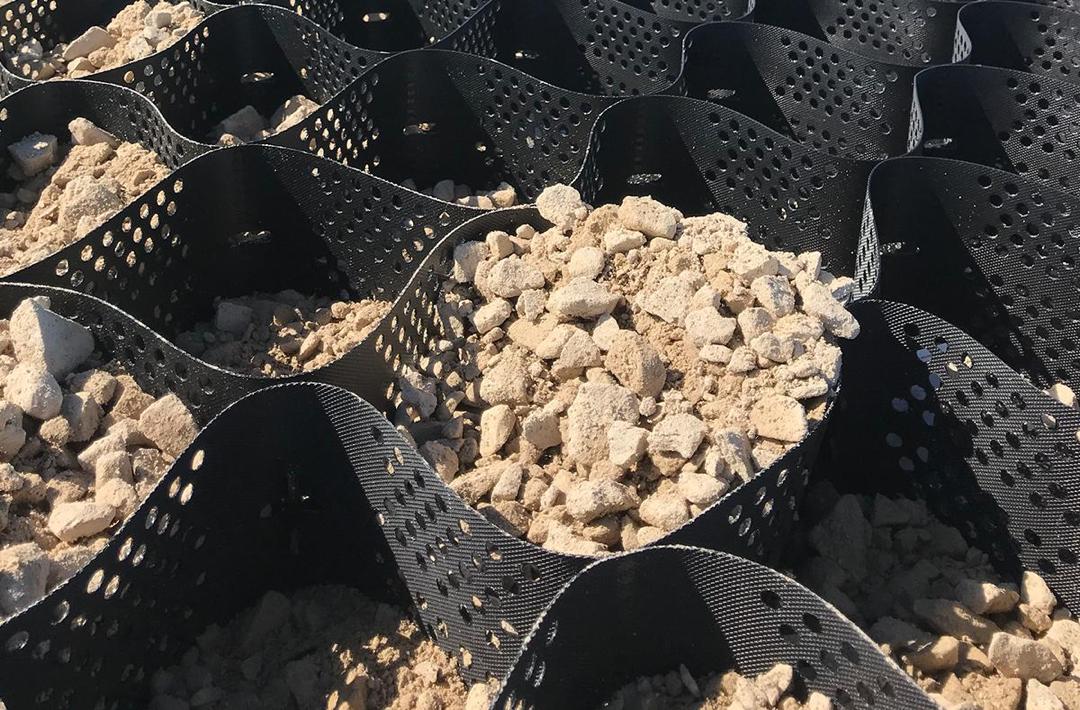
GeoStrata HDPE Geocell is a high-performance 3D rhomboidal cellular confinement system manufactured from 100% virgin high-density polyethylene to ASTM standards. When expanded on site, the interconnected honeycomb cell structure confines infill material - soil, aggregate, concrete, or sand - and transforms weak or unstable ground into a stable, load-bearing platform. The confinement effect prevents lateral movement of infill, dramatically increasing bearing capacity and reducing differential settlement without the need for deep excavation or mass concrete.
GeoStrata geocells are manufactured with a textured cell wall surface and perforated strips, maximising friction between the cell wall and infill material and allowing drainage through the cell structure. The rhomboidal indentation texture - with a surface density of 22 to 32 indentations per cm2 - ensures full composite action between geocell and infill under load. Cell perforations are limited to less than 12% of cell surface area, maintaining structural integrity while allowing pore pressure dissipation.
The GeoStrata range covers five weld spacings from GS 330 to GS 712 and cell depths from 75mm to 250mm - providing engineers with the correct confinement geometry for every application from light-duty gravel driveways and workshop yards to heavily loaded mine haul road bases, reinforced retaining walls, and high-velocity channel linings. All grades are supplied in large-format 3m x 11m panels, significantly reducing joint frequency and installation time versus standard-format panels.
GeoStrata HDPE Geocell is stocked and distributed by Geosynthetics Africa with pan-African logistics capability. Full technical support, application-specific grade selection, design assistance, and installation guidance are provided as standard. GeoStrata is the default geocell specification for engineers, contractors, and procurement teams across mining, roads, civil infrastructure, environmental, and water management sectors in sub-Saharan Africa.
Typical Values for EROSION CONTROL GEOCELLS
Properties & Dimensions
| Property | Test Method | GS HD330 | GS HD356 | GS HD445 | GS HD660 | GS HD712 |
|---|---|---|---|---|---|---|
| Weld spacing (±3 %) | - | 330 mm | 356 mm | 445 mm | 660 mm | 712 mm |
| Expanded cell width (±3 %) | - | 244 mm | 259 mm | 320 mm | 488 mm | 508 mm |
| Expanded cell length (±3 %) | - | 210 mm | 224 mm | 287 mm | 436 mm | 475 mm |
| Expanded section width (±3 %) | - | 3 m | 3 m | 3 m | 3 m | 3 m |
| Expanded section length (±3 %) | - | 11 m | 11 m | 11 m | 11 m | 11 m |
| Expanded section area (±3 %) | - | 33 m² | 33 m² | 33 m² | 33 m² | 33 m² |
| Cell depths available | - | 75–300 mm | 75–300 mm | 75–300 mm | 75–300 mm | 75–300 mm |
| Material | - | HDPE | HDPE | HDPE | HDPE | HDPE |
| Polymer density | ASTM D1505 / D792 | 0.935–0.965 g/cm³ | 0.935–0.965 g/cm³ | 0.935–0.965 g/cm³ | 0.935–0.965 g/cm³ | 0.935–0.965 g/cm³ |
| Carbon black content | ASTM D1603 / D4218 | Min. 2.0 % | Min. 2.0 % | Min. 2.0 % | Min. 2.0 % | Min. 2.0 % |
| Sheet thickness (post texturing) | ASTM D5199 | Min. 1.65 mm | Min. 1.65 mm | Min. 1.65 mm | Min. 1.65 mm | Min. 1.65 mm |
| ESCR | ASTM D1693 | >5000 hours | >5000 hours | >5000 hours | >5000 hours | >5000 hours |
| Cell wall texture | - | Rhomboidal indentations | Rhomboidal indentations | Rhomboidal indentations | Rhomboidal indentations | Rhomboidal indentations |
| Cell perforations | - | Max. 10 mm dia | Max. 10 mm dia | Max. 10 mm dia | Max. 10 mm dia | Max. 10 mm dia |
Popular Catalogue Items
GeoStrata™ HDPE Geocell - Cellular Confinement System
Textured, perforated HDPE cellular confinement system in five weld spacings from 330 mm to 712 mm and seven cell depths from 75 mm to 300 mm, supplied in 3 m × 11 m panels at 33 m² expanded. For slope stabilisation, load support, channel protection and retaining walls across Africa.Related Product Groups
Three Questions To Ask Before You Order
1.What does the GeoStrata product code mean - for example GS 100-445?
2.What is the minimum subgrade CBR I can work with using GeoStrata?
3.Which grade do I specify for a mine haul road on weak subgrade?
4.Can GeoStrata be used for retaining wall construction and what height is achievable?
5.What infill material should I use and does it need to be compacted?
6.How do I connect adjacent GeoStrata panels and what happens at boundaries?
7.What is the difference between GeoStrata virgin HDPE and recycled-content geocells?
Specification For The Design, Installation Of GeoStrata HDPE Geocell - Virgin HDPE Cellular Confinement System
Subgrade Preparation - Strip and trim the formation to the required level and remove all organic material, loose debris, and soft spots. Proof-roll the subgrade and cut out any weak areas before geocell installation. Place a 150-200 g/m2 non-woven geotextile separation layer over the prepared subgrade on all road base and load-bearing applications to prevent fines migration into the geocell infill layer under dynamic loading.
Panel Deployment - Unfold GeoStrata panels from the collapsed transport configuration and expand to full working dimensions by pulling from opposite corners until the panel reaches 3m x 11m. Work systematically across the site, connecting adjacent panels using the supplied connection pins or clips at all seam points before any infill is placed. Never infill a panel before its neighbours are connected - unconnected edges displace under compaction loading.
Boundary Anchorage - At all free edges, slope crests, toe trenches, and channel banks, drive steel anchor pins through the cell walls at maximum 1m centres at an angle into the subgrade. On slopes, anchor the upslope edge of each panel row before infilling using anchor pins at 500mm centres. On retaining wall applications, connect tendon straps to anchor pins at the crest as specified by the wall designer. Boundary anchorage is non-negotiable - unanchored panel edges are the primary cause of geocell installation failure.
Direction of Installation on Slopes - Install panels working from the toe of the slope upward. Each upper panel row overlaps the lower by a minimum of one full cell. Connect all seams between rows with pins at maximum 500mm centres. Use tendon straps anchored at the slope crest to prevent downslope creep of the geocell layer under sustained gravity load on slopes steeper than 1:2.
Infilling and Compaction - Fill cells with the specified infill material to 25-50mm proud of the cell top to allow for compaction settlement. Compact using a vibrating plate compactor working parallel to the slope gradient - never perpendicular. Do not allow compaction plant to operate on unfilled or partially filled cells. For vegetated applications, overfill by 10-15mm above the cell top with topsoil to allow for settlement and root establishment after vegetation cover is achieved.
Channel and Hydraulic Applications - Install panels working from the downstream end upstream so that each upper panel overlaps the lower in the direction of flow. Peg at maximum 750mm centres throughout the channel base and banks to resist hydraulic drag under peak flow conditions. For concrete-filled channel lining, place and strike the concrete within the geocell cells before adjacent panels are infilled to prevent cell displacement during pour.
Featured Projects Across Africa
Related Resources
Common GEOSTRATA HDPE GEOCELLS Applications
Request a Quote for This Product Family
Upload your BOQ, drawings, or specifications and our technical team will provide a detailed proposal.
Have a project? Start with us.
Get expert engineering support, reliable material supply, and best-in-class installation.