
Jute SoilLock Erosion Blanket - 292gsm Biodegradable Jute
Jute SoilLock is a 292gsm 100% natural woven jute erosion control blanket for slope stabilisation, embankment protection, channel lining and vegetation establishment on infrastructure and environmental projects across Africa. Supplied in jumbo 1.22m x 100m rolls for fast installation with fewer joints and lower labour costs - or in standard 1.22m x 50m rolls. The original 292gsm grade, not the 250gsm inferior alternatives in the market. Biodegrades completely within 24 months leaving zero plastic residue and a nutrient-rich organic mulch.
Technical Specification of Jute SoilLock Erosion Blanket - 292gsm Biodegradable Jute
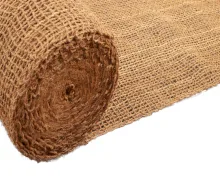
Jute SoilLock is manufactured from 100% natural woven jute fibre in a plain open-weave, single-yarn construction, featuring a 10 mm × 10 mm mesh aperture and approximately 65% open area. With a mass of 292 gsm, it represents the original full-strength grade widely specified for erosion control on African infrastructure, mining, rehabilitation, and riverbank stabilisation projects.
Unlike lighter 200 gsm or 250 gsm jute blankets offered as cheaper alternatives in the market, Jute SoilLock provides superior rainfall interception, moisture retention, and soil reinforcement performance. Its heavier construction delivers enhanced durability during establishment, improved resistance to surface erosion, and stronger soil-binding characteristics, helping to promote vegetation growth while maintaining slope stability in demanding site conditions.
The open mesh structure allows light and air to reach the seeded soil surface while the jute strands intercept rainfall splash impact, reduce runoff velocity and trap soil particles and seeds. Jute retains up to 1300g/m2 of water, maintaining moisture around germinating seeds during dry periods and protecting seedlings from direct sun. Once plant roots have established and the vegetation canopy closes, Jute SoilLock decomposes completely into organic mulch - adding fibre and nutrients to the soil without leaving any synthetic residue.
Geosynthetics Africa supplies Jute SoilLock in jumbo rolls of 1.22m x 100m giving 122m2 per roll - the largest standard roll format available in South Africa. Larger rolls mean fewer roll changes during installation, fewer transverse joints on the slope, lower packaging waste and reduced transport cost per square metre. Standard 1.22m x 50m rolls are also available for smaller projects or confined access sites. Both formats are supplied at the same 292gsm specification.
Typical Values for EROSION CONTROL GEOCELLS
Properties & Dimensions
| Property | Jute Soilock 292 |
|---|---|
| Material | 100% Natural jute fibre |
| Construction | Plain open weave · single yarn |
| Weight | 292 g/m2 |
| Width | 1.22m |
| Roll Length | 100m (jumbo) · 50m (standard) |
| Thickness | 5mm approximate |
| Mesh Aperture | 10mm x 10mm (±10mm) |
| Open Area | 65% approximate |
| Warp threads | 10.8 per 100mm |
| Weft threads | 12.0 per 100mm |
| Moisture retention | Up to 1300 g/m2 |
| Biodegradation | Within 24 months under normal conditions |
| Residue | Zero - fully organic |
Popular Catalogue Items
Jute SoilLock™ - 292gsm Jute Erosion Control Blanket
292gsm . Supplied in 1.22 m × 100 m jumbo rolls (122 m²) and 1.22 m × 50 m rolls (61 m²)Related Product Groups
Three Questions To Ask Before You Order
1.What is the difference between 292gsm and 250gsm jute blankets?
2.How long does Jute SoilLock take to biodegrade?
3.Can Jute SoilLock be installed before or after seeding?
4.What peg spacing is required?
5.Why are larger rolls better than shorter cut lengths?
6.What slope gradients is Jute SoilLock suitable for?
Specification For The Design, Installation Of Jute SoilLock Erosion Blanket - 292gsm Biodegradable Jute
Surface Preparation - Level the area and remove rocks, roots and obstructions to allow maximum soil contact with the blanket. Do not leave large voids between the blanket and the soil surface.
Anchor Trench - Excavate an anchor trench approximately 150mm deep at the top of the slope. Place the leading edge of the roll into the trench and backfill and compact. This prevents the blanket from peeling back from the crest under wind or water flow.
Rolling Out - Unroll Jute SoilLock from the top of the slope downward. Lay loosely to closely match topsoil contours - do not stretch the blanket between anchor points. The blanket must maintain full contact with the soil surface.
Overlaps and Joins - Overlap adjacent lengths by a minimum of 150mm in the direction of water flow, or sew together with sisal twine. On transverse joins running across the slope, the upslope length must overlap the downslope length. Avoid any gaps between adjacent lengths.
Pegging - Peg down at 1m grid intervals both down and across the slope using wooden pegs of 500mm or longer, notched to snag the fabric. On steeper slopes reduce peg spacing to 500mm intervals.
Seeding - Seeding can take place before or after laying. If seeding after installation, spread seed through the open mesh directly onto the soil below. Saplings and shrubs can be planted through the mesh after installation is complete.
Featured Projects Across Africa
Related Resources
Common JUTE SOIL EROSION SAVER CONTROL BLANKET Applications
Request a Quote for This Product Family
Upload your BOQ, drawings, or specifications and our technical team will provide a detailed proposal.
Have a project? Start with us.
Get expert engineering support, reliable material supply, and best-in-class installation.