
Galvanised Woven Gabion Baskets - Class A Galvanised & PVC Coated
Geosynthetics Africa supplies Class A Galvanised and PVC coated hexagonal woven double-twist mesh gabion baskets for retaining walls, river training structures, mine containment walls, channel lining, dam embankment protection, and architectural applications across Southern and East Africa. Manufactured from mild tensile steel wire to SANS 675 specification with 80x100mm mesh aperture, 2.7mm mesh wire, and 3.4mm salvage wire. Tensile strength 350-575 MPa. Standard sizes from 1x1x0.5m to 4x1x1m in stock. PVC coated variants available for corrosive, marine, and permanently submerged environments. Geotextile separation layers and binding wire supplied with every order.
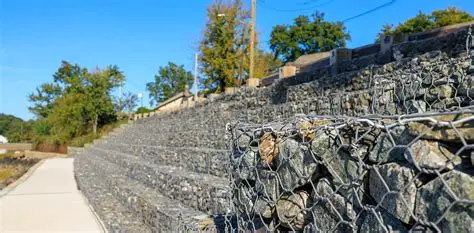
Technical Specification of Galvanised Woven Gabion Baskets - Class A Galvanised & PVC Coated
Geosynthetics Africa galvanised woven gabion baskets are manufactured from mild tensile steel wire double-twisted into a hexagonal woven mesh structure - the industry standard construction for flexible, permeable gravity retaining and erosion control systems. The double-twist connection between each wire pair is the defining structural characteristic of woven gabion mesh. Where a welded joint fractures and opens under load, settlement, or vibration, the double-twist joint deforms without breaking - a single broken wire does not open the structure. This mechanical redundancy makes woven hexagonal mesh gabion baskets the only correct specification for river training, dam embankment protection, and any retaining structure subject to dynamic loading, flooding, or differential settlement.
All wire is mild tensile steel Class A Galvanised to SANS 675 specification, with tensile strength of 350-575 MPa. Mesh aperture is 80 x 100mm hexagonal with 2.7mm mesh wire diameter and 3.4mm salvage wire along all roll and panel edges. Binding wire supplied with each order is 2.2mm diameter Class A Galvanised. For corrosive, marine, permanently submerged, or acid mine drainage environments, PVC coated gabion baskets are available - the same Class A Galvanised wire core with an additional 0.5mm grey PVC coating extruded over the wire. PVC coating is always applied over galvanised wire, never instead of it - providing dual-layer corrosion protection that significantly extends service life in aggressive environments.
Standard gabion basket sizes are available in stock across the full range of civil and mining applications. Basket dimensions are expressed as Length x Width x Height in metres. Standard sizes are 1x1x0.5m (0.5m3), 1x1x1m (1m3), 2x1x0.5m (1m3), 2x1x1m (2m3), 3x1x0.5m (1.5m3), 3x1x1m (3m3), 4x1x0.5m (2m3), 4x1x1m (4m3), 1.5x1x1m (1.5m3), and 2x0.5x0.5m (0.5m3). Non-standard sizes can be manufactured on request subject to minimum quantities and extended lead time. Baskets are supplied flat-packed for efficient transport and erected on site before filling.
For retaining walls exceeding 4m in height built in a backfill situation, a reinforced gabion soil system with extended mesh tails - known as a Gab-Tail system - becomes the more economical and faster solution versus a mass gravity gabion wall. The external gabion basket facing provides the structural front face while hexagonal woven mesh tails extend horizontally back into the compacted backfill, improving the lateral shear resistance and tensile strength of the retained soil. Backfill must meet minimum G6 or G7 grading specification with no particles exceeding 100-150mm, compacted in layers not exceeding 150mm at 95% Modified AASHTO. Geosynthetics Africa provides design assistance and technical guidance on reinforced gabion soil wall systems on request.
A non-woven geotextile separation layer must be placed between the gabion basket structure and the retained soil on all retaining wall, embankment, and channel lining applications. Without a geotextile, fine soil particles migrate through the mesh aperture under hydraulic gradient - causing progressive loss of retained material and eventual structural failure. Geosynthetics Africa supplies the geotextile separation layer as part of the integrated gabion system, specifying the correct grade based on retained soil particle size. Rock for infill must be hard, durable, and non-degradable with a minimum particle size of 100mm and maximum of 250mm for standard 80x100mm mesh aperture baskets.
Typical Values for GABION BASKETS
Properties & Dimensions
| Property | Galvanised Gabion Baskets | PVC Coated Gabion Baskets |
|---|---|---|
| Wire material | Mild tensile steel | Mild tensile steel |
| Galvanising standard | Class A - SANS 675 | Class A - SANS 675 |
| PVC coating | - | 0.5mm grey PVC |
| Mesh type | Hexagonal woven double-twist | Hexagonal woven double-twist |
| Mesh aperture | 80 x 100mm | 80 x 100mm |
| Mesh wire diameter | 2.7mm | 2.7mm |
| Salvage wire diameter | 3.4mm | 3.4mm |
| Binding wire diameter | 2.2mm | 2.2mm |
| Tensile strength | 350-575 MPa | 350-575 MPa |
| Zinc coating | Class A standard weight | Class A standard weight |
| Supply format | Flat-packed | Flat-packed |
| Recommended environment | Standard civil - non-corrosive | Marine - corrosive soils |
Popular Catalogue Items
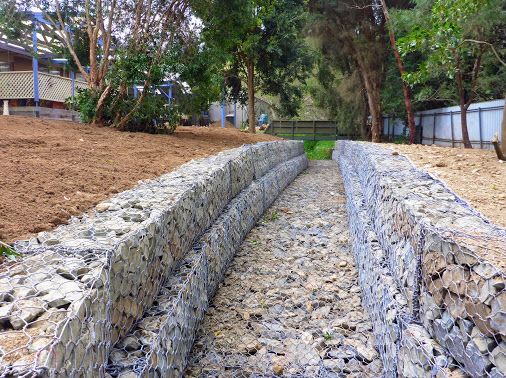
Galvanised Woven Gabion Baskets
Class A galvanised hexagonal woven double-twist gabion baskets, mild tensile steel to SANS 675. 80x100mm aperture, 2.7mm mesh wire, 3.4mm selvedge wire, 350–575 MPa tensile. Standard sizes from 1x1x0.5m to 4x1x1m, supplied flat-packed with binding wire. For mass gravity retaining walls, river training, dam embankment protection, mine containment and channel lining.Related Product Groups
Three Questions To Ask Before You Order
1.What is the difference between Class A Galvanised and PVC coated gabions and when do I specify each?
2.What rock size is required for gabion basket infill?
3.Is a geotextile required behind a gabion retaining wall?
4.When should I use a Gab-Tail reinforced system instead of a mass gravity gabion wall?
5.What are the standard gabion basket sizes and can non-standard sizes be ordered?
6.What is the minimum order quantity and what is the lead time?
7.Do you offer installation support or supply only?
Specification For The Design, Installation Of Galvanised Woven Gabion Baskets - Class A Galvanised & PVC Coated
Gabion basket installation requires no specialist plant or equipment and is suited to semi-skilled and unskilled labour under competent supervision. The critical requirements are correct geotextile placement before basket assembly, proper basket erection and lacing, correct rock infill size and compaction sequence, diaphragm panel installation in baskets longer than 1.5m, and correct lid lacing to complete the structural connection between basket courses. Incorrectly laced connections between adjacent baskets and between basket courses are the primary cause of gabion structure failure - correct lacing technique must be demonstrated to all installation personnel before work begins.
1. Foundation Preparation and Geotextile - Excavate and trim the foundation to the specified formation level. Compact the foundation surface. Place the non-woven geotextile separation layer over the foundation and up the full back face of the gabion structure before any basket is positioned. Overlap geotextile lengths by a minimum of 300mm in the direction of water flow. The geotextile must be continuous behind and beneath the full gabion structure without gaps or unprotected sections - gaps in the geotextile are the most common cause of fines migration and long-term deterioration of gabion retaining structures.
2. Basket Assembly and Erection - Unfold gabion baskets from the flat-packed supply format. Erect by folding up the four side panels and two end panels to form the box shape. All vertical panel edges of adjacent baskets must be laced together using 2.2mm binding wire with a continuous lacing stitch at maximum 150mm centres, alternating between single and double loops at every connection point. A single loop only at each connection point is insufficient and will open under load. Position assembled empty baskets in their final location and lace horizontally adjacent baskets together at all common edges before any filling begins.
3. Diaphragm Panels - For all baskets longer than 1.5m, install internal diaphragm panels at 1.0m centres along the basket length before filling. Lace diaphragm panels to the basket base and front face before filling begins. Diaphragms prevent face bulging under the lateral pressure of rock infill and the gravity load of subsequent basket courses. Omitting diaphragms in long baskets causes characteristic face bulging that reduces the effective gravity mass of the structure and the visual quality of the finished wall face.
4. Rock Infill Placement - Fill baskets in three layers, hand-placing all outer face stones carefully to achieve a tight, even face appearance and maximise fill density at the basket face. Machine filling of the basket interior is acceptable once the outer face layer is hand-placed and stable. Limit drop height of infill material to a maximum of 1m to prevent basket deformation during filling. Do not overfill - the rock surface must be level with or slightly below the basket top to allow the lid to close and lace flat. Compact each layer before placing the next to minimise post-construction settlement of the basket fill.
5. Lid Lacing and Subsequent Courses - Fold the wire mesh lid down flat onto the filled basket and lace to all four sides using 2.2mm binding wire at maximum 150mm centres, alternating single and double loops. Lace adjacent basket lids together across the full width of the structure. The lid lacing is a structural connection - inadequate lid lacing allows the upper basket course to separate from the course below under lateral load. Place the next course of empty baskets directly on top of the laced lids and repeat the assembly, filling, and lacing sequence for each course until the full wall height is achieved.
6. River and Channel Applications - For river bank protection and channel lining, install basket courses and mattresses working from the downstream end upstream so that each upper panel overlaps the lower in the direction of flow. Anchor all free edges and mattress perimeters using steel pegs driven through the mesh into the bank or bed at maximum 1m centres. For permanently submerged applications in corrosive river environments, specify PVC coated gabion baskets and mattresses. Place a non-woven geotextile separation layer beneath all river mattresses over erodible bed material before mattress placement.
Featured Projects Across Africa
Related Resources
Common GALVANISED WOVEN GABION BASKETS Applications
Request a Quote for This Product Family
Upload your BOQ, drawings, or specifications and our technical team will provide a detailed proposal.
Have a project? Start with us.
Get expert engineering support, reliable material supply, and best-in-class installation.