
River Reno Mattresses - Hexagonal Woven Gabion Mattresses for Africa
Geosynthetics Africa supplies Class A Galvanised and PVC coated hexagonal woven double-twist mesh river mattresses for riverbed scour protection, river bank revetment, channel lining, dam embankment protection, spillway aprons, and roadway drainage structures across Southern and East Africa. Manufactured in South Africa to SANS 1580 specification. Mesh aperture 60x80mm with 2.2mm mesh wire and 3.4mm salvage wire. Standard sizes from 2x1x0.3m to 6x2x0.30m in stock. Also available in 80x100mm aperture with 2.7mm wire for aggressive and corrosive environments. Geotextile separation layer supplied with every order.
Technical Specification of River Reno Mattresses - Hexagonal Woven Gabion Mattresses for Africa
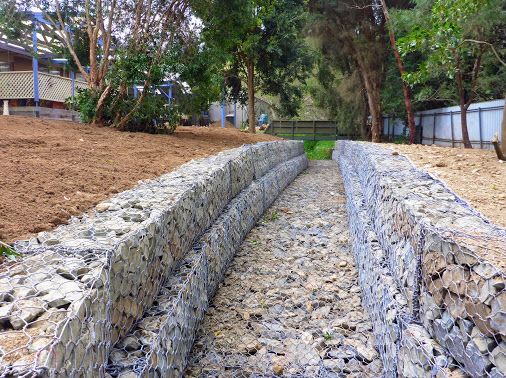
River mattresses - also known as Reno mattresses or gabion mattresses — are flat, shallow hexagonal woven double-twist mesh structures filled with rock on site to form flexible, permeable, monolithic protection layers over riverbeds, channel banks, dam embankment faces, and spillway aprons. Unlike box gabion baskets designed for mass gravity retaining structures, river mattresses are engineered specifically for hydraulic applications where a thin, flexible, rock-filled mat must conform to the irregular profile of a river bed or bank, resist scour and undermining, and remain structurally intact under sustained hydraulic loading and flood conditions.
Geosynthetics Africa river mattresses are manufactured from mild tensile steel wire double-twisted into a hexagonal woven mesh structure - the only mesh type suitable for mattress applications. Square weldmesh is not used for river mattresses because the rigid welded connection fractures under the differential movement and settlement experienced in hydraulic environments, opening the basket and releasing the rock fill. The double-twist woven connection deforms without breaking under movement, maintaining the integrity of the mattress even when individual wires are damaged by floating debris or abrasion under flood conditions.
Standard river mattresses are manufactured with 60x80mm hexagonal mesh aperture, 2.2mm mesh wire diameter, and 3.4mm salvage wire along all panel edges - a finer mesh geometry than box gabion baskets, selected specifically to maximise flexibility over irregular riverbed and bank profiles while maintaining adequate rock retention. For more aggressive or corrosive environments - including acid mine drainage discharge zones, saline rivers, and permanently submerged coastal applications - river mattresses are available in 80x100mm aperture with 2.7mm wire and 3.4mm salvage wire, providing a heavier and more robust wire specification for extended design life under chemically aggressive conditions.
All river mattresses are available in Class A Galvanised to SANS 1580 specification, or with an additional 0.5mm grey PVC coating extruded over the galvanised wire core for enhanced corrosion resistance. PVC coating is always applied over galvanised wire - providing dual-layer protection in marine, permanently submerged, and chemically aggressive environments. Mattresses are supplied flat-packed with internal diaphragm panels at 1m centres along the mattress length, dividing the mattress into uniform cells to prevent rock displacement and maintain even thickness under hydraulic loading. A non-woven geotextile separation layer is supplied with every order and must be placed beneath all river mattresses over erodible subgrades to prevent fines migration from the riverbed into the rock fill.
River mattresses resist sustained water flow velocities exceeding 6 m/s when correctly installed and filled with the specified rock - making them suitable for the full range of hydraulic applications encountered on African civil and mining projects, from roadside drains and irrigation canal linings through to high-energy spillway aprons and river diversion structures. Rock mattresses are proven to be more effective than loose rip-rap in high shear stress conditions because the wire mesh confines the rock fill and prevents individual stones from being displaced under peak flow - maintaining a continuous protective layer over the entire protected surface rather than allowing progressive stone-by-stone displacement.
Typical Values for GABION BASKETS
Properties & Dimensions
| Property | Standard Mattress - 60x80mm | Heavy Duty Mattress - 80x100mm |
|---|---|---|
| Galvanising standard | Class A - SANS 1580 | Class A - SANS 1580 |
| PVC coating option | 0.5mm grey PVC over galvanised core | 0.5mm grey PVC over galvanised core |
| Mesh type | Hexagonal woven double-twist | Hexagonal woven double-twist |
| Mesh aperture | 60 x 80mm | 80 x 100mm |
| Mesh wire diameter | 2.2mm | 2.7mm |
| Salvage wire diameter | 3.4mm | 3.4mm |
| Binding wire diameter | 2.2mm | 2.2mm |
| Diaphragms | Internal at 1m centres | Internal at 1m centres |
| Recommended environment | Standard civil | Aggressive /corrosive/ acid mine drainage/ marine |
| Supply format | Flat-packed with lids | Flat-packed with lids |
Popular Catalogue Items
Reno Mattresses - Galvanised Woven Gabion Mattresses
Class A galvanised hexagonal woven double-twist gabion mattresses to SANS 675, in 0.17m, 0.23m and 0.30m thicknesses. Compartmented by diaphragms at 1m centres, supplied flat-packed. For river bed and bank protection, channel lining, spillway aprons, culvert outlets, scour protection and slope revetment. PVC coated for corrosive and permanently submerged conditions.Related Product Groups
Three Questions To Ask Before You Order
1.What is the difference between a river mattress and a box gabion basket?
2.What rock size should be used to fill river mattresses?
3.Is a geotextile required beneath river mattresses?
4.When should I specify PVC coated versus standard galvanised river mattresses?
5.How are river mattresses installed on steep bank slopes?
6.What is the difference between standard 60x80mm and heavy duty 80x100mm river mattresses?
Specification For The Design, Installation Of River Reno Mattresses - Hexagonal Woven Gabion Mattresses for Africa
River mattress installation requires no specialist plant or equipment. The critical requirements are correct geotextile placement before mattress positioning, correct toe anchorage in a cut-off trench at the base of the protected slope or bed, correct rock infill particle size, and adequate perimeter and panel pegging to resist hydraulic drag under peak flow conditions. Install mattresses working from the downstream end upstream and from the toe of the bank upward - this sequencing ensures that each mattress overlaps the one below in the direction of flow, preventing water from getting beneath the structure at panel joints.
1. Survey and Preparation - Survey the riverbed and bank profile to establish the extent of protection required. Remove all loose vegetation, roots, and large boulders from the surface to be protected. Grade the bank to a uniform slope where possible - steep irregularities in the bank profile cause mattress bridging and void formation beneath the mesh. Excavate cut-off trenches at the top and toe of the protected area, minimum 300mm deep x 300mm wide, for toe and crest anchorage of the mattress panels.
2. Geotextile Placement - Place the non-woven geotextile separation layer over the prepared bed and bank surface before any mattress is positioned. Work from the downstream end upstream, overlapping geotextile panels by a minimum of 300mm in the direction of flow - shingle the overlaps so the upstream panel lies on top of the downstream panel, preventing flow from getting beneath the joint. Peg the geotextile at regular intervals to prevent displacement during mattress placement and filling. The geotextile must extend into the cut-off trenches at the toe and crest.
3. Toe Anchorage - Fold the leading edge of the first mattress row into the excavated toe cut-off trench. Backfill and compact the trench over the folded mattress edge. This buried toe anchorage prevents scour from undermining the base of the mattress and is the most critical single installation detail - an unanchored mattress toe will be progressively undermined by scour and will fail under flood conditions regardless of the quality of the installation above.
4. Mattress Placement and Panel Connection - Unfold mattresses flat onto the prepared geotextile surface. Connect adjacent mattress panels at all common edges using 2.2mm binding wire with a continuous lacing stitch at maximum 150mm centres alternating single and double loops. Lace mattress panels to the side panels and lid before filling. Do not leave unlaced edges between adjacent mattress panels - unlaced edges open under hydraulic loading and allow rock fill to escape.
5. Rock Filling and Lid Closing - Fill mattress cells with rock of the specified particle size to the top of the cell walls. Hand-place the top layer of rock to achieve a level, tight surface. Fold the mattress lid down flat onto the filled cells and lace to all four edges using 2.2mm binding wire at maximum 150mm centres. Peg through the mattress lid and mesh body into the bank at maximum 1m centres across the full mattress area. On steep bank slopes, install straining wires along the length of each mattress row, anchored at the crest, to resist downslope gravity creep of the filled mattress.
Featured Projects Across Africa
Related Resources
Common RIVER RENO MATRESSES Applications
Request a Quote for This Product Family
Upload your BOQ, drawings, or specifications and our technical team will provide a detailed proposal.
Have a project? Start with us.
Get expert engineering support, reliable material supply, and best-in-class installation.