
Triaxial Geogrids – Aggregate Stabilisation for Roads, Rail & Trafficked Areas
Tensar TriAx® TX triaxial geogrids are the world's first and most widely proven stabilisation geogrids — manufactured from punched and stretched polypropylene with a hexagonal structure and triangular apertures for near-uniform 360° in-plane stiffness. ETA certified. Over 500 million square metres installed globally. Designed to reduce aggregate thickness, construction cost and carbon emissions on roads, rail, working platforms and trafficked areas across Africa.
Technical Specification of Triaxial Geogrids – Aggregate Stabilisation for Roads, Rail & Trafficked Areas
Tensar TriAx® geogrid was the first product manufactured specifically for the stabilisation of aggregates. Unlike reinforcement geogrids which resist tensile loads in retaining walls and slopes, TriAx geogrids work by confining aggregate particles - locking them in place under trafficking to create a stiffer, stronger mechanically stabilised layer (MSL).
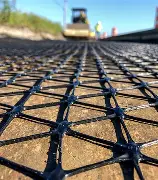
The geometry of Tensar TriAx has been designed specifically for this function. Manufactured from a punched and stretched polypropylene sheet, it has a hexagonal structure with ribs oriented in three directions. The resulting triangular apertures are defined by ribs of rectangular cross-section with a high degree of molecular orientation continuous through the integral node. This near-uniform 360° in-plane stiffness efficiently distributes traffic loads acting radially on the stabilised layer, reducing deformation under repeated loading.
Tensar TriAx is ETA certified under EAD 080002-00-0102 for the stabilisation of unbound layers by way of interlock with aggregate. It is manufactured under a management system complying with BS EN ISO 9001:2015. All grades contain a minimum of 2% finely divided carbon black for UV resistance.
Typical Values for GEOGRIDS INTERLAYERS
Properties & Dimensions
| Property | Test Method | TX150 | TX160 | TX170 |
|---|---|---|---|---|
| Radial Secant Stiffness @ 0.5% strain | EOTA TR41 B.1 | 360 kN/m | 390 kN/m | 480 kN/m |
| Radial Secant Stiffness @ 2% strain | EOTA TR41 B.1 | 250 kN/m | 290 kN/m | 360 kN/m |
| Stiffness Ratio | EOTA TR41 B.1 | 0.80 | 0.80 | 0.80 |
| Junction Efficiency | EOTA TR41 B.2 | 100% | 100% | 100% |
| Hexagon Pitch | EOTA TR41 B.4 | 80 mm | 80 mm | 80 mm |
| Polymer | - | PP | PP | PP |
| Design Life (pH 4–9, <15°C) | EN 14030 / EN ISO 13438 | 100 years | 100 years | 100 years |
Popular Catalogue Items
Triaxial Geogrid – Tensar® TriAx® (TX)
Tensar® TriAx® (TX) triaxial geogrid: a hexagonal structure with triangular apertures that confines aggregate for stronger, stiffer road foundations, working platforms and rail trackbed. Aggregate savings of up to 50%, with over 500 million m² installed globally. Supplied across Africa by Geosynthetics Africa, an official Tensar Associate.Related Product Groups
Three Questions To Ask Before You Order
1.What is the difference between a stabilisation geogrid and a reinforcement geogrid?
2.What is the difference between TX150, TX160, TX170 and TX190L?
3.What is the difference between TX5/TX7 and TX150–TX190L?
4.Can Tensar TriAx be used on African road projects?
5.Does Tensar provide design support for TriAx projects?
Specification For The Design, Installation Of Triaxial Geogrids – Aggregate Stabilisation for Roads, Rail & Trafficked Areas
TriAx installation is straightforward - unroll, align, tension and cover. The key requirement is a minimum 150 mm aggregate cover before any plant travels over the geogrid.
Prepare and proof-roll the subgrade to the specified formation level
Unroll TriAx geogrid with the correct side facing up - confirm orientation per design drawings
Pull taut by hand to remove wrinkles and lay flat - no mechanical tensioning required
Adjacent rolls are butt-jointed - no overlap required for stabilisation applications
Place aggregate immediately - do not leave geogrid exposed for more than 30 days
Maintain minimum 150 mm aggregate cover before trafficking with construction plant
Compact in accordance with contract specification
Featured Projects Across Africa
Related Resources
Common TRIAXIAL GEOGRIDS Applications
Request a Quote for This Product Family
Upload your BOQ, drawings, or specifications and our technical team will provide a detailed proposal.
Have a project? Start with us.
Get expert engineering support, reliable material supply, and best-in-class installation.