
GSE® PolyLock-T HDPE Termination Profile
Watertight mechanical termination of HDPE geomembrane to concrete structures. Cast into new concrete, welded to the liner.
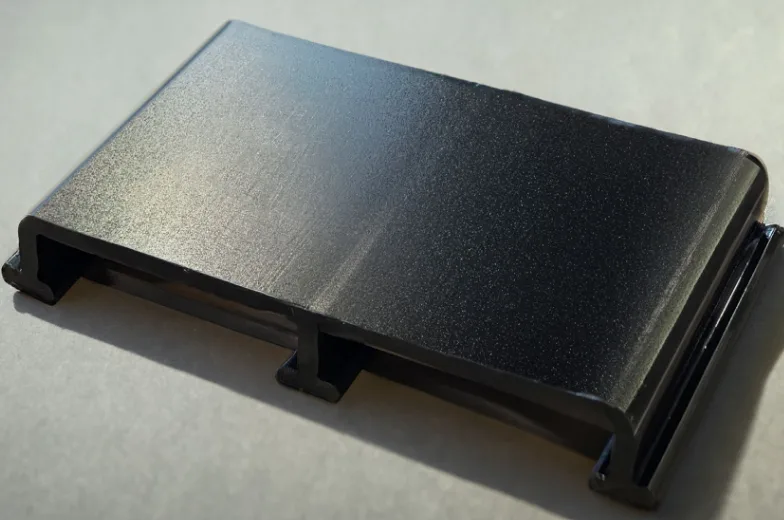
Technical Specification of GSE® PolyLock-T HDPE Termination Profile
PolyLock-T is an HDPE profile that creates a watertight connection between a concrete structure and an HDPE geomembrane lining system. Three parallel T-anchors embed into the concrete to provide mechanical anchorage; the exposed face is HDPE, so the geomembrane is welded directly to it by extrusion weld - a homogeneous polymer-to-polymer joint rather than a mechanical clamp relying on gaskets and bolt torque.
This matters at the detail where most containment systems actually leak. Terminating a liner against concrete with a batten strip and mastic depends on compression being maintained across a joint that sees thermal movement, concrete shrinkage and, in tanks and secondary containment, hydrostatic pressure trying to open it. A cast-in HDPE profile removes the mechanical interface entirely: the liner is welded to plastic, and the plastic is locked into the concrete.
Produced in 5m standard lengths from high-quality HDPE raw material, chosen for weldability to geomembrane. Rugged, durable and chemically resistant.
Where it's used. Tank and reservoir linings, secondary containment bunds, pump station and sump linings, process structures, and any cut-and-cover or below-ground concrete element where a lining system terminates into concrete. Suitable for new concrete construction - it is placed onto the formwork before concreting, or inserted into wet concrete.
Typical Values for GEOMEMBRANE LINERS
Properties & Dimensions
| Property | Test Method | Value |
|---|---|---|
| Resin | - | HDPE, black |
| Density | - | ≥ 0.94 g/cm³ |
| Carbon black content | - | ≥ 2% |
| Standard length | - | 5 m |
| Overall width | - | 148 ±6 mm |
| Profile height | - | 22 ±3 mm |
| Number of T-anchors | - | 3, parallel |
| T-anchor height | - | approx. 22 mm |
| T-anchor width | - | approx. 13 mm |
Popular Catalogue Items
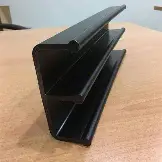
GSE PolyLock T HDPE Termination Strip
cast-in locking embedment profile for permanent geomembrane-to-concrete anchorageRelated Product Groups
Three Questions To Ask Before You Order
1.Can PolyLock-T be installed into existing concrete?
2.What concrete strength is required?
3.Who does the welding - us or the contractor?
4.How are lengths joined?
5.Is extrusion welding the profile acceptable?
6.Why drill vent holes for horizontal installation?
Specification For The Design, Installation Of GSE® PolyLock-T HDPE Termination Profile
Jointing lengths - PolyLock-T is supplied in 5m lengths and butt-welded to form a continuous run. Cut joint faces square and clean using a compass saw or metal cutting saw, mitred to suit the angle where the termination line changes direction. Preheat a hot air welder fitted with a mirror adapter — a Leister Triac or similar, with a 250 × 250 welding mirror — to 220–250 °C. Hold both prepared faces coplanar against the mirror under slight pressure. When the material softens and bulges at the edges, press the faces together under high pressure for a maximum of 30 seconds. Inner and outer corners are welded with a T-strap across the joint. Extrusion welding the profile is possible, but a watertight connection to the concrete is only achieved when the T-bars are jointed to each other as well - welding the face alone leaves a continuous path along the anchors.
Vertical installation - For vertical faces, fix the welded profile to the formwork with nails at approximately 300mm centres, alternating sides. Nail length is selected to suit the shutter board thickness, typically 20–30mm. Check alignment along the full run before the pour, since the profile sets the line the geomembrane will terminate on and cannot be adjusted afterwards.
Horizontal installation - For horizontal surfaces, drill 4–5mm air vent holes along the profile at 1m centres, alternating sides. Press the profile into fresh concrete of minimum C20/25 grade under slight pressure and vibration, allowing trapped air to escape through the drilled holes. Venting matters: air trapped beneath the profile leaves voids around the T-anchors and compromises the embedment. Weight the profile down until the concrete has hardened.
After striking formwork - Once the formwork is struck, clean all concrete residue from the exposed profile face and remove every fixation nail. Both will prevent a sound weld. The geomembrane is then extrusion welded to the profile by a qualified welding technician. Cutting, welding and installation of the profile itself are carried out by the construction contractor on site; Geosynthetics Africa's crews execute the geomembrane-to-profile weld as part of the lining installation scope, with the joint included in the seam log and QA dossier.
Featured Projects Across Africa
Related Resources
Common GSE POLYLOCK T Applications
Request a Quote for This Product Family
Upload your BOQ, drawings, or specifications and our technical team will provide a detailed proposal.
Have a project? Start with us.
Get expert engineering support, reliable material supply, and best-in-class installation.