
LLDPE Geomembrane Liners
GRI GM17 · 0.5 – 2.5 mm · FLEXIBILITY FOR SETTLEMENT - GRI GM17 compliant LLDPE with published UV performance: HP-OIT retention of 35% minimum after 1,600 hours of accelerated weathering to GRI GM11. Flexible enough for settlement, documented enough for exposed service.
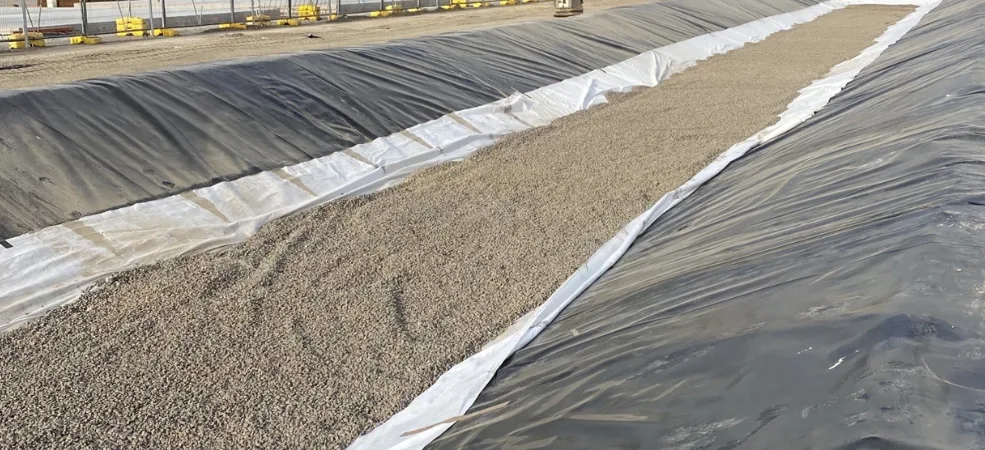
Technical Specification of LLDPE Geomembrane Liners
Linear low-density polyethylene is a polyethylene copolymer with short, uniform side branches on a linear backbone. That molecular structure is what separates it from HDPE: where HDPE is stiff, strong and vulnerable to stress cracking under sustained deformation, LLDPE yields. Density is 0.939 g/cm³ or lower against roughly 0.94 and above for HDPE, and the practical result is elongation at break of 850 to 900% with multi-axial break resistance of 30% or more. The liner deforms to relieve stress rather than concentrating it at the point of movement.
That behaviour makes LLDPE the standard selection wherever the ground beneath the liner will not stay still. Landfill closure and capping systems sit over waste that consolidates unevenly for decades. Mining applications, seismic zones and construction over poorly compacted or heterogeneous fill present the same problem. In each case a stiffer membrane transfers the settlement into its own material as localised strain, and LLDPE simply follows the ground instead. Multi-axial testing to ASTM D5617 measures precisely this, deformation in every direction at once rather than along a single axis.
The material is supplied in nominal thicknesses from 0.5 to 2.5 mm with a ±10% tolerance, double-sided smooth, in rolls of approximately 7 m width, and is manufactured to meet or exceed GRI GM17, the standard specification for LLDPE geomembranes. Carbon black content is 2.0 to 3.0% with dispersion in categories 1 and 2, and dimensional stability is within ±2% in each direction when tested at 100°C. Special thicknesses are available on request.
Durability is documented rather than asserted. Oxidative induction time is 100 minutes or more to ASTM D3895, and UV performance is measured under GRI GM11 as high-pressure OIT retention after 1,600 hours of accelerated weathering — 20-hour UV cycles at 75°C alternating with 4 hours of condensation at 60°C - with a minimum of 35% retained. Low temperature brittleness is −77°C to ASTM D746. These are the antioxidant depletion and weathering measures that determine how a polyethylene geomembrane ages in exposed service, and they are the reason LLDPE can be specified for exposed applications with a defensible service life expectation.
Typical Values for GEOMEMBRANE LINERS
Properties & Dimensions
| Property | Test Method | Geoline LL1000 | GeoLine LLL1500 | GeoLine LLL2000 | GeoLine LLL2500 |
|---|---|---|---|---|---|
| Thickness (mm) | DIN EN ISO 9863-1 | 1.0 | 1.5 | 2.0 | 2.5 |
| Density (g/cm³) | DIN EN ISO 1183-1/A | ≤0.939 | ≤0.939 | ≤0.939 | ≤0.939 |
| Stress at break (MPa) | DIN EN ISO 527-3 | 33 | 33 | 33 | 33 |
| Elongation at break (%) | DIN EN ISO 527-3 | 900 | 900 | 900 | 900 |
| Tear resistance (N) | DIN ISO 34-1/B | 115 | 175 | 230 | 285 |
| Puncture resistance (N) | DIN EN ISO 12236 | 2350 | 3500 | 4600 | 5700 |
| Carbon black content (%) | ASTM D1603 | 2.0 – 3.0 | 2.0 – 3.0 | 2.0 – 3.0 | 2.0 – 3.0 |
| Carbon black dispersion | ASTM D5596 | Category 1/2 | Cat. 1/2 | Cat. 1/2 | Cat. 1/2 |
| Dimensional stability (%) | DIN 53377, 100°C/1h | ±2 | ±2 | ±2 | ±2 |
| Melt flow index (g/10 min) | DIN EN ISO 1133 | ≤3.0 | ≤3.0 | ≤3.0 | ≤3.0 |
| Oxidative induction time (min) | ASTM D3895 | ≥100 | ≥100 | ≥100 | ≥100 |
| Multiaxial elongation at break (%) | Similar to ASTM D5617 | ≥30 | ≥30 | ≥30 | ≥30 |
| Low temperature brittleness (°C) | ASTM D746 | −77 | −77 | −77 | −77 |
| UV resistance — HP-OIT retained after 1,600 h (%) | ASTM D5885 | ≥35 | ≥35 | ≥35 | ≥35 |
Popular Catalogue Items
GEOLINE LL - LLDPE Geomembrane Liner | Linear Low Density Polyethylene, GRI-GM17
LLDPE geomembrane liner in 0.50–2.50 mm, GRI-GM17.Related Product Groups
Three Questions To Ask Before You Order
1.When should I use LLDPE instead of HDPE?
2.Is LDPE the same thing?
3.What service life can I expect in exposed conditions?
4.Which thickness should I specify?
5.Does it comply with GRI GM17?
6.Is it chemically resistant?
Specification For The Design, Installation Of LLDPE Geomembrane Liners
Installation follows the project CQA plan. Material conforms to GRI GM17; seam performance is specified under GRI GM19a, Seam Strength and Related Properties of Thermally Bonded Homogeneous Polyolefin Geomembranes. Where a project specification conflicts with these, the specification governs and the conflict is raised in writing before deployment.
Subgrade is proof-rolled and accepted in writing before any panel is unrolled, free of stones, roots, sharp protrusions, standing water and desiccation cracking beyond the project limits, with anchor trenches cut to profile. Panels are deployed to the approved layout drawing with seams running up and down slopes, and ballasted against wind uplift from the moment of unrolling. LLDPE's flexibility means it conforms closely to whatever lies beneath it, so subgrade preparation directly determines installed performance.
Field seaming is by hot wedge fusion for production seams and extrusion welding for details, patches and penetrations. Trial seams are produced on offcut material at the start of each shift, after any break exceeding the CQA interval, and following any change of operator, machine or ambient conditions, and each is tested before production welding resumes. Destructive samples are taken at intervals selected under GRI GM14, or GRI GM20 where control charts are specified.
All production seams receive full-length non-destructive testing, evaluated under GRI GM29. Dual-track seams are pressure tested to ASTM D5820; single-track seams, extrusion welds, patches and penetrations are vacuum box tested to ASTM D5641 or air lance tested to ASTM D4437. Where leak location is specified, method selection follows ASTM D6747, with exposed surveys to ASTM D7002, D7703 or D7953 and covered surveys to ASTM D8265. The handover package comprises mill certificates traceable to the supplied rolls, subgrade acceptance record, as-built panel layout, all seam test results, calibration records, repair register, and the final QA/QC sign-off certificate that starts the warranty period.
Featured Projects Across Africa
Related Resources
Common LLDPE GEOMEMBRANE LINERS Applications
Industries Served
Request a Quote for This Product Family
Upload your BOQ, drawings, or specifications and our technical team will provide a detailed proposal.
Have a project? Start with us.
Get expert engineering support, reliable material supply, and best-in-class installation.