
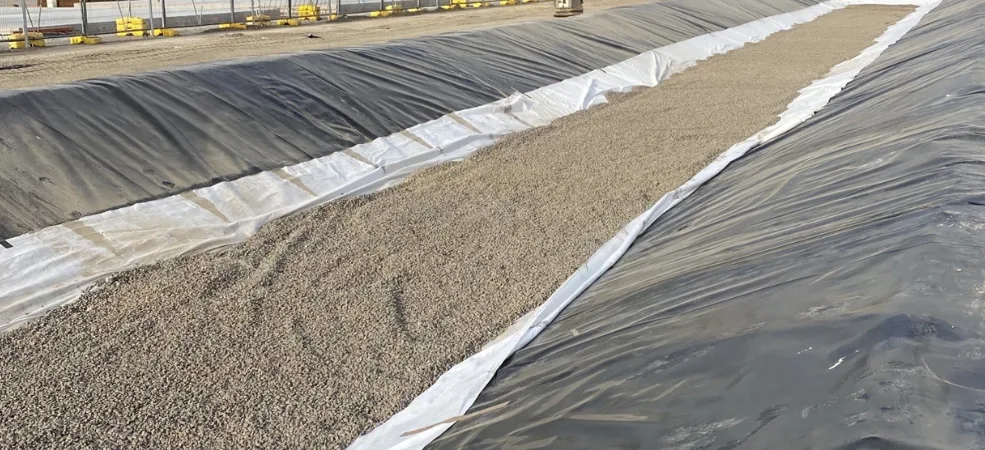
Geomembrane Liners
GEOLINE LL - LLDPE Geomembrane Liner | Linear Low Density Polyethylene, GRI-GM17
Flexible LLDPE geomembrane liner in 0.50–2.50 mm (20–100 mil), smooth or textured, manufactured to GRI-GM17. Built for settlement-prone subgrades, landfill caps, ponds and lagoons.
Overview
GEOLINE LL is a linear low density polyethylene (LLDPE) geomembrane liner supplied across the full commercial thickness range, from 0.50 mm (20 mil) through 2.50 mm (100 mil), in both smooth and single- or double-sided textured finishes. All grades are manufactured to meet or exceed GRI-GM17.
Where an HDPE liner resists chemicals and stress cracking, an LLDPE liner earns its place through elongation. LLDPE typically reaches several hundred percent elongation at break, which lets the membrane stretch and conform rather than tear when the ground beneath it moves. That makes it the default choice for landfill closure caps over settling waste mass, liners over compressible or poorly consolidated subgrade, steep-sided cells where conformance around the toe matters, and any containment where differential settlement is expected over the design life.
The same flexibility pays off during installation. LLDPE sheet is easier to deploy in cold conditions, conforms to detail work and penetrations with less strain, and produces fewer wrinkles on warm days than an equivalent HDPE sheet — which reduces the panel handling and welding time on site.
Typical applications: landfill capping and closure systems, secondary containment bunds, water and effluent lagoons, irrigation and farm reservoirs, biodigester liners, aquaculture ponds, canal lining, tailings and heap leach covers, and floating covers.
All rolls are supplied with mill certificates and MQC test data. Welding is by dual-track hot wedge for panel seams and extrusion fillet for detail and repair work - the same equipment and technique used for HDPE, at adjusted temperature and speed settings. Installation should be carried out by welders qualified against the relevant destructive and non-destructive test regime.
- MaterialLinear Low Density Polyethylene (LLDPE)
- StructureSmooth, single-sided textured, double-sided textured
- ColourBlack, Tan
- StandardGRI-GM17
- Roll Width7m
- Roll LengthThickness Dependent
Typical Properties
| Property | Test Method | Geoline LL1000 | GeoLine LLL1500 | GeoLine LLL2000 | GeoLine LLL2500 |
|---|---|---|---|---|---|
| Thickness (mm) | DIN EN ISO 9863-1 | 1.0 | 1.5 | 2.0 | 2.5 |
| Density (g/cm³) | DIN EN ISO 1183-1/A | ≤0.939 | ≤0.939 | ≤0.939 | ≤0.939 |
| Stress at break (MPa) | DIN EN ISO 527-3 | 33 | 33 | 33 | 33 |
| Elongation at break (%) | DIN EN ISO 527-3 | 900 | 900 | 900 | 900 |
| Tear resistance (N) | DIN ISO 34-1/B | 115 | 175 | 230 | 285 |
| Puncture resistance (N) | DIN EN ISO 12236 | 2350 | 3500 | 4600 | 5700 |
| Carbon black content (%) | ASTM D1603 | 2.0 – 3.0 | 2.0 – 3.0 | 2.0 – 3.0 | 2.0 – 3.0 |
| Carbon black dispersion | ASTM D5596 | Category 1/2 | Cat. 1/2 | Cat. 1/2 | Cat. 1/2 |
| Dimensional stability (%) | DIN 53377, 100°C/1h | ±2 | ±2 | ±2 | ±2 |
| Melt flow index (g/10 min) | DIN EN ISO 1133 | ≤3.0 | ≤3.0 | ≤3.0 | ≤3.0 |
| Oxidative induction time (min) | ASTM D3895 | ≥100 | ≥100 | ≥100 | ≥100 |
| Multiaxial elongation at break (%) | Similar to ASTM D5617 | ≥30 | ≥30 | ≥30 | ≥30 |
| Low temperature brittleness (°C) | ASTM D746 | −77 | −77 | −77 | −77 |
| UV resistance — HP-OIT retained after 1,600 h (%) | ASTM D5885 | ≥35 | ≥35 | ≥35 | ≥35 |
Note: The above specifications represent the product family properties. Please refer to the product datasheet for individual SKU values.
Typical Applications
View all applicationsLandfill Closure & Capping
The application LLDPE was developed for. A capping system sits over waste that consolidates unevenly for decades, and a stiff liner concentrates that movement into localised strain. LLDPE's 900% elongation and multi-axial break resistance let the barrier deform with the settlement instead of cracking at it.
Mining Containment
Heap leach pads, process ponds and tailings facilities where subgrade is heterogeneous or ongoing deformation is expected. Flexibility accommodates the movement, and the heavier grades give the puncture resistance — up to 5700 N — that ore placement and plant traffic demand.
Compatible Systems
View all systemsGEOLINE LL100 — 1.0 mm
The general-purpose grade for pond linings, secondary containment and capping over moderate settlement. Tear resistance 115 N, puncture 2350 N, with the full elongation performance of the range.
GEOLINE LL150 — 1.5 mm
The most commonly specified thickness for landfill closure and capping systems. Puncture resistance of 3500 N gives working margin for cover soil placement and plant movement during construction.
GEOLINE LL200 — 2.0 mm
Specified where cover material is heavy, plant traffic is significant or the containment is critical. Puncture resistance 4600 N and tear resistance 230 N, with elongation unchanged at 900%.
GEOLINE LL250 — 2.5 mm
The heaviest grade at 5700 N puncture resistance, for the most demanding closure and mining applications where mechanical protection governs and a thinner sheet would need a protective geotextile.
Thinner grades — 0.5 and 0.75 mm
Available for lighter-duty and temporary applications, or where the liner is fully protected between geotextile layers. Same polymer, standard and durability package; lower mechanical values.
Installation Guidance
Standard Method Statement
Installation follows the project CQA plan. Material conforms to GRI GM17; seam performance is specified under GRI GM19a, Seam Strength and Related Properties of Thermally Bonded Homogeneous Polyolefin Geomembranes. Where a project specification conflicts with these, the specification governs and the conflict is raised in writing before deployment.
Subgrade is proof-rolled and accepted in writing before any panel is unrolled, free of stones, roots, sharp protrusions, standing water and desiccation cracking beyond the project limits, with anchor trenches cut to profile. Panels are deployed to the approved layout drawing with seams running up and down slopes, and ballasted against wind uplift from the moment of unrolling. LLDPE's flexibility means it conforms closely to whatever lies beneath it, so subgrade preparation directly determines installed performance.
Field seaming is by hot wedge fusion for production seams and extrusion welding for details, patches and penetrations. Trial seams are produced on offcut material at the start of each shift, after any break exceeding the CQA interval, and following any change of operator, machine or ambient conditions, and each is tested before production welding resumes. Destructive samples are taken at intervals selected under GRI GM14, or GRI GM20 where control charts are specified.
All production seams receive full-length non-destructive testing, evaluated under GRI GM29. Dual-track seams are pressure tested to ASTM D5820; single-track seams, extrusion welds, patches and penetrations are vacuum box tested to ASTM D5641 or air lance tested to ASTM D4437. Where leak location is specified, method selection follows ASTM D6747, with exposed surveys to ASTM D7002, D7703 or D7953 and covered surveys to ASTM D8265. The handover package comprises mill certificates traceable to the supplied rolls, subgrade acceptance record, as-built panel layout, all seam test results, calibration records, repair register, and the final QA/QC sign-off certificate that starts the warranty period.
Quality Assurance & Testing
Field QA/QC Checklist
- Subgrade Acceptance: Subgrade signed off before deployment: smooth, compacted, free of stones, roots and protrusions, and no standing water or desiccation cracks.
- Material Conformance: Roll numbers and manufacturer QC certificates checked against GRI-GM13 (HDPE) or GRI-GM17 (LLDPE); conformance samples taken where the CQA plan requires.
- Trial Welds: Trial seams made and peel/shear tested at the start of each shift, for each welder and machine, and whenever conditions change.
- Non-Destructive Seam Testing: 100% of seams tested: air-pressure testing of double-wedge welds (ASTM D5820) and vacuum-box testing of extrusion welds, patches and repairs (ASTM D5641).
- Destructive Seam Testing: Seam samples cut at intervals set by the CQA plan (GRI-GM14) and tested in shear and peel to ASTM D6392 against GRI-GM19 values.
- Leak Location Survey: Electrical leak location survey (ASTM D7007 for covered liners, ASTM D7002/D7703 for exposed liners) where specified, before handover.
- Panel Layout & Repairs Record: As-built panel layout, seam log and repair log kept and signed off, with every repair vacuum-tested.
Manufacturing Standards
- GRI-GM13 (HDPE) / GRI-GM17 (LLDPE) material specification
- GRI-GM19 seam strength requirements
- ASTM D6392 seam strength testing
- ASTM D5820 air channel / ASTM D5641 vacuum box testing
- ASTM D7007 electrical leak location (where specified)
- Manufacturer QC certificates per roll
- GRI-GM17
Documents
Product Selection Guide
Compare performance properties across the entire category hierarchy before specifying.
Installation & Method Statement
Standard deployment procedures, installation specifications, and field application method statements.
QA/QC Site Checklist
Field quality control procedures, inspection checklists, and testing standards to verify installation integrity.
Technical Data Sheet (TDS)
Guaranteed minimum average roll values (MARV) and material testing properties.
Chemical Resistance / Accessories Guide
Chemical compatibility matrix and list of auxiliary materials needed for installation.
Projects Using GEOLINE LL - LLDPE Geomembrane Liner | Linear Low Density Polyethylene, GRI-GM17
Submit your BOQ.
Get a quote – not just a price.
Upload your BOQ or speak to our technical team for expert recommendations and support.