
GSE® Studliner® - HDPE Concrete Protection Liner
Studded HDPE concrete protection lining for sewers, manholes, tanks and industrial containment. Supply across Africa, specialist installation and documented QA/QC from one accountable partner.
Technical Specification of GSE® Studliner® - HDPE Concrete Protection Liner
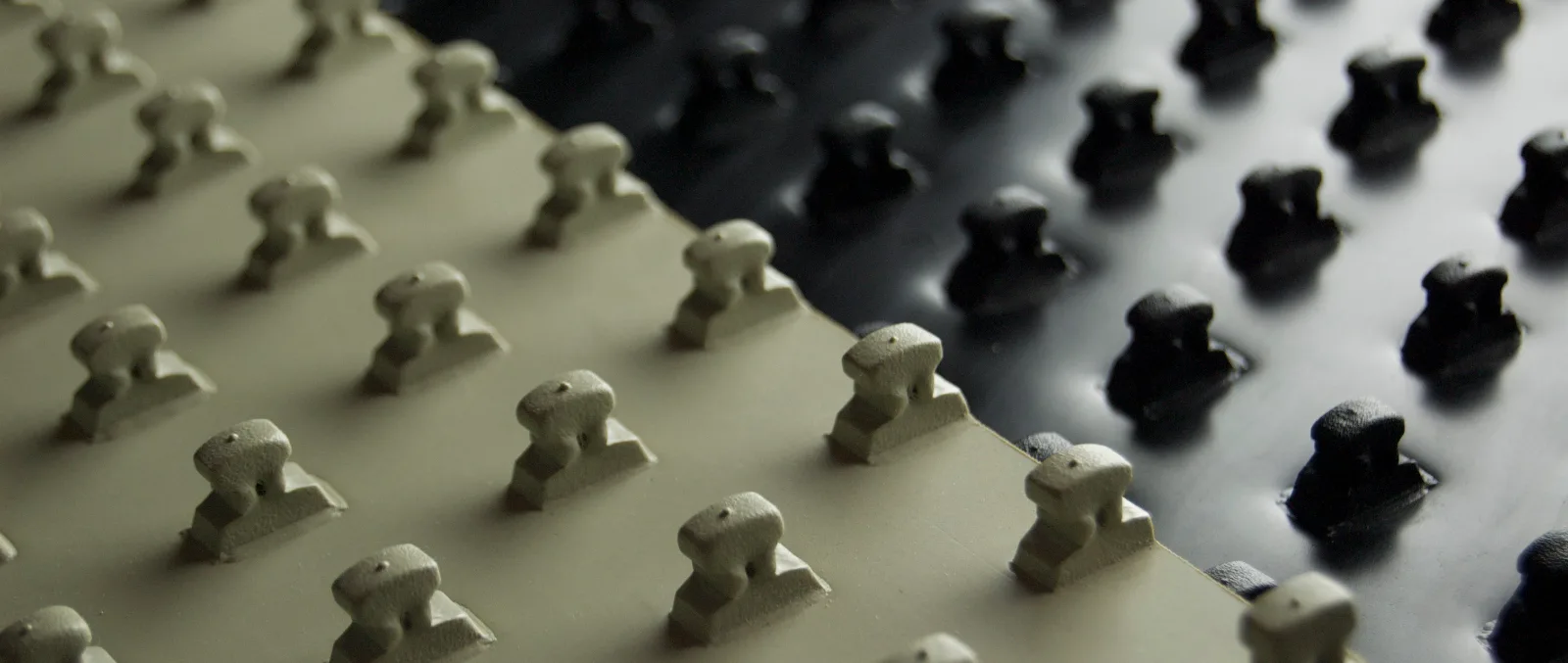
GSE® Studliner® is a high-density polyethylene (HDPE) concrete protection liner with integral extruded studs on one face. More than 1,200 studs per square metre anchor the sheet into concrete or grout. The smooth exposed face and welded joints provide a continuous protective barrier for new construction and rehabilitation.
Concrete protection liner applications include precast sewer pipes and manholes, cast-in-place wastewater tanks, industrial process structures, sumps and trenches. The HDPE sheet resists chemical attack and mechanical damage. Thickness, chemical compatibility, operating temperature, anchorage and joint details must be confirmed for each project. Available sheet thicknesses range from 2.0 to 5.0 mm, in black or grey, with rolls and prefabricated panels available.
Geosynthetics Africa is an authorised supplier of GSE products in Africa. We provide material supply and delivery, specialist installation and documented QA/QC for concrete protection lining projects. Our scope covers panel layouts, formwork coordination, thermal welding, penetrations, terminations, seam testing, repairs and handover records.
Technical notes: Values apply to the 2, 3, 4 and 5 mm grades. Tensile properties are measured in each direction using a Type IV dumbbell specimen and a 50.8 mm gauge length. ¹ Pull-out strength requires concrete compressive strength of at least 35 MPa. ² For near-spherical agglomerates, nine of ten views must be Category 1 or 2, with no more than one view in Category 3. *Modified test procedure. Roll dimensions are nominal.
Quality-control test frequency: Thickness is checked every fifth roll. Density, tensile properties, carbon black or pigment content, and carbon black dispersion are checked once per 9,290.3 m². Notched constant tensile load is checked once per formulation. Stud pull-out, thermal expansion, low-temperature brittleness, dimensional stability, water absorption and water vapour transmission are checked once per product.
Typical Values for WATERPROOFING CONCRETE PROTECTION
Properties & Dimensions
| Property | Test Method | Unit | Nominal Value |
|---|---|---|---|
| Nominal thickness | ASTM D5199 | mm | 2 / 3 / 4 / 5 |
| Density | ASTM D1505 | g/cm³ | 0.94 |
| Tensile strength at yield | ASTM D6693 | MPa | 15 |
| Elongation at break | ASTM D6693 | % | 500 |
| Stud pull-out strength¹ | - | kPa | >670 |
| Carbon black content - black | ASTM D1603* / D4218 | % | 2-3 |
| Pigment content - grey | ASTM D5630* | % | 1.5-2.5 |
| Carbon black dispersion² | ASTM D5596 | Category | See note 2 |
| Notched constant tensile load | ASTM D5397 | h | 500 |
| Linear thermal expansion | ASTM D696 | °C⁻¹ | 1.20 × 10⁻⁴ |
| Low-temperature brittleness | ASTM D746 | °C | -77 |
| Dimensional stability | ASTM D1204 | % | ±1.0 |
| Water absorption | ASTM D570 | % | 0.1 |
| Water vapour transmission | ASTM E96 | g/m²/day | <0.01 |
| Roll width | - | m | 2.4 |
| Roll length - 2 / 3 / 4 / 5 mm | - | m | 75 / 65 / 60 / 60 |
| Roll area - 2 / 3 / 4 / 5 mm | - | m² | 183 / 158 / 146 / 146 |
| Concrete strength for pull-out¹ | - | MPa | ≥35 |
Popular Catalogue Items
Related Product Groups
Three Questions To Ask Before You Order
1.Who manufactures GSE Studliner?
2.Can Studliner be used on existing concrete structures?
3.What thicknesses and colours are available?
4.What concrete strength is required?
5.Which chemicals is Studliner resistant to?
6.What is the maximum operating temperature?
7.How are joints and seams made?
8.Can Studliner be supplied pre-shaped?
9.How long does Studliner extend the life of concrete?
Specification For The Design, Installation Of GSE® Studliner® - HDPE Concrete Protection Liner
GSE® Studliner® is supplied in rolls with a nominal width of 2.4 m or as prefabricated pieces, and should be stored on a clean, smooth surface, covered and out of direct sunlight. Panels are fixed to the formwork smooth side against the form, with the studs facing the concrete. Fix them with nails, screws, tie wire or banding, allowing for thermal movement, and never attach rebar to the liner.
Seams are overlapped by about 100 mm and temporarily sealed so concrete can't get between the sheets. Plan concrete pouring in the early morning, at dusk or at night, when the liner is thermally contracted, and vibrating the concrete to fully embed the studs. Floors can be lined by grouting the liner onto an existing slab.
Prepare clean, dry surfaces and complete trial seams using project material before field welding. Weld panel joints, penetrations and repairs using the approved method. Vacuum test accessible welds in accordance with ASTM D5641 and the project procedure; spark testing to ASTM D6365 can be used where the joint detail supports it. Include final spark testing of the complete sheet surface in the inspection and test plan. Record defects, repairs and retests. Destructive testing is not advised after the liner is embedded in concrete.
Featured Projects Across Africa
Related Resources
Common STUDDED HDPE CONCRETE LINERS CPL Applications
Request a Quote for This Product Family
Upload your BOQ, drawings, or specifications and our technical team will provide a detailed proposal.
Have a project? Start with us.
Get expert engineering support, reliable material supply, and best-in-class installation.