
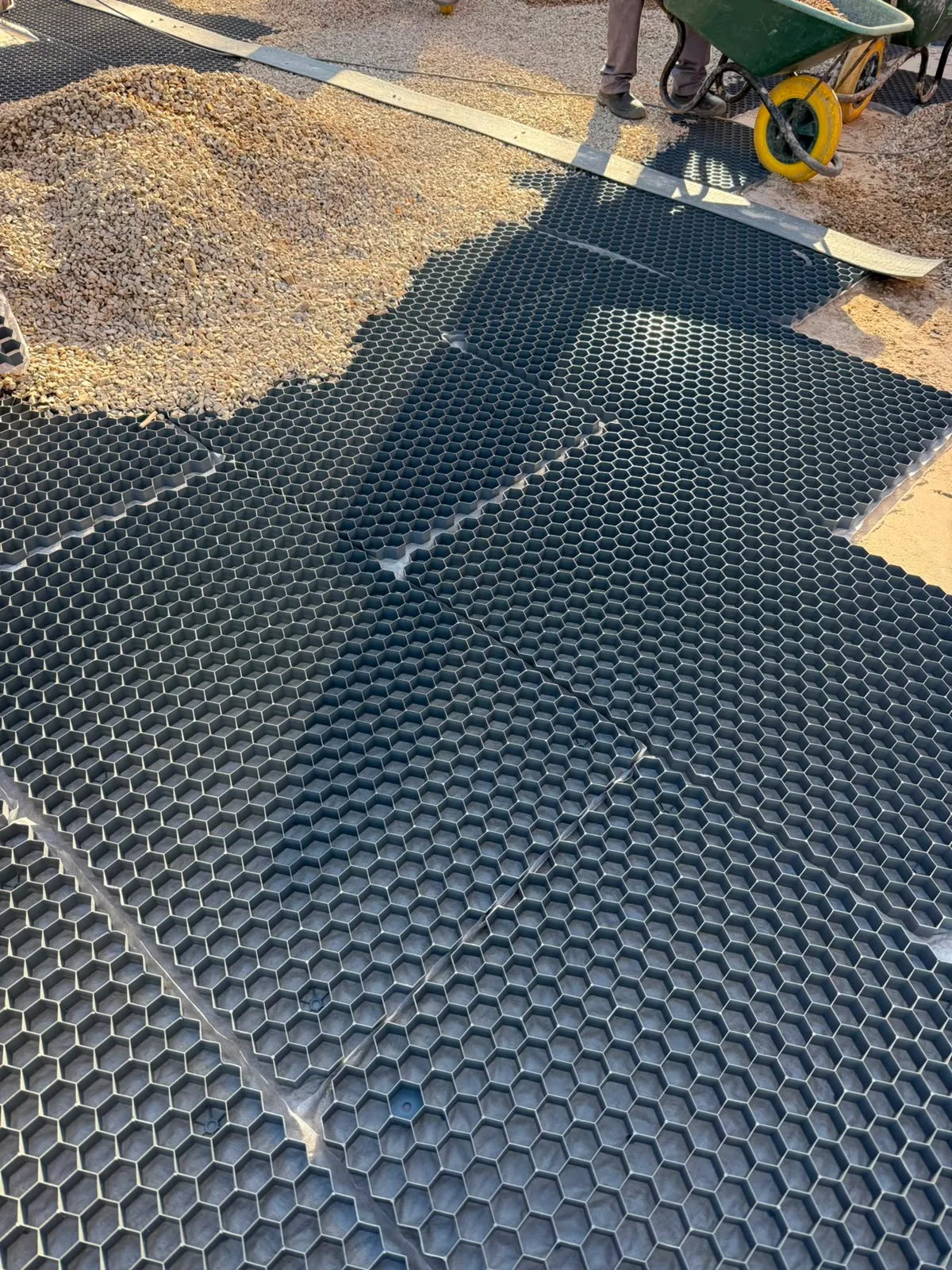
Here's how most gravel stabilisation gets built. Someone specifies a cellular confinement grid - a general-purpose product, originally developed for soil and base reinforcement. Because gravel would fall straight through the open cells, a geotextile has to go underneath. That gets bought separately, usually whatever general-purpose nonwoven the merchant had, rolled out on site, and the grid laid on top of it.
Two products, two suppliers, and a system that only exists once the crew has assembled it in the ground.
BERA Gravel Fix is one product. The geotextile is ultrasonically laminated to the honeycomb in the factory, and the grid geometry was designed around holding gravel rather than adapted to it. That distinction is the whole argument, and it plays out in four places.
The fabric is unspecified
When the geotextile is bought separately, nobody decides what it should be. It's a line item — "geotextile, 100 g/m²" or whatever the merchant stocks. Nothing in the specification says which polymer, which construction, or what it needs to do structurally.
That matters, because the fabric under a gravel grid is carrying load. It spans the open cell base and holds the gravel while distributing wheel loads to the cell walls. A bulky needlepunched nonwoven compresses and sags into the void below; a thin, stiff spunbond spans it. Bera's published rut-depth testing shows needlepunched fabrics — short and continuous fibre both - deforming substantially more than spunbond under simulated traffic, because initial modulus is what resists rutting.
Gravel Fix ships with DuPont Typar SF20 specified for that job. A site-assembled system ships with whatever arrived on the truck.
Nobody chose the polymer either
Most general-purpose geotextiles in the market are polyester. Typar is polypropylene, published by DuPont as predicted durable for a minimum of 100 years in all natural soils, with 100% strength retention under oxidation (EN ISO 13438), chemical (EN 14030) and microbiological (EN 12225) resistance testing.
PET is susceptible to hydrolytic degradation, and that susceptibility rises in alkaline conditions - exactly what you find where permeable paving meets concrete kerbs, cement-bound edge restraints or lime-stabilised subbase. It's a real mechanism with a real consequence: the fabric that was structural on day one is less structural in year fifteen.
A pre-laminated system removes the question. A site-assembled one leaves it to whoever placed the order.
Two loose layers move
This is the failure mode that shows up first and is hardest to fix. A grid laid on a separate sheet of geotextile is two independent layers. During installation they shift relative to each other as crews walk on them, trim edges and fill cells. Under load and thermal cycling they keep moving. Gaps open at panel joints where the fabric has pulled back, and gravel starts migrating into the bedding at those points.
Lamination makes it one layer. And Gravel Fix panels carry extended geotextile lips on two sides, so adjacent sheets overlap on the fabric itself - continuity of separation across every joint, by construction rather than by workmanship. On a site-assembled build, that continuity depends entirely on how carefully the separate fabric was overlapped before the grids went down on top of it, which nobody can inspect once it's covered.
The grid wasn't designed for gravel
General-purpose cellular confinement is dimensioned for soil, aggregate base or vegetated fill. Gravel Fix's geometry is specific: 42mm cells, 32mm depth on the Pro, and tapered walls - 1.4mm at the base narrowing to 0.8mm at the top - to put material where the vertical load is. Fill specification is 3–16mm gravel laid 15–20mm proud of the cell wall.
Those numbers exist because the failure modes of a gravel surface are specific: cell size that lets fill rock and migrate, wall geometry that flexes under vehicle loading, fill depth that leaves cells exposed to UV and tyre scuffing. A grid designed for another purpose may work, but nothing about its dimensions was chosen with this one in mind.
What it means commercially
A site-assembled system has no single point of accountability. If the surface ruts, is that the grid, the fabric, the subbase or the installation? Each supplier can point at the others. With a designed system, one manufacturer specified the whole assembly and stands behind it - and the installer's job is foundation, laying and filling, not deciding which geotextile the design needs.
Foundation still governs, as it does under any permeable surface: 10cm of sharp sand or angular gravel for pedestrian paths, 15–25cm of compacted MOT crushed stone plus 4–6cm of levelling sand for vehicle use. Bera call out compaction explicitly, and no panel compensates for a base that wasn't compacted properly.
Where this fits in a SuDS scheme
Gravel stabilisation is source control - rainfall infiltrates where it lands. Bera publish infiltration of up to 180 litres per second per m² for the panel, which confirms the surface layer won't be the bottleneck. Design your drainage on the subbase and subgrade, not on the panel figure.
One installation constraint worth planning around in African conditions: Typar has good UV resistance for several months, but DuPont's guidance is to cover it within two weeks of installation, and prolonged tropical sunlight causes strength loss. Sequence the gravel delivery to match the laying programme rather than laying panels ahead of it.
The question to ask
When comparing quotations, the useful question isn't price per square metre. It's whether the price includes a geotextile, what that geotextile is, and who decided it was the right one. If the answer is "buy separately," you're pricing a component and comparing it against a system.
We supply BERA Gravel Fix Pro across Africa, EPD-certified for green building submissions. Talk to our team about specification and foundation design.