
Most slope and embankment failures on soft ground don't happen because the reinforcement snapped.
They happen for two much less dramatic reasons. Either the fill deformed far enough that the structure was unserviceable long before anything reached ultimate tensile strength — cracked crest, bulged face, settled haul road. Or pore water pressure built up in a saturated subgrade, effective stress dropped away, and the shear strength the design depended on simply stopped being there.
Those are two different problems. Historically they've been solved with two different products: a geogrid for tension, a nonwoven geotextile underneath it for separation and filtration. Two rolls, two unrolling operations, two sets of overlaps, two chances to get the orientation wrong.
MIRAGRID® PEC does both jobs in one layer.
What MIRAGRID PEC actually is
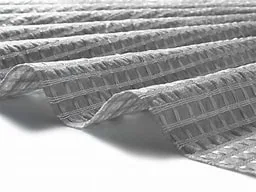
MIRAGRID® PEC is a biaxial geocomposite. Per the Solmax technical data sheet, it is composed of high modulus polyester fibres attached to a continuous filament nonwoven geotextile backing, and Solmax describes the range as suitable for short and long term soil reinforcement applications.
That construction is the whole point:
- The high-modulus polyester carries tensile load in both machine and cross-machine direction — biaxial, not one-way.
- The continuous filament nonwoven backing separates the fill from the subgrade, filters fines, and lets pore water escape the failure zone instead of pooling at the reinforcement interface.
- Both arrive on the same roll, in the same lift, in a single unrolling operation.
It's also worth knowing if you're reading older specifications or legacy drawings: ROCK PEC is now MIRAGRID® PEC. Same product, current name.
Stiffness is the number that matters - not ultimate strength
This is the part most tender documents get wrong. They specify an ultimate tensile strength and stop there.
But on a reinforced slope, the reinforcement only does work once the soil has strained enough to load it. Design your structure around ultimate strength and you're implicitly accepting whatever deformation gets you there. What you actually want to know is: how much force does this material develop at the strains I can tolerate?
MIRAGRID PEC's datasheet publishes exactly that, tested to EN ISO 10319. Tensile strength at 2%, 3% and 5% strain, against nominal strength:
- PEC 40/40 - 9 kN/m at 2%, 13 kN/m at 3%, 23 kN/m at 5%. Nominal 42 kN/m.
- PEC 55/55 - 13 kN/m at 2%, 19 kN/m at 3%, 30 kN/m at 5%. Nominal 58 kN/m.
- PEC 75/75 - 18 kN/m at 2%, 25 kN/m at 3%, 40 kN/m at 5%. Nominal 79 kN/m.
- PEC 95/95 - 22 kN/m at 2%, 33 kN/m at 3%, 54 kN/m at 5%. Nominal 100 kN/m.
Read the 5% figures against the nominal figures. Across every grade, roughly half the nominal tensile strength is already mobilised at 5% strain - 23 of 42 kN/m on the 40/40, 54 of 100 kN/m on the 95/95. That's a stiff response, and stiffness is what keeps a crest level and a face plumb.
Elongation at nominal strength sits at 11% in the machine direction across the whole range, and 10.5–11% cross-machine. High-modulus polyester earns its name.
The drainage function nobody specifies - and what it honestly does
Here's where accuracy matters more than marketing.
The nonwoven backing gives MIRAGRID PEC a water permeability normal to the plane of 55 mm/s (EN ISO 11058) across all four grades. Water sitting in the fill above, or migrating up from a saturated subgrade below, can pass through the reinforcement layer rather than being trapped against it.
What it is not is a drainage geocomposite. In-plane water flow capacity at 20 kPa is 2.0 × 10⁻³ l/ms (EN ISO 12958). That is a modest number and we're not going to pretend otherwise. MIRAGRID PEC relieves pore pressure by letting water cross the plane into a properly designed drainage layer or blanket. It does not conduct meaningful volumes of water along its own length. If your design needs an in-plane drain, spec an in-plane drain.
The filtration side is genuine, though. Characteristic opening size (O90, EN ISO 12956) runs 95–120 µm depending on grade - fine enough to hold subgrade fines back while the fill consolidates, which is the difference between a working platform that stays a platform and one that pumps itself into mud over a wet season.
Where it fits on a slope job
Four situations where the grid-plus-nonwoven combination genuinely earns its cost over a bare geogrid:
Basal reinforcement under embankment fills. The Solmax installation guideline is explicit about embankment geometry: the longitudinal direction of MIRAGRID PEC shall run perpendicular to the longitudinal axis of the embankment. Tension develops across the fill, spanning soft zones, while the nonwoven keeps the imported fill and the in-situ material from mixing.
Reinforced fill behind a steep or faced slope. The guideline instructs that reinforcement be placed as perpendicular as possible to the sloped face unless the design says otherwise. Note what this means: MIRAGRID PEC is the reinforcement inside the soil mass. The facing - vegetated, block, or gabion — is a separate system, and Solmax's wall and slope portfolio covers those separately. Anyone selling you a geocomposite as a complete wall system is selling you half a structure.
Working and load platforms over weak ground. Cranes, piling rigs, drill rigs and haul traffic over low-bearing subgrade, where you need load spreading and separation in one layer.
Landfill and containment slopes. Waste slopes are the classic case where reinforcement, separation and pore-pressure relief are all live concerns in the same layer.
Getting it right on site
The best-specified geocomposite on the continent still fails if it's installed badly. From the Solmax installation guideline (Rev 1025), the points that actually get missed:
- Cover the rolls. Stored longer than two weeks, MIRAGRID PEC rolls must be covered completely against direct sunlight. Different grades and roll sizes are stored separately - a mislabelled 55/55 laid where the design called for 95/95 is not recoverable after the fill goes on.
- Prepare the subgrade properly. Level, smooth and compact it. Remove trees, shrubs and anything else that could damage the material.
- Lay it flat. No slack, no folds. Slack means the soil has to strain further before the reinforcement takes load - which is exactly the failure mode the low-strain performance above was bought to prevent.
- Overlaps: 200 mm transverse, typically. The size of the overlap should be specified in the design. Where it isn't, a transverse overlap of typically 200 mm may be needed at the junction of adjacent panels. On very soft ground the overlap may be increased to avoid unreinforced areas. Critically: overlap along the direction of principal stress is either forbidden or specified in the design - never a site decision. Panels can also be joined by sewing.
- Never drive on it. Direct driving on MIRAGRID PEC with any kind of vehicle is not allowed. Fill is placed by back-dumping from trucks running on previously compacted fill, spread with a bulldozer or similar tracked vehicle.
- Respect the lift thickness. Where the design doesn't state otherwise, a minimum fill thickness of 400 mm - 300 mm after compaction - applies.
- Limit exposure. Keep the time MIRAGRID PEC sits unprotected to a minimum.
Roll and supply data for your BOQ
All four grades supply at 5.3 m wide × 100 m long - 530 m² per roll. Roll weights by grade:
- PEC 40/40 - 200 kg
- PEC 55/55 - 225 kg
- PEC 75/75 - 259 kg
- PEC 95/95 - 296 kg
Two practical consequences. First, at 200–296 kg a roll, this is a plant-handled product - budget for a telehandler or excavator with a spreader bar at the face, not a labour gang. Second, at 530 m² of gross coverage per roll, your net rate after transverse overlaps and cutting to a curved or benched geometry will be meaningfully lower than 530. Build the overlap allowance into the take-off rather than discovering it on the last lift.