
Silt Curtains & Turbidity Barriers – Africa
GeoCurtain silt curtains and turbidity barriers for marine construction, dredging, port and harbour works, bridge and causeway builds, river rehabilitation and mine water containment across Africa. Three performance classes cover the full range of site conditions - Type 1 for still or low-flow water, Type 2 for moving water and tidal estuaries, Type 3 for open ocean and high-energy exposure. Each barrier is fabricated to project depth and length using UV-stabilised impermeable or permeable curtain fabric, closed-cell flotation, ballast chain and reinforced load lines, with connector systems that let sections be joined, extended and redeployed across a programme. Specified to satisfy environmental authorisation conditions and water quality monitoring requirements, with layout planning, anchoring design and deployment support from our team. Pan-African supply and installation
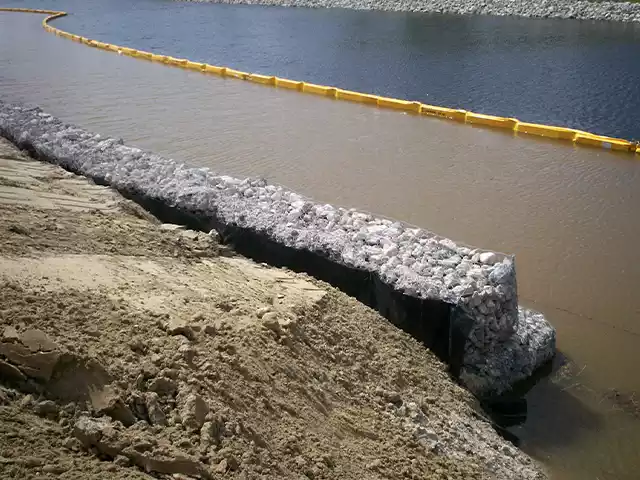
Technical Specification of Silt Curtains & Turbidity Barriers – Africa
A silt curtain (also called a turbidity curtain or silt screen) is a floating barrier deployed in waterways to contain suspended sediment disturbed by construction, dredging, or marine works. It provides the enclosed area and time needed for sediment particles to settle to the bottom before water returns to the surrounding environment.
Silt curtains are increasingly specified on marine and inland waterway projects across Africa where unnatural turbidity levels threaten ecologically sensitive areas - coral reefs, seagrass beds, mangroves, estuary systems, and water intakes for desalination or irrigation. Regulatory bodies and environmental impact assessments across the continent now routinely require turbidity control as a condition of project approval.
Curtain performance depends on matching the design class to site conditions. Three classes cover the full range of applications: Class 1 for still or sheltered water with minimal current, Class 2 for rivers, ports, and calm harbours with moderate forces, and Class 3 for open water, harbour entrances, and river mouths where strong wind and tidal loads are present. Float size, ballast weight, skirt depth, webbing strength, and connector grade all step up between classes.
Geosynthetics Africa supplies silt curtains specified and manufactured to the conditions of your site — body of water, skirt depth, current velocity, tidal range, deployment duration, and any applicable EPA or environmental permit requirements. Standard sections are 20 metres with custom lengths and depths available. Curtains are delivered fully assembled and ready for immediate deployment across South Africa and over 30 African countries.
Typical Values for DEWATERING SYSTEMS
Properties & Dimensions
| Property | Class 1 | Class 2 | Class 3 |
|---|---|---|---|
| Float Chamber PVC | 400gsm | 610gsm | 900gsm |
| Float Size | 50mm x 100mm | upto 150mm x 150mm | upto 200mm x 200mm |
| Skirt Depth | Up to 2m | Up to 8m | Up to 20m |
| Skirt Material | 260gsm Geotextile | 260gsm Geotextile | 260gsm Geotextile |
| Ballast Chain | 6mm galvanised | 6mm – 8mm galvanised | 8mm – 13mm galvanised |
| Webbing | 25mm – 1T breaking strain | 50mm – 2T breaking strain | 50mm – 5T breaking strain |
| Connectors | Bowshackles | Standard Z-connectors | Heavy duty Z-connectors |
| Skirt Connectors | Marine grade #10 zipper | Marine grade #10 zipper | Marine grade #10 zipper |
| Standard Section Length | 20m | 20m | 20m |
| UV Resistance- | Up to 5 years | Up to 5 years | Up to 5 years |
Popular Catalogue Items
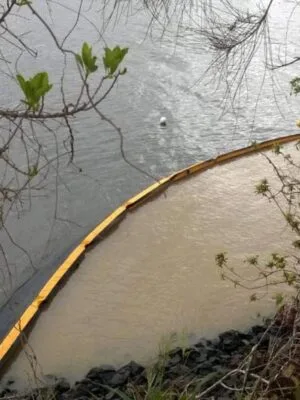
GeoCurtain™ Class 1 Silt Curtain – Calm Water Sediment Control
Low Risk Waterways, Lagoons, Ponds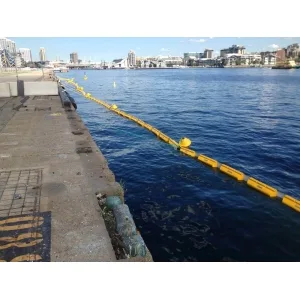
GeoCurtain™ Class 2 Silt Curtain – River & Moderate Conditions
Medium Duty Barriers, Rivers and Calm Harbours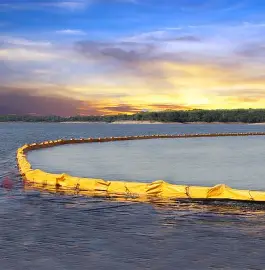
GeoCurtain™ Class 3 Silt Curtain – Marine & High Energy Applications
High Energy marine and CoastalRelated Product Groups
Three Questions To Ask Before You Order
1.How do I select the correct silt curtain class for my project?
2.How deep does the silt curtain skirt need to be?
3.What current velocities can silt curtains operate in?
4.How should a silt curtain be anchored?
5.What configuration should the silt curtain be deployed in?
6.How do waves affect silt curtain performance?
7.Is vessel traffic a problem for silt curtain deployments?
8.How long can a silt curtain remain deployed?
9.What inspection and maintenance is required during deployment?
10.Can silt curtains be reused after a project?
11.What accessories are available with silt curtains?
12.What information do I need to provide to get a silt curtain specified and quoted?
Specification For The Design, Installation Of Silt Curtains & Turbidity Barriers – Africa
Silt curtain deployment requires advance planning, correct anchoring, and disciplined handling procedures. The two most common causes of silt curtain failure on African waterway projects are inadequate anchoring that allows the curtain to drift or collapse under tidal load, and incorrect skirt depth that causes the curtain to billow, drag the seabed, or flare under current. Both are preventable with correct specification and competent site supervision.
Pre-Deployment Preparation - Install the anchoring system in the waterway before the curtain arrives at the water's edge. Confirm anchor positions account for tidal rise and fall and allow sufficient mooring line length for the curtain to move vertically without stress. Ensure a clear working area on shore or on the deployment vessel. Join pallet sections in consecutive order on land with the skirt remaining furled. For large deployments across multiple pallets, confirm each pallet is numbered and sequenced correctly before any section enters the water.
Towing to Position – Once the desired curtain length is connected and furled, tow the system to the deployment location at a maximum speed of two to three knots. The curtain must remain furled during towing. Never drag an unfurled curtain with the skirt deployed through water - this places severe and undue stress on the webbing, connectors, and skirt material and will cause damage.
Anchoring and Skirt Release – Secure the furled curtain to the anchoring system before releasing the skirt. Check that the skirt is not twisted around the flotation chamber - a twisted skirt will not deploy correctly and will concentrate stress at the twist point. Once the curtain is anchored in the correct position and confirmed untwisted, remove the ties furling the skirt and allow the curtain system to drop into place under its own ballast weight. Do not attach the curtain directly to piles or poles driven into the seabed under any circumstances.
Confirming Correct Deployment – After the skirt has deployed, visually confirm the curtain is sitting vertically in the water column, the ballast chain is hanging freely and not resting on the seabed, and the freeboard is sitting correctly above the waterline. Check that all connector points are secure and that the curtain forms the intended configuration - closed, open, or maze - relative to the work area and any adjacent structures. Confirm a minimum 0.5m gap exists between the skirt base and the seabed at low tide.
Repositioning if Required – If the curtain needs to be moved after initial deployment, furl the skirt before dragging or towing the system to its new position. Never reposition an unfurled curtain. Disconnect from anchoring points, furl, reposition, re-anchor, and re-release the skirt in sequence.
Ongoing Inspection and Maintenance – For deployments longer than three months implement a scheduled inspection programme. Check curtain position, skirt condition, anchor line integrity, connector and zipper condition, marine growth accumulation, and hardware wear at anchoring points at intervals determined by site exposure - from daily in high-energy environments to quarterly in sheltered stable conditions. Keep a spare curtain section on site. Record all inspections and maintenance actions. Where visual inspection from the surface is insufficient, deploy underwater divers to inspect the submerged skirt and connections - particularly following any observed sediment plume within the protected area.
Recovery – Before removing the curtain, cease all marine works and conduct a visual inspection of water quality within the protected area to confirm no active sediment plume. Disconnect the curtain from anchoring points, furl the skirt, and remove the mooring system. Tow the furled curtain back to the launch site. On land, clean with a high-pressure washer to remove biofouling, silt, and sediment, allow to dry completely, and repack on pallets for storage or disposal. A well-maintained curtain can be redeployed on future projects.
Featured Projects Across Africa
Related Resources
Common GEO CURTAIN SILT TURBIDITY CURTAINS Applications
Request a Quote for This Product Family
Upload your BOQ, drawings, or specifications and our technical team will provide a detailed proposal.
Have a project? Start with us.
Get expert engineering support, reliable material supply, and best-in-class installation.