
GEOTUBE® Dewatering Systems
GEOTUBE® geotextile dewatering technology by Solmax, supplied and installed across Africa by Geosynthetics Africa. Large-format containers engineered for high-volume dewatering of mine tailings, dredged sediment, municipal sludge and industrial process waste - achieving up to 90% volume reduction and over 99% solids capture. Custom-fabricated to circumference and length for each application, with high-strength woven fabric that retains fines while releasing clean effluent for discharge or reuse. Full project support: feed characterisation, polymer conditioning trials, tube sizing, containment cell layout and on-site commissioning. Pan-African logistics from South African stock
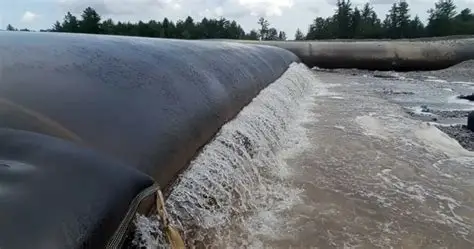
Technical Specification of GEOTUBE® Dewatering Systems
GEOTUBE® dewatering technology, developed by TenCate Geosynthetics and now produced under Solmax, has become the method of choice for organisations managing large and small volumes of sludge, tailings, and industrial waste streams globally. The system operates on a principle of simplicity - slurry is pumped hydraulically into a specially engineered woven geotextile container, environmentally safe polymers cause solids to bind together and water to separate, and clear effluent drains passively through the fabric pores. Over 99% of solids are captured, and volume reduction of up to 90% is achievable through repeated fill and dewatering cycles. No belts, gears, or mechanical components are required.
GEOTUBE® containers are available in a wide range of sizes and can be custom fabricated to fit available space and project requirements. Units can be mounted in mobile roll-off containers for transport across site, deployed in underwater steel frames for harbour and marine applications, or stacked above ground to maximise containment capacity within a defined footprint. The largest units in the range reach circumferences of up to 36.6 m and individual lengths exceeding 57 m, making GEOTUBE® the only dewatering container system capable of handling the volumes generated by major dredging programmes, large industrial tailings facilities, and high-volume wastewater treatment operations.
The GEOTUBE® fabric is a specially engineered woven polypropylene geotextile available in two primary grades. The GT500 is the standard dewatering grade, offering 78.8 kN/m tensile strength in the machine direction and 109.4 kN/m in the cross-machine direction, with an apparent opening size of 0.43 mm and a water flow rate of 813 l/m2/min. The GT1000M is the heavy-duty grade, with 175.0 kN/m tensile strength biaxially, a seam strength of 88 kN/m, and 85% UV strength retention after 500 hours of exposure. Both grades use patented circumferential seaming technology that distributes hoop stress along the seam length, maintaining structural integrity under the high internal pressures generated during hydraulic filling of large-diameter units.
Geosynthetics Africa is an authorised supplier of GEOTUBE® products from Solmax for South Africa and the broader African region. We supply the full range including standard dewatering containers, the GT500 1m x 1m dewatering bag for smaller volume applications, mobile dewatering systems for roll-off container deployment, and marine and underwater containers for nearshore and harbour applications. Full technical support including system sizing, polymer programme recommendations, Jar Testing, and on-site installation guidance is available for all GEOTUBE® projects.
Typical Values for DEWATERING SYSTEMS
Properties & Dimensions
| Property | Test Method | GT500 | GT1000M |
|---|---|---|---|
| Net bentonite content | - | Custom Woven PP | Custom Woven PP |
| Tensile Strength MD | ASTM D4595 | 78.8 kN/m | 175.0 kN/m |
| Tensile Strength CMD | ASTM D4595 | 109.4 kN/m | 175.0 kN/m |
| Tensile Elongation MD/CMD | ASTM D4595 | 20% max / 20% max | 20% max / 20% max |
| Factory Seam Strength | ASTM D4884 | 70.0 kN/m | 88.0 kN/m |
| Apparent Opening Size (AOS) | ASTM D4751 | 0.43 mm (No. 40 Sieve) | 0.60 mm (No. 30 Sieve) |
| Water Flow Rate | ASTM D4491 | 813 l/m2/min | 815 l/m2/min |
| Mass per Unit Area | ASTM D5261 | 585 g/m2 | 1,119 g/m2 |
| UV Resistance | ASTM D4355 | 80% strength retained after 500 hrs | 85% strength retained after 500 hrs |
Popular Catalogue Items
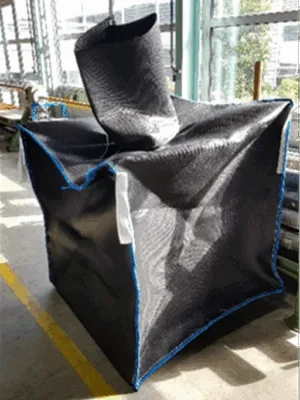
GEOTUBE® GT500 Dewatering Container – (with Sleeve & Top Cover)
78.8 / 109.4 kN/m MD/CMD tensile, AOS 0.43 mm, up to 36.6 m circumferenceRelated Product Groups
Three Questions To Ask Before You Order
1.What is the three-stage GEOTUBE® dewatering process?
2.What is the difference between the GT500 and GT1000M fabric grades?
3.What happens to the GEOTUBE® container and its contents after dewatering is complete?
4.Can GEOTUBE® handle acid mine drainage?
5.Is GEOTUBE® suitable for wastewater treatment works?
6.What polymer is used with GEOTUBE® and is it environmentally safe?
7.Can GEOTUBE® units be stacked to increase capacity within a limited footprint?
8.What is the GEOTUBE® GT500 1m x 1m dewatering bag used for?
Specification For The Design, Installation Of GEOTUBE® Dewatering Systems
GEOTUBE® Dewatering Containers, Installation Overview - Prepare a level containment area capable of supporting the filled weight of the GEOTUBE® unit. The base should be lined with an impermeable geomembrane to capture and direct effluent to a collection point, with a drainage layer of nonwoven geotextile and aggregate placed beneath the tube to allow filtrate to drain freely. Unroll the GEOTUBE® container in position with all Eyeport inlet and vent fittings orientated upward. Connect pump supply lines and confirm all fittings and discharge routing before filling begins. Conduct a Jar Test prior to the first fill cycle to confirm polymer type, dosage, and slurry compatibility. Fill at a controlled rate to avoid overpressurising the fabric. Allow dewatering to occur passively between fill cycles. Refill progressively until maximum solids volume is reached. For underwater applications, lower the GEOTUBE® unit in its steel frame to the waterbody floor before filling begins.
GEOTUBE® GT500 Dewatering Bag, Installation Overview - Position the GT500 dewatering bag on a stable, drained surface with the fill opening accessible for connection to the slurry feed. For closed-top units, connect the fill port sleeve to the pump or gravity feed line. Support the filled weight of the bag on a frame or pallet as specified. Do not use the positioning belts to lift the filled bag. Bags should not be overfilled beyond the designed fill volume. Allow full drainage before handling. Dispose of filled bags in accordance with the waste classification of the retained solids.
Featured Projects Across Africa
Related Resources
Common GEOTUBE DEWATERING SYSTEMS Applications
- Mining Tailings and Slurry Management
- Dredging and Harbour Sediment Dewatering
- Municipal and Industrial Wastewater Treatment
- Water Resource Management and Reclamation
- Precious Metals Recovery
- Acid Mine Drainage Treatment
- Power Generation and Fly Ash Management
- Environmental Remediation
- Emergency and Disaster Response
- Aquaculture and Agriculture Waste Management
Request a Quote for This Product Family
Upload your BOQ, drawings, or specifications and our technical team will provide a detailed proposal.
Have a project? Start with us.
Get expert engineering support, reliable material supply, and best-in-class installation.