
EPDM Geomembrane Liners for Exposed Water Containment
Rubber liners that don't wrinkle, crack or fail in African sun. 465% elongation absorbs the thermal movement that cracks thermoplastic liners in exposed service. For dams, reservoirs, ponds and steel tank lining. NSF/ANSI 61 potable. ASTM D4637 Type I. Supplied and installed in 30+ African countries.
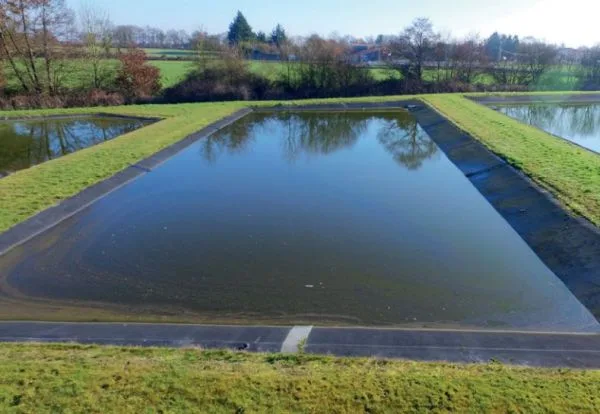
Technical Specification of EPDM Geomembrane Liners for Exposed Water Containment
EPDM (Ethylene Propylene Diene Monomer) is a synthetic rubber geomembrane whose vulcanised molecular structure delivers intrinsic resistance to UV radiation, ozone, and weathering - without reliance on carbon black or plasticiser additives that migrate and degrade over time. Unlike thermoplastic membranes, EPDM's chemical composition remains stable across decades of fully exposed service, making it the specification standard for uncovered reservoirs, open ponds and long-term surface water containment across Africa.
With 465% ultimate elongation (ASTM D412), EPDM conforms to irregular substrates, accommodates differential settlement, and flexes through thermal cycling that causes rigid coatings and lower-elongation thermoplastic liners to crack at joints and corrugations. This makes it the verified flexible lining solution for earthen dam embankments, concrete reservoir rehabilitation, and internal lining of corrugated steel and sectional water storage tanks - including buffel tanks - where structural movement is a design condition, not an exception.
Certified to ASTM D4637 Type I and NSF/ANSI 61 for direct potable water contact, EPDM is supplied by Geosynthetics Africa in large-format rolls of up to 9.15m × 30.49m (278.98m² per roll) - minimising field seams on large water-retaining structures where seam frequency directly correlates with containment risk. We supply EPDM as a complete engineered system: membrane, bonding adhesive, HP-250 primer, SecurTAPE, pressure-sensitive flashing, lap sealant, and termination hardware - one system, one supplier, delivered across 30+ African countries.
Typical Values for GEOGRIDS INTERLAYERS
Properties & Dimensions
| Property | Test Method | 1.14mm (45-mil) | 1.52mm (60-mil) |
|---|---|---|---|
| Tensile Strength | ASTM D412 | 11.0 MPa | 11.0 MPa |
| Ultimate Elongation | ASTM D412 | 465% | 465% |
| Tear Strength | ASTM D624 Die C | 35.0 kN/m | 35.0 kN/m |
| Weight | - | 1.4 kg/m² | 1.9 kg/m² |
| Brittleness Temperature | ASTM D746 | -45°C | -45°C |
| UV Weathering | ASTM G155 | No cracks @ 41,580 kJ/m² | No cracks @ 41,580 kJ/m² |
| Roll Width (max) | - | 9.15m | 9.15m |
| Roll Length | - | 30.49m | 30.49m |
| Potable Water | - | NSF/ANSI 61 | NSF/ANSI 61 |
| Standard | - | ASTM D4637 Type I | ASTM D4637 Type I |
Popular Catalogue Items
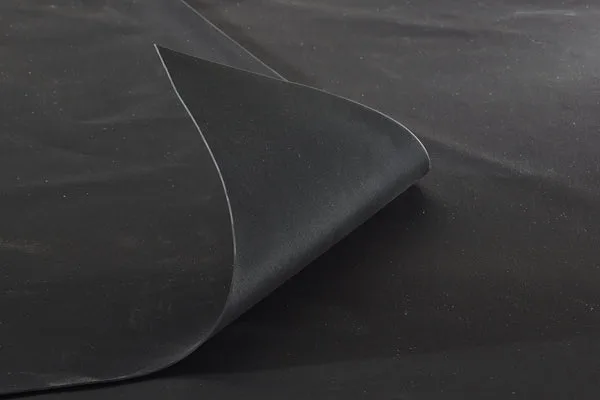
Related Product Groups
Three Questions To Ask Before You Order
1.Is EPDM suitable for potable drinking water storage?
2.Can EPDM be used to line corrugated steel buffel tanks?
3.What temperatures can EPDM handle?
4.How does EPDM compare to HDPE for dam and reservoir lining?
Specification For The Design, Installation Of EPDM Geomembrane Liners for Exposed Water Containment
Subgrade preparation is critical for all EPDM lining systems. The substrate must be smooth, compacted to 95% Proctor, and free of protrusions, sharp edges, organic material and standing water before membrane deployment. On earthen embankments and dam slopes, a needle-punched geotextile protection layer is recommended between the subgrade and membrane where subgrade particle size, root penetration risk or construction traffic presents a puncture hazard.
For fully adhered systems, the substrate and underside of the membrane are coated with Carlisle bonding adhesive and allowed to reach tack before the membrane is rolled into place and broomed down. Seams between adjoining panels are completed using HP-250 primer applied to the splice area in conjunction with SecurTAPE or Factory-Applied Tape. All seams must be rolled with a silicone-bearing hand roller to ensure full contact and eliminate air entrapment. In temperatures below 5°C, the primed splice area must be heated with a hot-air gun before and during tape application.
For corrugated steel and sectional tank lining, the membrane is cut and fitted to the internal tank geometry with wall drapes installed first, followed by the base liner. The liner is terminated at the tank rim using termination bars and fasteners aligned to the bolt pattern of the corrugated rim, sealed with lap sealant and water cut-off mastic at all penetrations and fittings. All pipe penetrations are flashed using pressure-sensitive ELASTOFORM flashing or pressure-sensitive pipe seals. A full system review and material schedule should be completed by our technical team prior to order for tank lining projects.
Featured Projects Across Africa
Related Resources
Common EPDM GEOMEMBRANES Applications
Request a Quote for This Product Family
Upload your BOQ, drawings, or specifications and our technical team will provide a detailed proposal.
Have a project? Start with us.
Get expert engineering support, reliable material supply, and best-in-class installation.