
Flexible Concrete Liner System for Africa - TILTEX GCCM
TILTEX is a Geosynthetic Cementitious Composite Mat - concrete in a roll. Unroll it, anchor it, hydrate it. Within 90 minutes it begins to set; within 28 days it reaches full structural concrete strength. No batching plant, no formwork, no heavy equipment. Africa's most practical, logistics-efficient flexible concrete lining solution for canals, ditches, slopes, bunds, reservoirs and mine infrastructure - supplied and supported by Geosynthetics Africa.
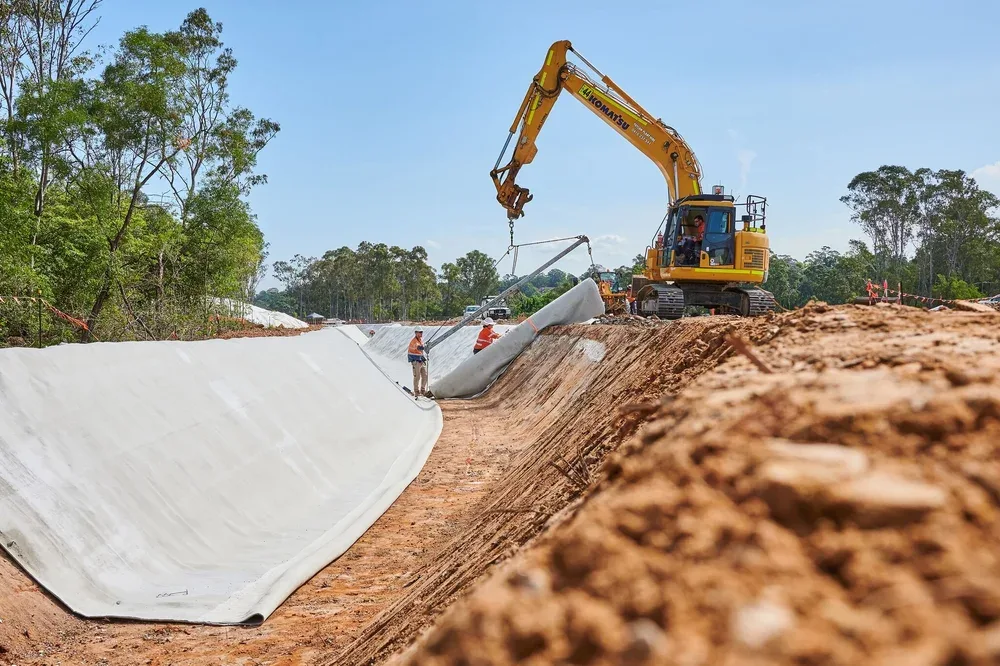
Technical Specification of Flexible Concrete Liner System for Africa - TILTEX GCCM
TILTEX is a needle-punched composite consisting of a specially formulated dry cement-sand mix encapsulated between two layers of polypropylene nonwoven geotextile. The needle-punching process locks the upper and lower geotextile layers together, maintaining an even distribution of the cement-sand mix throughout the mat and creating millions of reinforcing PP fibres embedded in the cured concrete matrix. This fibre reinforcement ensures the composite retains structural integrity even if the concrete surface sustains localised cracking - the geotextile holds the structure unified.
Quartz sand in the mix provides density and ensures even water distribution during hydration, while improving chemical and abrasion resistance in the cured state. Before hydration, TILTEX behaves exactly like a geotextile - flexible, rollable and conformable to any surface profile. It drapes into ditch sections, curves around culvert inlets, and fits complex terrain without bridging or voiding. Once sprayed with water at a minimum ratio of 1 litre per 2 kg of liner mass, the cement activates and the mat transforms into a continuous, monolithic concrete surface.
The self-sealing and self-healing characteristic of Eurobent GCL is its defining advantage over geomembrane-only liner systems. Minor installation damage, small punctures, and tears below a critical size self-seal as the bentonite hydrates and swells under confining stress - defects that would remain permanent breaches in a geomembrane become sealed by the swelling bentonite matrix. This self-healing behaviour provides inherent redundancy in composite liner systems where geomembrane is the primary element and GCL is the secondary barrier - a redundancy that no synthetic liner system alone can deliver. On African construction sites where installation conditions are often difficult and substrate preparation imperfect, this self-healing characteristic is a critical performance reserve.
TILTEX Plus incorporates an additional PE geomembrane layer bonded to the underside of the mat, achieving full impermeability tested to EN 13967:2012 and ASTM D 5887-16. The geomembrane can be specified from 0.2 mm to 2.0 mm thickness in LLDPE, HDPE or PVC depending on project requirements, making TILTEX Plus suitable for reservoirs, containment ponds, lined irrigation canals and secondary containment bunds where zero seepage is a design requirement. TILTEX Plus panels are overlapped with geomembrane-to-geomembrane welding or adhesive tape at joints for a continuous waterproof barrier beneath the concrete surface.
TILTEX is produced by Eurobent Sp. z o.o., a specialist GCCM manufacturer operating since 2008 with extensive project experience across Europe, Australia, the Middle East and Africa. It is CE certified under EN 13253, EN 13254, EN 13255, EN 13256 and EN 13257 (System 2+), carries an updated Declaration of Performance for use in construction, and is backed by a 30-year product warranty. Geosynthetics Africa is the dedicated regional supplier, providing technical specification support, grade selection, anchoring design assistance and on-site installation guidance across Africa.
Typical Values for WATERPROOFING CONCRETE PROTECTION
Properties & Dimensions
| Property | Test Method | TILTEX 7P | TILTEX 9P | TILTEX 10P | TILTEX 12P |
|---|---|---|---|---|---|
| Mass per unit area | EN 14196 | 7,600 g/m² (±10%) | 9,600 g/m² (±10%) | 10,600 g/m² (±10%) | 12,600 g/m² (±10% |
| Thickness | EN ISO 9863-1/-2 | 7.0 mm (±1 mm | 9.0 mm (±1 mm | 10.0 mm (±1 mm | 12.0 mm (±1 mm |
| Tensile strength MD/CMD | EN ISO 10319 | 20.0 / 20.0 kN/m | 20.0 / 20.0 kN/m | 20.0 / 20.0 kN/m | 20.0 / 20.0 kN/m |
| Elongation at break MD/CMD | EN ISO 10319 | 40 / 40% (−10%) | 40 / 40% (−10%) | 40 / 40% (−10%) | 40 / 40% (−10%) |
| CBR puncture strength | EN ISO 12236 | 4.0 kN (−0.4 kN) | 4.0 kN (−0.4 kN) | 4.0 kN (−0.4 kN) | 4.0 kN (−0.4 kN) |
| Dynamic puncture resistance | EN ISO 13433 | 0 mm (+1 mm) | 0 mm (+1 mm) | 0 mm (+1 mm) | 0 mm (+1 mm) |
| Protection efficiency | EN 14574 | 5.0 kN (−0.5 kN) | 5.0 kN (−0.5 kN) | 5.0 kN (−0.5 kN) | 5.0 kN (−0.5 kN) |
| Compressive strength | PN EN 196-1 | 80 MPa | 80 MPa | 80 MPa | 80 MPa |
| Bending strength | PN EN 12467 | 14.5 MPa - Class 1 | 14.5 MPa - Class 1 | 14.5 MPa - Class 1 | 14.5 MPa - Class 1 |
| Setting start | PN-EN 196-3 | > 90 min | > 90 min | > 90 min | > 90 min |
| Durability - freeze-thaw | PN EN 12467 | RL ≥ 0.75 Pass | RL ≥ 0.75 Pass | RL ≥ 0.75 Pass | RL ≥ 0.75 Pass |
| Durability - heat-rain | PN EN 12467 | RL ≥ 0.75 Pass | RL ≥ 0.75 Pass | RL ≥ 0.75 Pass | RL ≥ 0.75 Pass |
| Durability - warm water | PN EN 12467 | RL ≥ 0.75 Pass | RL ≥ 0.75 Pass | RL ≥ 0.75 Pass | RL ≥ 0.75 Pass |
| Durability - soak-dry | PN EN 12467 | RL ≥ 0.75 Pass | RL ≥ 0.75 Pass | RL ≥ 0.75 Pass | RL ≥ 0.75 Pass |
| Reaction to fire | PN EN 12467 | B-s1, d0 | B-s1, d0 | B-s1, d0 | B-s1, d0 |
| Resistance to roots | PD CEN/TS 14416 | Passed | Passed | Passed | Passed |
| Manning's value | ASTM D 6460 | n = 0.022 | n = 0.022 | n = 0.022 | n = 0.022 |
| Roll width × length | - | 5.0 × 20 m (±2% | 5.0 × 20 m (±2% | 5.0 × 20 m (±2% | 5.0 × 20 m (±2% |
| Role Area | - | 100 m² | 100 m² | 100 m² | 100 m² |
Popular Catalogue Items
TILTEX™ Concrete Blanket - GCCM Flexible Concrete Liner (7mm to 12mm Grades)
TILTEX™ GCCM is a flexible, needle-punched concrete blanket available in 7mm to 12mm grades (and TILTEX Plus). Designed for canal, ditch, and slope lining without formwork, it sets in 90 minutes and achieves 80 MPa compressive strength. CE System 2+ certified. Supplied in 5.0m × 20m rolls (100 m²). - FR: Matelas Béton Cimentaire Flexible GCCM 7mm-12mm (80 MPa, CE) - PT: Manta de Concreto Flexível GCCM 7mm-12mm (80 MPa, CE)Related Product Groups
Three Questions To Ask Before You Order
1.What is a GCCM and how does TILTEX work?
2.Which TILTEX grade do I need for my project?
3.How much water is required and can sea water be used?
4.Can TILTEX be installed on frozen ground or in extreme heat?
5.How are TILTEX panels joined and anchored?
6.What maintenance does TILTEX require once installed?
Specification For The Design, Installation Of Flexible Concrete Liner System for Africa - TILTEX GCCM
Subgrade preparation - : Remove all sharp rocks, organic matter and vegetation. The surface should present an even profile with no voids - TILTEX conforms to the subgrade shape but must not bridge over hollows. Compact subgrade to a minimum relative Proctor density of 90%, verified by sand cone method. TILTEX may also be installed over existing concrete structures for rehabilitation.
Unrolling and positioning - Unroll TILTEX liner onto the prepared surface with no wrinkles or folds. On slopes, orient panels parallel to the slope direction. Begin at the lowest point of the channel or slope and work upward. Overlap panels in the direction of water flow - upper panel over lower panel, like roof tiles. Use a front-end loader or excavator with a spreader bar assembly for 5.0 m wide rolls. The roll core tube (100 mm internal diameter) accepts a steel spreader pipe for mechanical deployment.
Cutting and fitting - Before hydration TILTEX cuts cleanly with a standard carpet knife or safety knife. Mark cut lines with a felt pen. Panels can be trimmed on site to fit around culvert openings, pipe penetrations, inlet structures, bends and any irregular profile. No power tools or specialist cutting equipment are required.
Watering overlaps - Before laying each successive panel, lift the overlap edge of the upper panel and spray water onto the exposed area of the lower panel in the overlap zone. Lower the upper panel back into position. This pre-wetting ensures the lower panel fully hydrates in the joint area, which would otherwise be shielded from water by the overlying panel.
Joining overlaps - Fix each overlap with screws or steel bars inserted approximately 50 mm from the panel edge at 200 mm centres. Fasteners must be sharp enough to penetrate the cementitious composite cleanly. Alternatively, adhesive sealant or a hot air gun can be used to join panels. For TILTEX Plus, fold back the upper panel to expose the geomembranes. Clean membrane surfaces with acetone. Weld membranes ≥ 0.5 mm thickness using a geomembrane welding machine; join thin films with adhesive tape. Unfold the upper panel over the joint.
Anchoring - At the top of slopes, insert U-bars or equivalent anchors at 500 mm centres along the middle of the anchor trench. Anchor trenches should be 500 mm deep × 600 mm wide, positioned at a safe distance from the slope crest and backfilled with compacted topsoil or concrete after TILTEX edge is placed. Across the panel field, Gripple pins, J-pins or TL-P4 anchors are spaced to design requirements based on slope angle, soil conditions and anticipated loading. Head size of all anchors must be sufficient to prevent pull-through - minimum 15 mm for concrete and wood substrate fixings.
Hydrating -: After fixing and joining all panels, spray TILTEX uniformly with water. Minimum water-to-liner mass ratio is 1:2. Use a sprayer - avoid high-pressure jets. Re-spray one hour after first hydration. Do not move or walk on TILTEX after hydration begins. In hot conditions: hydrate after sunset, cover with polyethylene sheeting immediately, monitor and re-hydrate if top surface dries within the first 24 hours. In cold conditions below 5°C: cover with protective sheeting immediately after hydration. Below −4°C: do not install. Setting begins within 90 minutes; operational within 24 hours; full design strength at 28 days.
Featured Projects Across Africa
Related Resources
Common FLEXIBLE CONCRETE LINER SYSTEM FOR AFRICA TILTEX GCCM Applications
- Canal and Irrigation Ditch Lining
- Road and Railway Ditch Lining
- Slope Erosion Control and Protection
- Slope Stabilisation
- Bund and Embankment Lining
- Reservoir, Dam and Pond Lining
- Culvert Rehabilitation and Lining
- Geomembrane Protection
- Mining and Tailings Infrastructure
- River Bank and Waterway Protection
- Gabion Remediation
Request a Quote for This Product Family
Upload your BOQ, drawings, or specifications and our technical team will provide a detailed proposal.
Have a project? Start with us.
Get expert engineering support, reliable material supply, and best-in-class installation.