
Waterproofing & Concrete Protection
TILTEX™ Concrete Blanket - GCCM Flexible Concrete Liner (7mm to 12mm Grades)
TILTEX™ GCCM is a flexible, needle-punched concrete blanket available in 7mm to 12mm grades (and TILTEX Plus). Designed for canal, ditch, and slope lining without formwork, it sets in 90 minutes and achieves 80 MPa compressive strength. CE System 2+ certified. Supplied in 5.0m × 20m rolls (100 m²). - FR: Matelas Béton Cimentaire Flexible GCCM 7mm-12mm (80 MPa, CE) - PT: Manta de Concreto Flexível GCCM 7mm-12mm (80 MPa, CE)
Overview
TILTEX is a needle-punched composite of a dry cement-sand mix encapsulated between two polypropylene nonwoven geotextile layers. Needle-punching locks the two geotextiles together, holds the cement-sand mix evenly distributed, and leaves millions of PP fibres embedded in the cured matrix. That fibre reinforcement means localised surface cracking does not compromise the structure - the geotextile holds it unified.
Before hydration TILTEX handles like a geotextile: flexible, rollable, conformable. It drapes into ditch sections, curves around culvert inlets and fits irregular terrain without bridging or voiding, and cuts with a standard safety knife. Sprayed at a minimum of 1 litre per 2 kg of mat, the cement activates and the mat becomes a continuous monolithic concrete surface.
Four grades are supplied - 7P, 9P, 10P and 12P - differing in thickness and cement loading. Tensile strength, puncture resistance, durability and Manning's n = 0.022 are common across the range, so grade selection is driven by hydraulic duty and abrasion exposure rather than by structural capacity. TILTEX Plus adds a bonded PE geomembrane from 0.2 mm to 2.0 mm in LLDPE, HDPE or PVC for zero-seepage duty, tested to EN 13967:2012 and ASTM D 5887-16.
CE certified under EN 13253, 13254, 13255, 13256 and 13257 (System 2+), with a 30-year product warranty. Supplied across Africa in 5.0 × 20 m rolls of 100 m².
- MaterialPolypropylene (PP) nonwoven geotextile with cement-sand core
- StructureNeedle-punched GCCM composite · 7, 9, 10 and 12 mm grades
- ColourWhite-grey (dry) · Concrete grey (hydrated)
- StandardCE System 2+ (EN 13253/13254/13255/13256/13257) · ISO 9001 · ISO 14001
- Roll Width5.0 m (±2%)
- Roll Length20 m (±2%) · 100 m² per roll
Typical Properties
| Property | Test Method | TILTEX 7P | TILTEX 9P | TILTEX 10P | TILTEX 12P |
|---|---|---|---|---|---|
| Mass per unit area | EN 14196 | 7,600 g/m² (±10%) | 9,600 g/m² (±10%) | 10,600 g/m² (±10%) | 12,600 g/m² (±10% |
| Thickness | EN ISO 9863-1/-2 | 7.0 mm (±1 mm | 9.0 mm (±1 mm | 10.0 mm (±1 mm | 12.0 mm (±1 mm |
| Tensile strength MD/CMD | EN ISO 10319 | 20.0 / 20.0 kN/m | 20.0 / 20.0 kN/m | 20.0 / 20.0 kN/m | 20.0 / 20.0 kN/m |
| Elongation at break MD/CMD | EN ISO 10319 | 40 / 40% (−10%) | 40 / 40% (−10%) | 40 / 40% (−10%) | 40 / 40% (−10%) |
| CBR puncture strength | EN ISO 12236 | 4.0 kN (−0.4 kN) | 4.0 kN (−0.4 kN) | 4.0 kN (−0.4 kN) | 4.0 kN (−0.4 kN) |
| Dynamic puncture resistance | EN ISO 13433 | 0 mm (+1 mm) | 0 mm (+1 mm) | 0 mm (+1 mm) | 0 mm (+1 mm) |
| Protection efficiency | EN 14574 | 5.0 kN (−0.5 kN) | 5.0 kN (−0.5 kN) | 5.0 kN (−0.5 kN) | 5.0 kN (−0.5 kN) |
| Compressive strength | PN EN 196-1 | 80 MPa | 80 MPa | 80 MPa | 80 MPa |
| Bending strength | PN EN 12467 | 14.5 MPa - Class 1 | 14.5 MPa - Class 1 | 14.5 MPa - Class 1 | 14.5 MPa - Class 1 |
| Setting start | PN-EN 196-3 | > 90 min | > 90 min | > 90 min | > 90 min |
| Durability - freeze-thaw | PN EN 12467 | RL ≥ 0.75 Pass | RL ≥ 0.75 Pass | RL ≥ 0.75 Pass | RL ≥ 0.75 Pass |
| Durability - heat-rain | PN EN 12467 | RL ≥ 0.75 Pass | RL ≥ 0.75 Pass | RL ≥ 0.75 Pass | RL ≥ 0.75 Pass |
| Durability - warm water | PN EN 12467 | RL ≥ 0.75 Pass | RL ≥ 0.75 Pass | RL ≥ 0.75 Pass | RL ≥ 0.75 Pass |
| Durability - soak-dry | PN EN 12467 | RL ≥ 0.75 Pass | RL ≥ 0.75 Pass | RL ≥ 0.75 Pass | RL ≥ 0.75 Pass |
| Reaction to fire | PN EN 12467 | B-s1, d0 | B-s1, d0 | B-s1, d0 | B-s1, d0 |
| Resistance to roots | PD CEN/TS 14416 | Passed | Passed | Passed | Passed |
| Manning's value | ASTM D 6460 | n = 0.022 | n = 0.022 | n = 0.022 | n = 0.022 |
| Roll width × length | - | 5.0 × 20 m (±2% | 5.0 × 20 m (±2% | 5.0 × 20 m (±2% | 5.0 × 20 m (±2% |
| Role Area | - | 100 m² | 100 m² | 100 m² | 100 m² |
Note: The above specifications represent the product family properties. Please refer to the product datasheet for individual SKU values.
Typical Applications
View all applicationsCanal and Irrigation Ditch Lining
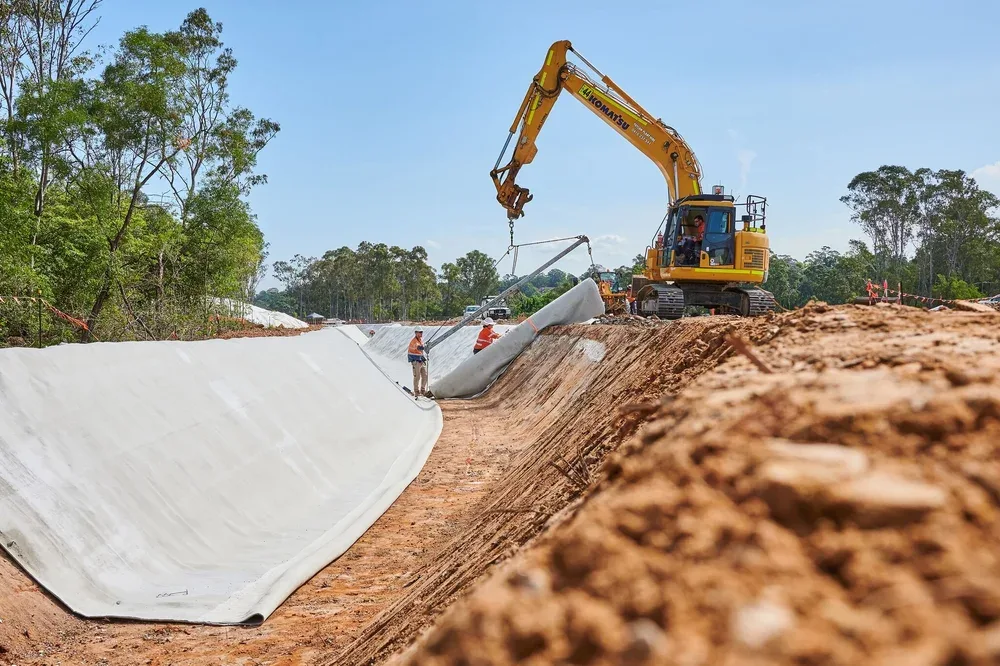
TILTEX provides a hard-wearing, hydraulically smooth lining for open irrigation canals, farm channels and drainage ditches. With a Manning's roughness coefficient of n = 0.022, it maximises flow efficiency while eliminating seepage losses and preventing erosion of the channel invert and banks. TILTEX Plus adds full impermeability for zero-loss lined canals. Installation proceeds without dewatering - panels unroll into wet channels and cure to structural concrete in situ. Replaces conventional poured, sprayed or precast concrete at significantly lower installed cost across African irrigation schemes.
Road and Railway Ditch Lining
TILTEX lines road reserve drainage channels, cut drains, table drains and railway side ditches to prevent scour and structural undermining of adjacent pavements and embankments. Panels install parallel to the ditch profile in a single operation without formwork or batching equipment - critical for linear infrastructure projects covering long distances across remote terrain. TILTEX 9 and above are specified for this application. The non-flammable B-s1 d0 fire classification makes TILTEX suitable alongside active rail corridors and fuel-carrying roads.
Slope Erosion Control and Protection
TILTEX is installed parallel to slope faces to provide a permanent hard erosion control surface on road cuttings, embankments, spillways and natural slopes where vegetated protection is unsuitable due to high flow velocities, dry climates or poor soil conditions. It replaces shotcrete and riprap while requiring no specialist plant or concrete crew. TILTEX conforms to the existing slope profile before hydration, eliminating the voids and bridging that compromise conventional concrete placement on irregular surfaces. Gripple pins and anchor trenches secure the mat to the slope at design-specified intervals.
Slope Stabilisation
Where slope bodies are structurally unstable and at risk of deep sliding, TILTEX replaces shotcrete as the surface element in engineered stabilisation systems incorporating soil nails, rock bolts and ground anchors. TILTEX panels are fixed through the anchor head plate to the stabilisation array, providing a continuous armoured surface that prevents surface erosion, frost action and deterioration of the underlying stabilisation works. All slope stabilisation applications using TILTEX must be designed by a qualified geotechnical engineer.
Bund and Embankment Lining
TILTEX rapidly lines secondary containment bunds at fuel depots, chemical storage facilities, power stations and industrial plants, as well as flood embankments and earth dam faces. It replaces turf - which requires maintenance, cannot establish in dry conditions and presents a fire risk - and eliminates the need for costly cast-in-place concrete on earthen structures. TILTEX Plus provides the waterproofing layer where bund lining must also function as a containment barrier. Anchor trenches at the crest and toe of the bund secure the mat against uplift and sliding.
Compatible Systems
View all systemsTILTEX 7
7,600 g/m² - 7 mm thickness. Entry-level GCCM grade for geomembrane protection, blinding concrete, mechanical protection of underground cables and pipes, temporary waterproofing, ground stabilisation and slope erosion control on moderate gradients. Lowest mass per unit area, maximum coverage per truck.
TILTEX 9
9,600 g/m² - 9 mm thickness. Extends to road and railway ditch lining, nozzle and culvert recovery, gabion protection, bund lining and slope erosion on steeper gradients. The most widely specified grade for road reserve drainage and rural irrigation schemes across southern and east Africa.
TILTEX 10
10,600 g/m² - 10 mm thickness. Heavy-duty grade for canal and weir lining, river bank protection, containment pond lining and slope stabilisation under high flow velocities and abrasion. The standard specification for irrigation infrastructure, mining process water channels and municipal stormwater systems.
TILTEX 12
12,600 g/m² - 12 mm thickness. Maximum standard grade for tailings dam and landfill bund lining, sea and dam swell protection, maintenance access ways on geomembranes, vehicle temporary circulation surfaces and mechanical protection of membranes under reinforcement. Where structural mass and long-term durability are the primary design criteria.
TILTEX Plus
Any grade (7 / 9 / 10 / 12) with integral PE geomembrane bonded to the underside. Fully impermeable - tested to EN 13967:2012 and ASTM D 5887-16. Membrane thickness from 0.2 mm to 2.0 mm in LLDPE, HDPE or PVC. Geomembrane laps are welded (≥ 0.5 mm) or adhesive-taped (thin films). Specified for reservoirs, farm dams, lined irrigation canals, containment bunds and any application where zero seepage is required.
Installation Guidance
Standard Method Statement
Subgrade preparation - : Remove all sharp rocks, organic matter and vegetation. The surface should present an even profile with no voids - TILTEX conforms to the subgrade shape but must not bridge over hollows. Compact subgrade to a minimum relative Proctor density of 90%, verified by sand cone method. TILTEX may also be installed over existing concrete structures for rehabilitation.
Unrolling and positioning - Unroll TILTEX liner onto the prepared surface with no wrinkles or folds. On slopes, orient panels parallel to the slope direction. Begin at the lowest point of the channel or slope and work upward. Overlap panels in the direction of water flow - upper panel over lower panel, like roof tiles. Use a front-end loader or excavator with a spreader bar assembly for 5.0 m wide rolls. The roll core tube (100 mm internal diameter) accepts a steel spreader pipe for mechanical deployment.
Cutting and fitting - Before hydration TILTEX cuts cleanly with a standard carpet knife or safety knife. Mark cut lines with a felt pen. Panels can be trimmed on site to fit around culvert openings, pipe penetrations, inlet structures, bends and any irregular profile. No power tools or specialist cutting equipment are required.
Watering overlaps - Before laying each successive panel, lift the overlap edge of the upper panel and spray water onto the exposed area of the lower panel in the overlap zone. Lower the upper panel back into position. This pre-wetting ensures the lower panel fully hydrates in the joint area, which would otherwise be shielded from water by the overlying panel.
Joining overlaps - Fix each overlap with screws or steel bars inserted approximately 50 mm from the panel edge at 200 mm centres. Fasteners must be sharp enough to penetrate the cementitious composite cleanly. Alternatively, adhesive sealant or a hot air gun can be used to join panels. For TILTEX Plus, fold back the upper panel to expose the geomembranes. Clean membrane surfaces with acetone. Weld membranes ≥ 0.5 mm thickness using a geomembrane welding machine; join thin films with adhesive tape. Unfold the upper panel over the joint.
Anchoring - At the top of slopes, insert U-bars or equivalent anchors at 500 mm centres along the middle of the anchor trench. Anchor trenches should be 500 mm deep × 600 mm wide, positioned at a safe distance from the slope crest and backfilled with compacted topsoil or concrete after TILTEX edge is placed. Across the panel field, Gripple pins, J-pins or TL-P4 anchors are spaced to design requirements based on slope angle, soil conditions and anticipated loading. Head size of all anchors must be sufficient to prevent pull-through - minimum 15 mm for concrete and wood substrate fixings.
Hydrating -: After fixing and joining all panels, spray TILTEX uniformly with water. Minimum water-to-liner mass ratio is 1:2. Use a sprayer - avoid high-pressure jets. Re-spray one hour after first hydration. Do not move or walk on TILTEX after hydration begins. In hot conditions: hydrate after sunset, cover with polyethylene sheeting immediately, monitor and re-hydrate if top surface dries within the first 24 hours. In cold conditions below 5°C: cover with protective sheeting immediately after hydration. Below −4°C: do not install. Setting begins within 90 minutes; operational within 24 hours; full design strength at 28 days.
Quality Assurance & Testing
Field QA/QC Checklist
- Material Conformance: Certificates checked against ASTM D8364 for the specified GCCM type and properties.
- Subgrade: Subgrade shaped and compacted; vegetation and sharp objects removed.
- Placement & Joints: Rolls placed with the specified overlaps and fixed by screws, staples or sealant to the manufacturer's guide.
- Hydration: Fully hydrated with the specified water quantity; curing time observed before loading or water flow.
- Anchoring: Anchor trench and edge terminations completed as designed.
Manufacturing Standards
- ASTM D8364 GCCM material specification
- Manufacturer installation guide
- CE System 2+ (EN 13253/13254/13255/13256/13257) · ISO 9001 · ISO 14001
Documents
Product Selection Guide
Compare performance properties across the entire category hierarchy before specifying.
Installation & Method Statement
Standard deployment procedures, installation specifications, and field application method statements.
QA/QC Site Checklist
Field quality control procedures, inspection checklists, and testing standards to verify installation integrity.
Technical Data Sheet (TDS)
Guaranteed minimum average roll values (MARV) and material testing properties.
Chemical Resistance / Accessories Guide
Chemical compatibility matrix and list of auxiliary materials needed for installation.
Projects Using TILTEX™ Concrete Blanket - GCCM Flexible Concrete Liner (7mm to 12mm Grades)
Submit your BOQ.
Get a quote – not just a price.
Upload your BOQ or speak to our technical team for expert recommendations and support.